

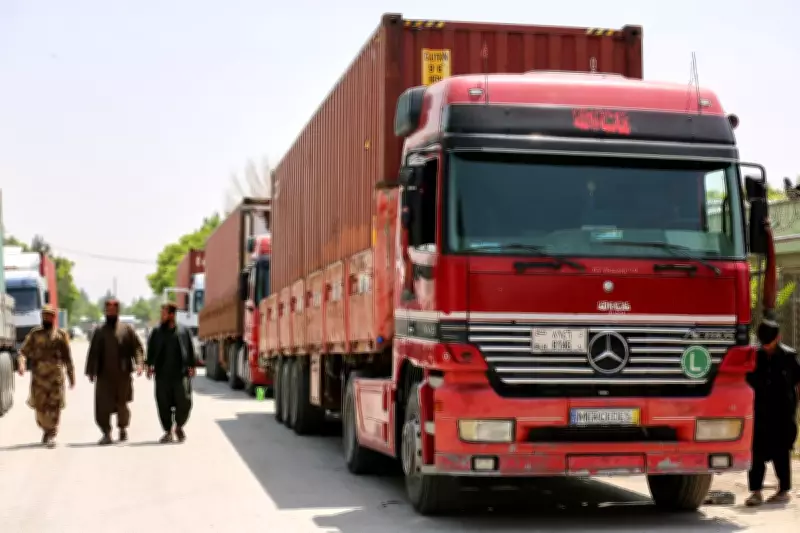
The closure of the Strait of Hormuz due to ongoing conflict has dealt a devastating blow to landlocked Afghanistan, cutting off critical trade and aid routes. Already grappling with border closures following clashes with neighboring Pakistan late last year, Afghanistan had turned to Iran as an alternative to Pakistan's major shipping hub of Karachi. However, the rerouting through Iran's Bandar Abbas port proved short-lived, as war in the region has stranded hundreds of ships and their crews in the strait, while thousands of Afghanistan-bound containers remain stuck in Pakistan.
Humanitarian Crisis Deepens
The United Nations' World Food Program (WFP), which provides life-saving nutritional supplements for malnourished mothers and children and fortified high-energy biscuits for schoolchildren in Afghanistan, has seen transportation costs skyrocket and supplies dwindle. Most of WFP's nutrition supplies were sourced from Pakistan, but after the border closed in October, shipments were rerouted by sea through Dubai and Iran. That route is now effectively closed as Tehran controls the strait and the U.S. blockades Iranian ports. By mid-April, nutritional supplements had run out.
“At a time when malnutrition is already at near-record levels, weakened and desperate mothers and children are being turned away from health clinics, as we have no food to give them,” said John Aylieff, WFP's country director in Afghanistan. Even before the crisis, the organization struggled with aid cuts, receiving only 8% of its annual funding this year. “On top of a funding crisis, conflict in the Middle East and the closure of the border with Pakistan are choking WFP’s operations — blocking supply routes, driving up costs and straining markets at the worst possible time,” Aylieff added.

Supply Routes Disrupted
Supplies must now be routed by land through Central Asia, far from any ocean. WFP's transportation costs have tripled, while the cost of supplements for malnourished mothers and children has jumped by 35%. One shipment of high-energy fortified biscuits, stuck in the United Arab Emirates since the Iran war broke out in late February, has been taking a long, circuitous route through Saudi Arabia, Jordan, Syria, Turkey, Georgia, Azerbaijan, and across the Caspian Sea into Turkmenistan. It has been on the road for three months.
Businesses Face Ruin
Afghan businesses are also suffering. Lutfullah Akbari, who runs a small company in Kabul importing construction equipment, has his supplies from China stuck on ships unable to transit the Strait of Hormuz. Rising costs for logistics companies have left him considering abandoning his cargo. “The Iran-U.S. war has had a huge impact on my business,” he said. Other traders have rerouted shipments through Central Asia, but it is longer and more expensive. “The logistics company now wants more than the value of our goods and the capital we had invested in them. We can’t afford it,” Akbari said. “Even if I bring them here, I’ll have to sell them all at a loss. I can’t afford to lose twice.”
Gul Meer Amini, director of logistics at freight company Etifaq Bamyan International Transport and Trade Forwarding, noted that the cost of renting a container has surged from $3,000-$3,600 to over $7,000, and for some goods, it has topped $11,000. “The impact is reaching all traders,” he said. Mohammad Murtaza Ishaqzai, who sells electronics in Kabul, said delivery costs for goods from China via Iran have shot up from $1,100-$1,500 to more than $15,000. “We can’t export and we can’t import,” he said, appealing to the Taliban government to resolve its conflict with Pakistan to allow border trade to resume. “If the situation continues, our business will be finished.”

Shifts in Trade Patterns
Despite the crisis, Afghanistan's Commerce and Trade Ministry spokesperson Abdul Salam Jawad said overall price increases in the country remained low, at around 3%, thanks to continued trade with Iran and sourcing many imports from Central Asia, Russia, and China. “The problem we faced was the restrictions on our imported goods and containers coming from other countries via Iran. We are waiting for a solution to be found in the Strait of Hormuz so that we can export normally,” he said. Khan Jan Alokozai, senior adviser to Afghanistan’s Chamber of Commerce and Investment, added that more than 60% of Afghanistan’s trade now passes through Central Asia, mitigating the overall impact of the Iran war. Food and petroleum products are coming in through Central Asia and Russia, while much trade is now conducted via Turkey, with goods transported by rail through Iran or Azerbaijan.





