

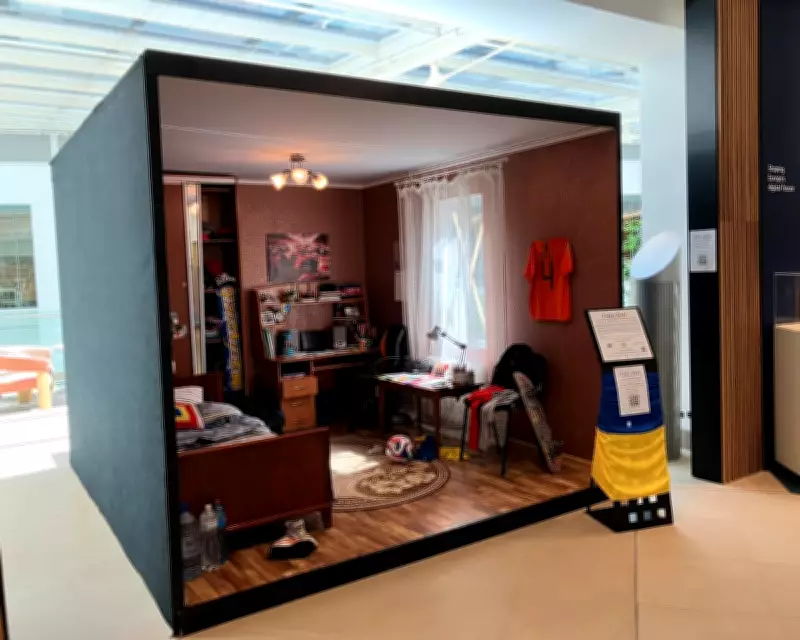
A striking art installation depicting a teenager's bedroom has been unveiled at the European Commission headquarters in Brussels, drawing attention to the plight of more than 20,500 Ukrainian children unlawfully taken to Russia since the conflict began. The exhibit, created by the NGO Bird of Light Ukraine, features football shirts on the wall, crumpled clothes on the floor, and open exercise books, evoking the empty rooms of children who have been forcibly transferred.
Evoking the Reality of Stolen Childhoods
The installation is designed to immerse visitors in the life of Artem, a fictional 13-year-old whose story is based on real testimonies. With heavy Soviet furnishings and early 2000s shiny wallpaper, the room is instantly recognizable to anyone who grew up in Ukraine, according to co-creator Zhanna Galeyeva. Artem lived with his widowed mother in occupied territories until Russian soldiers forced her to send him to a so-called "health camp" in Crimea. The barely audible hum, punctuated by explosions and wind, creates a tense atmosphere that reflects the ongoing trauma.
Scope of the Crisis
Ukrainian authorities have identified over 20,570 children who have been unlawfully deported or forcibly transferred to Russia. Only 2,133 have returned. The rest have been stripped of their identities, indoctrinated in military camps, or placed into forced adoption across 210 locations in Russia and Belarus. Researchers believe the true number is higher, as Russian authorities falsify identities and erase records.

International Response
As delegates from 63 countries gathered at the European Commission for the International Coalition for the Return of Ukrainian Children, Western allies announced new sanctions. The EU imposed asset freezes and travel bans on 23 individuals and entities, while the UK sanctioned 29. Targets include the Centre for Military Sports Training and Patriotic Education of Youth, known as the "warrior centre," which provides cadet-style military instruction. The UK also sanctioned Yulia Velichko, minister for youth in the self-proclaimed Luhansk People's Republic, for her role in deporting children.
Funding and Efforts to Trace Children
The UK announced an additional £1.2 million to help trace children and verify identities, building on £2.8 million pledged last December. Stephen Doughty, the UK's Europe minister, called tracing "the first crucial task" and described the deportations as "one of the most heinous aspects of Russia's war," aimed at erasing Ukraine's future. The UK also sanctioned 56 people involved in Russian disinformation operations.
Challenges in Securing Returns
EU foreign policy chief Kaja Kallas noted the difficulty of securing returns, as Ukraine has not deported any Russian children, making exchanges impossible. She emphasized the need to leverage international support, including from countries with closer ties to Russia. Turkey, Qatar, and other neutral states have helped mediate around 100 returns, but most are undertaken by families at great personal risk.
Future Exhibitions
The installation will travel to other venues, including the Italian parliament and the European Parliament in Strasbourg. Galeyeva hopes it will prompt policymakers to "wake up their own father and mother inside" and remember that the crisis cannot wait.






