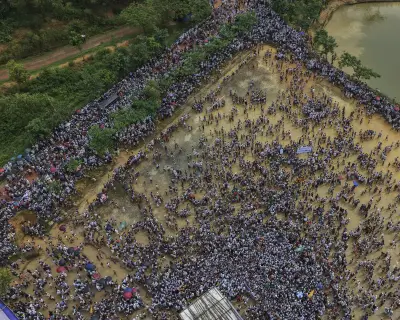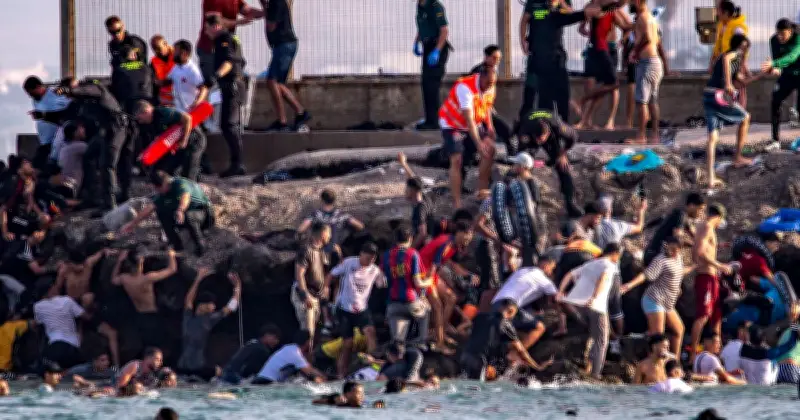
Spanish police believe thousands of identical inflatable rings were distributed to migrants as part of a coordinated plan before some 80,000 people stormed into the Spanish territory of Ceuta in late July. The black and white rings were seen piled up on beaches in the North Africa enclave following two days of chaos.
Coordinated distribution suspected
Spain's National Police believe the rings were bought in bulk and then handed out to migrants along the coast. Officers said "it was not possible" the migrants could have bought all the inflatables from shops in border towns, as there would not have been enough stock for the surge of orders.
In a new report, the National Police said they believe about 8,000 to 10,000 identical inflatable rings were used in the crossings on July 30 and 31. The report added the total number could be even higher, as aerial imagery analysis suggests there may have been as many as 30,000.
Overestimation warning
However, the force warned this could be an overestimation, as some rings were used more than once by migrants. The report by the National Immigration and Borders Centre, part of Spain's National Police, said: "A single batch was acquired beforehand, distributed locally and then used in a generalised manner."
It described a "pre-arranged distribution", adding: "The almost exclusive and large quantity of a single model of float, together with the limited number of distributors and points of sale, allows us to rule out a random origin of the stock that appears on those days, in that area (Castillejos) and for that range of quantities (4,000 - 30,000)."
Deaths and inquiry
At least 100 people died during the crossing surge from Morocco, with most migrants swimming around a border fence. Some have blamed Morocco for stoking the border breach; however, Spanish Prime Minister Pedro Sanchez, speaking on Monday, said no intelligence reports suggested "any involvement in one way or another" from the Rabat authorities.
A report by Madrid's National Intelligence Centre last week said misinformation on social media about relaxed border restrictions fuelled the surge. A high court judge is leading a judicial inquiry into the mass border breach.