

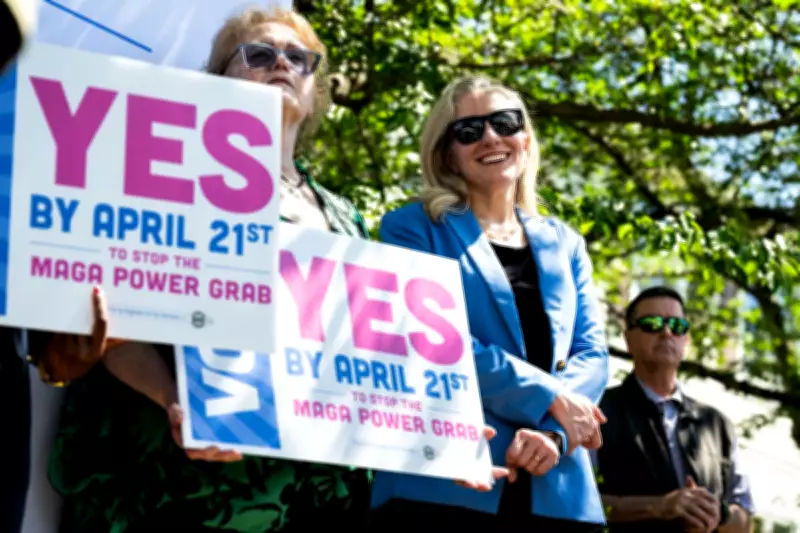
Virginia's Redistricting Referendum Poised to Reshape Congressional Landscape
Virginia voters are heading to the polls on Tuesday to decide on a pivotal referendum that could redraw the state's congressional maps, with significant implications for control of the House of Representatives. The measure, which has garnered support from Democratic Governor Abigail Spanberger, aims to counteract former President Donald Trump's nationwide push for mid-decade redistricting that favours Republican interests.
Recent polling indicates the referendum holds only a narrow lead in Virginia, a state that Vice President Kamala Harris secured in the previous presidential election. Voter engagement appears high, with early voting turnout exceeding 1.37 million ballots, suggesting a closely contested outcome.
Governor Spanberger's Stance and Political Implications
Governor Abigail Spanberger, who achieved a decisive victory in last November's election, has championed the new maps as a necessary response to what she describes as Trump's efforts to use gerrymandering in red states to maintain GOP dominance in the House. In a social media post last weekend, Spanberger asserted, "The president said he's 'entitled' to more seats in Congress. Virginia voters have the power to push back."

If approved, the redistricting plan could transform Virginia's congressional delegation from its current composition of six Democrats and five Republicans to a configuration where Democrats hold all but one seat. This shift would mark a substantial gain for the party ahead of the November midterm elections, where historical trends often see the ruling party lose seats.
Background of the Redistricting Battle
The current redistricting conflict traces back to last year, when Republican-led legislatures in states like Texas, Missouri, and North Carolina enacted new maps designed to disadvantage Democratic incumbents. In retaliation, California voters passed maps that could flip five Republican-held seats, setting a precedent for ballot-box decisions on gerrymandering.
Virginia's referendum seeks to amend the state constitution to establish a nonpartisan redistricting process through the 2030 census, overriding a voter-approved system from six years ago. Although the legislature has already endorsed this change, it requires voter approval to take effect and could face a revote if successful.
Legal Challenges and Political Opposition
The referendum is not without controversy, as it faces an ongoing legal challenge in the state supreme court, which could potentially invalidate the results. Additionally, the Republican National Committee has filed a lawsuit against Fairfax County, alleging that voter identification procedures might permit non-citizens to vote. Plaintiffs include two Republican congressmen whose districts would be altered by the referendum.
Polls reveal a deeply divided electorate, with rural voters expressing frustration over proposed maps that would link them to representatives from northern suburbs near Washington DC. Spanberger's governance has also come under scrutiny, with Republicans accusing her of abandoning moderate positions to support left-leaning policies like the referendum.
Campaign Spending and High-Profile Endorsements
The race has attracted substantial financial investment, with Democratic-aligned groups contributing over $64 million to the main committee advocating for the referendum, while opponents raised approximately $30 million. High-profile figures have entered the fray, with former President Barack Obama recording television ads in favour of the yes vote, and opponents highlighting his past criticisms of gerrymandering in their own advertisements.
Former Republican Governor Glenn Youngkin has campaigned vigorously against the measure, underscoring the partisan divide. The outcome in Virginia could influence similar efforts elsewhere, such as in Florida, where Governor Ron DeSantis has called a special session to consider congressional map changes that might yield up to three additional seats for Republicans.

Broader National Context
Beyond Virginia, Democrats anticipate gains in Utah due to a court ruling mandating new boundaries, highlighting the nationwide stakes of redistricting battles. As voters cast their ballots, the referendum serves as a critical test of public sentiment on gerrymandering and could set a precedent for future electoral reforms across the United States.





