

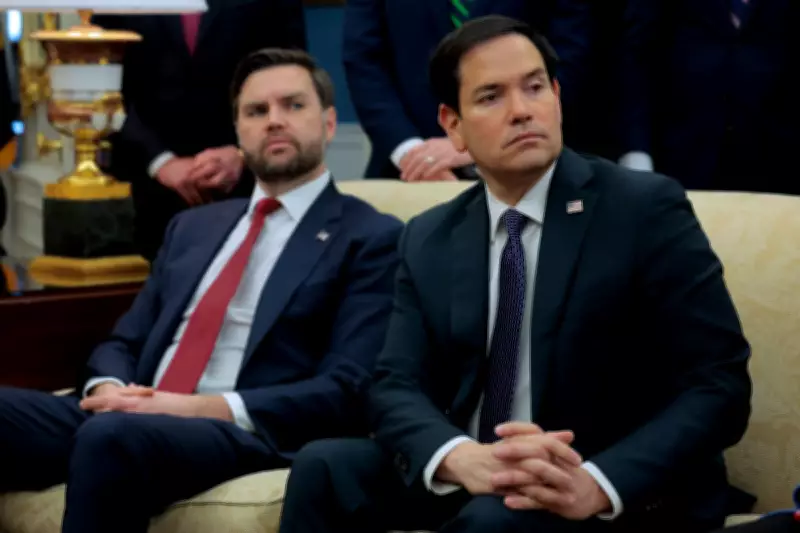
CPAC Straw Poll Reveals Vance as Frontrunner for 2028 Republican Nomination
The future leadership of the Republican Party came into sharp focus this weekend as the Conservative Political Action Conference (CPAC) unveiled its annual straw poll results. Held this year in Texas rather than its traditional Maryland venue, the gathering of conservative activists revealed Vice President JD Vance as the clear favorite to succeed Donald Trump as the party's standard-bearer in 2028.
Vance Maintains Narrow Lead Over Rubio
According to the poll conducted among conference attendees on Saturday, Vance secured 53 percent support compared to Secretary of State Marco Rubio's 35 percent. This represents a significantly closer margin than Vance's decisive victory over Steve Bannon in last year's CPAC poll, suggesting the one-man dominance of Republican politics may be waning.
Every other potential Republican contender registered at 2 percent or lower, with Florida Governor Ron DeSantis tying Donald Trump Jr. at just 2 percent support. This dramatic decline for DeSantis, who previously challenged Trump in primary contests, underscores the shifting dynamics within the party's power structure.

Historical Context of CPAC Polling
The CPAC straw poll has served as a reliable barometer of conservative sentiment for years. Since 2016, the conference had consistently endorsed Donald Trump as its preferred candidate, with the former president dominating the poll through multiple election cycles. In 2024, Trump captured over 90 percent of CPAC votes as he pursued another presidential bid.
This year's results mark a significant departure from that pattern, with the poll now focusing on potential successors rather than the current standard-bearer. The last time CPAC endorsed someone other than Trump was in 2016, when Senator Ted Cruz won the poll, followed by Senator Rand Paul the previous year.
Vance's Political Trajectory and Challenges
Vance's rise within Republican ranks has been meteoric but not without complications. The vice president has assumed a highly visible role in the second Trump administration, clearly positioning himself as the heir apparent to the MAGA movement. However, this prominence has exposed him to political risks, including a publicly documented confrontation with Ukrainian President Volodymyr Zelensky in early 2025.
His past opposition to military interventionism has created awkward moments, particularly regarding the administration's operations in Iran. Additionally, Vance remains a relatively untested political candidate beyond his 2022 Senate race, which he won primarily through Trump's endorsement rather than independent political machinery.
The Rubio Factor and Future Contests
While Vance leads among younger Republican voters, Rubio has cultivated his own base through a MAGA-infused traditional conservatism. This ideological divide suggests the 2028 Republican primary could become a closely contested battle for the party's soul, with Vance representing the continuation of Trumpism and Rubio offering a potentially more mainstream alternative.
The value of Trump's endorsement in 2028 remains uncertain, particularly as the president's approval ratings have declined to just 41 percent in recent Fox News polling. Other surveys show even lower numbers, raising questions about whether Trump's support will carry the same weight with independent voters in future elections.
Uncertainty in the Post-Trump Era
Vance's political fortunes have been inextricably linked to Trump's support since his Senate campaign. He has never run for office without the former president's endorsement, creating uncertainty about his ability to secure the nomination if Trump were to support another candidate like Rubio in 2028.
Nevertheless, the CPAC poll positions Vance as the clear favorite among Trump loyalists, suggesting he remains best positioned to inherit leadership of the MAGA movement. As Republican voters begin looking beyond the Trump era, this straw poll offers the first concrete indication of how the party's internal dynamics might evolve in coming years.






