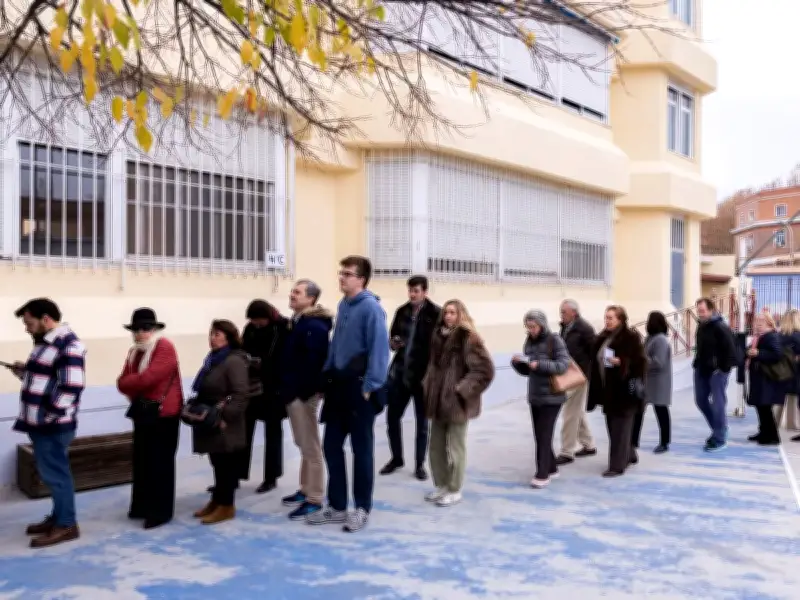
Polls opened in Spain on Sunday for a snap general election, with the possibility that the far right could help form a new government for the first time in more than half a century. Socialist Prime Minister Pedro Sánchez called the vote eight months early after MPs rejected planned changes to the country's housing laws.
Sánchez's PSOE party faces strong competition from the conservative People's Party (PP), which may need the support of the far-right Vox to secure a majority. Opinion polls suggest the prime minister is trailing narrowly behind rival Alberto Núñez Feijóo's PP.
Campaign Issues and Warnings
Sánchez has warned voters that a conservative government would not make their lives more affordable, and he has frequently said his opponents would take the country backward. "I'm feeling optimistic," he told reporters after casting his vote, saying he expected "a huge turnout."
Opposition leader Feijóo has promised voters more stability and better governance. He has criticised Sánchez's record not just for the government's failure to improve Spaniards' housing woes. The government has also suffered due to two fatal train crashes this year on Spain's high-speed rail network, a nationwide blackout in April 2025 and a border crisis in Spain's North African exclave of Ceuta.
Feijóo also pilloried Sánchez, who relied on backing from far-left and separatist parties to cling to power in 2023, for not being able to pass a budget in nearly four years due to lack of parliamentary support. "I ask Spaniards not to vote with fear, but with memory," Feijóo said in Madrid after casting his ballot. "Today is a day when the Spanish people take the helm and will decide the future, the destiny, and the direction of Spain."
Vox's Potential Role
It is widely expected that Feijóo will attempt to form a coalition with the far-right Vox party, led by Santiago Abascal, who has campaigned on an immigration crackdown. Vox is betting that its hard-line stance will win over voters and enable it to play kingmaker with the PP. Vox backs policies such as "national priority" — putting Spanish citizens first for welfare — and "remigration" for foreigners not considered to be contributing to the economy.
The far right was last part of Spain's national government during the dictatorship of Francisco Franco, which ended with his death in 1975. Critics have described the party's ideology as reminiscent of aspects of the era, which Vox rejects.
Key Issues and Expectations
One of the central issues in this election has been immigration, particularly after a mass rush of people from Morocco into the Spanish territory of Ceuta in the summer. More than 70,000 people entered the North African territory between 30 and 31 July, over 70% of the city's regular population. Feijóo said the election sees "Spaniards take the wheel and decide Spain's future, the destiny and direction not only for the next four years, but possibly for the next decade." "Depending on the electoral results, there might be a before and after in Spain's politics," he said.
A lack of affordable housing has been the dominant theme of this election campaign, followed by the wider cost of living and immigration. Sánchez, who has been in power since 2018, has proved to be a political survivor. He has gained a high profile on the international stage through his opposition to Israel's action in Gaza and criticism of US President Donald Trump.
If his party wins the most seats in the parliament, he would likely struggle to form a left-wing coalition. The parties have already shared power in four Spanish regions. Vox's presence in national government could reshape further the balance of power in Europe. The final pre-election polls show that the PP and Vox could win a majority this time, with a projection by El Pais and pollster 40DB predicting a large enough vote share to win between 178 and 188 seats. PSOE and the Broad Front, the successor to Sumar, would fall short with a projected outcome of up to 133 seats.
Almost 39 million people have a vote in Spain, and while commentators expect a high turnout, most polls have suggested a close finish. Provisional results are expected about an hour after polls close on Sunday evening, before official results arrive overnight into Monday.