

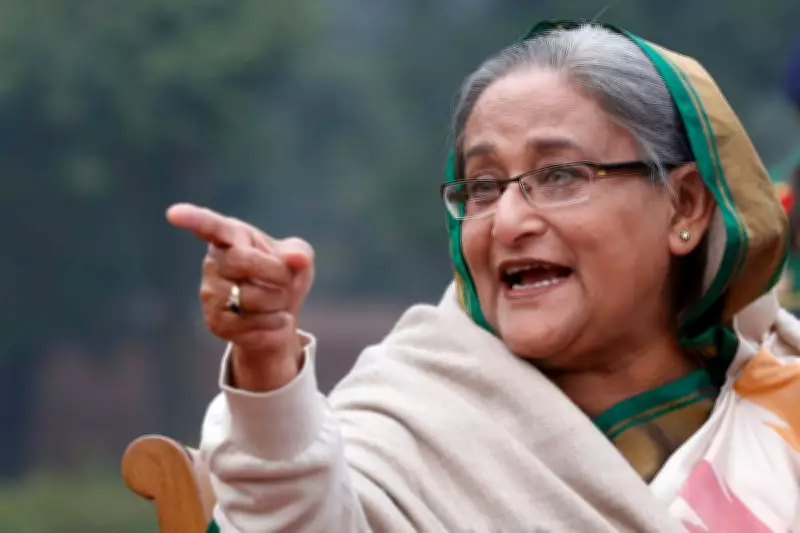
From her place of exile in neighbouring India, Bangladesh's deposed former leader Sheikh Hasina has launched a scathing critique of the nation's forthcoming general election. Her condemnation comes after her political party, the Awami League, was formally barred from participating in the pivotal polls scheduled for next month.
A Warning of Prolonged Instability
In a detailed email correspondence with The Associated Press last week, Hasina issued a stark warning. She asserted that without an inclusive, free, and fair electoral process, Bangladesh would face a prolonged period of political and social instability. "Each time political participation is denied to a significant portion of the population, it deepens resentment, delegitimizes institutions and creates the conditions for future instability," she wrote.
Hasina, who was sentenced to death in absentia for her government's crackdown on a 2024 student uprising that resulted in hundreds of fatalities and ended her 15-year rule, added a pointed remark. "A government born of exclusion cannot unite a divided nation."

Interim Government and Allegations of Disenfranchisement
The former prime minister directly accused the interim administration, led by Nobel Peace Prize laureate Muhammad Yunus, of deliberate disenfranchisement. She claimed the government had excluded millions of her supporters by banning the Awami League from the electoral contest. Yunus assumed leadership just three days after Hasina fled to India on August 5, 2024, following weeks of violent civil unrest.
While Yunus has publicly pledged to oversee a free and fair election, significant doubts persist among critics and observers. Questions remain about whether the process will meet international democratic standards and achieve genuine inclusivity following the ban on the country's former ruling party.
The Stakes of a Fraught Election
More than 127 million Bangladeshis are eligible to cast their votes on February 12th in what is widely viewed as the nation's most consequential election in decades. It marks the first national vote since Hasina's removal from power. The electoral process is further complicated by a concurrent constitutional referendum on sweeping political reforms, adding a layer of uncertainty.
Campaigning has already commenced, with political rallies taking place in the capital, Dhaka, and other major cities. The Yunus administration has stated that security forces will ensure an orderly election and prevent any coercion or violence aimed at influencing the outcome. The Election Commission has confirmed that approximately 500 foreign observers, including delegations from the European Union and the Commonwealth, are expected to monitor the polls.
Security Concerns and Political Realignments
The period since Hasina's ouster has been marked by considerable political and security challenges. Human rights organisations and minority groups have accused interim authorities of failing to adequately protect civil and political rights. The Awami League has alleged arbitrary arrests and deaths in custody of its members, allegations the government denies.
Critics have also voiced alarm over reported attacks on minority communities, particularly Hindus, and a perceived growth in the influence of Islamist groups. Concerns over press freedoms under Yunus have surfaced, with several journalists facing criminal charges and the offices of leading newspapers being attacked by protesters.
In this volatile landscape, the Bangladesh Nationalist Party (BNP), led by Tarique Rahman, has emerged as a leading contender. Rahman, the son of Hasina's late rival Khaleda Zia, returned from over 17 years of self-imposed exile in December. His main rival appears to be a coalition of eleven groups headed by the Islamist Jamaat-e-Islami party, which faced severe repression under Hasina's government.
Hasina's Call to 'Heal the Nation's Wounds'
Despite facing long-standing accusations of presiding over an authoritarian regime, suppressing dissent, and allegations of enforced disappearances by security agencies under her watch, Hasina has framed her recent comments as a plea for national reconciliation. She dismissed the court that sentenced her as a "kangaroo court," a view echoed by some international rights groups concerned about the trial's fairness.

In her communication, Hasina called for a break in Bangladesh's cycle of political bans and boycotts. She acknowledged that elections during her tenure were "not truly participatory" when major parties chose to boycott. "I recognize this was far from ideal," she stated, urging all political parties to end this destructive pattern. "Otherwise, there will be no redemption."
She concluded with a vision for the future, stating the country "needs a legitimate government" that governs "with the genuine consent of the people." "That is the best way for the nation to heal its wounds," the exiled leader asserted, as Bangladesh approaches a critical juncture in its democratic journey.





