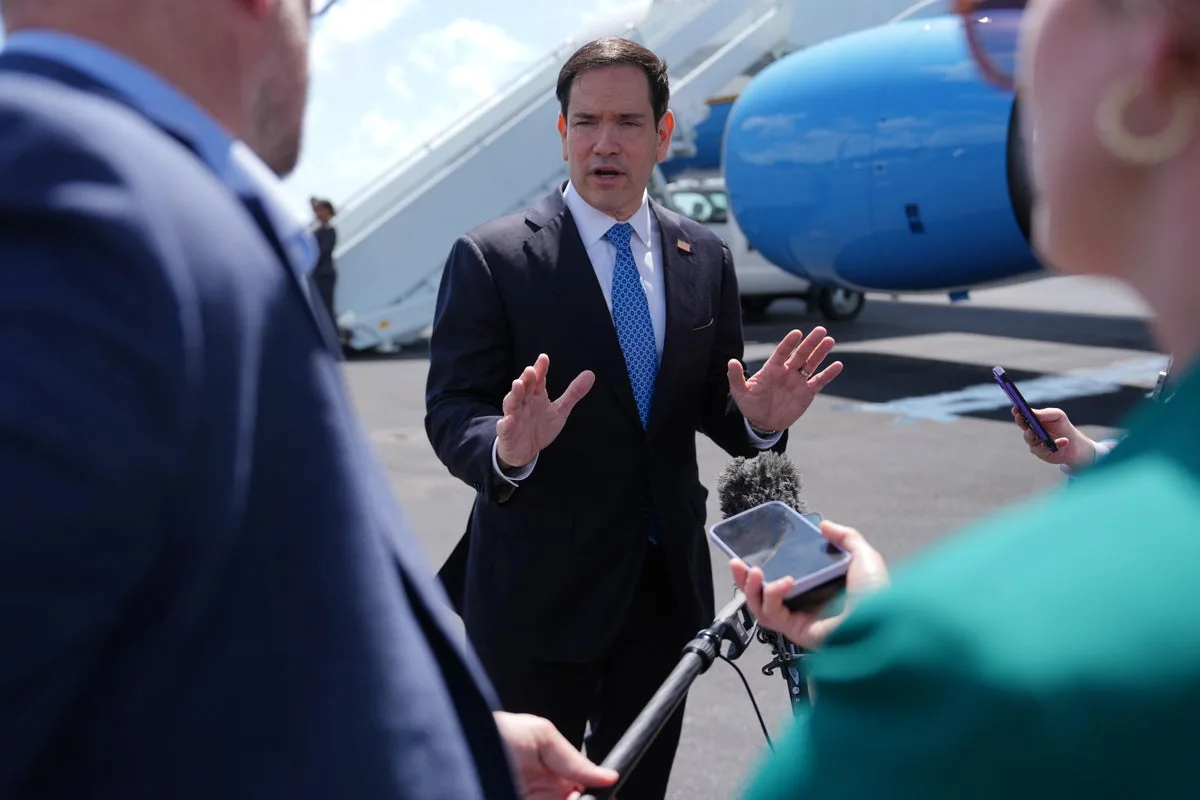
US Secretary of State Marco Rubio has said the White House is 'very upset' with NATO members for 'going into hiding' during the Iran war, as he headed to a meeting of alliance foreign ministers in Sweden.
Rubio's Criticism of NATO Allies
America's top diplomat levelled his latest criticism ahead of the summit, also speaking to UK Foreign Secretary Yvette Cooper. The US State Department said their discussion included 'the importance of Europe providing more of its own security and the need for increased defence investment and greater burden sharing in the NATO alliance'.
President Donald Trump has been scathing over Britain's reluctance to be drawn into the Iran conflict, accusing Sir Keir Starmer of being weak and deriding the Royal Navy. This sparked reports the US could review its position on Britain's claim to the Falkland Islands as punishment.
UK Restrictions on US Military Bases
The Prime Minister refused to give the US free rein in its use of British military bases to carry out attacks against Iran, with permission limited to defensive strikes on missile sites. Tensions have also risen over the response of the UK and other countries to the crisis in the Strait of Hormuz, which was open to shipping prior to the US and Israel offensive against Iran.
Tehran's stranglehold on the Gulf waterway has shocked economies worldwide, including the UK's, and seen a spike in oil prices. Washington has argued Europe needs the sea route 'much more than we do' and ensuring free transit of vessels was 'much more their fight than ours'.
Disagreements Over Post-War Plans
Plans being overseen by Britain and France to protect shipping in the critical waterway once hostilities end have also been challenged by the US, with Mr Rubio arguing 'it doesn't make sense'. Speaking to reporters in Florida before flying to the NATO summit, Mr Rubio would not be drawn over reported plans by the US to reduce its force contribution to the alliance, insisting it was a matter for the president and defence department.
But he said: 'I don't think anyone is shocked to know that the United States, and the president in particular, is very disappointed at NATO right now.' While a long-time supporter of the alliance, Mr Rubio said the refusal by members, such as Spain, to use their bases made the US question the benefit of membership.
Rubio's Detailed Remarks
He added: 'Understand that there are many countries in NATO that agree with us that Iran can't have a nuclear weapon, that Iran is a threat to the world. So the president said, fine, I'm going to do something about it. He's not asking them to commit troops. He's not asking them to send their fighter jets in. But they refuse to do anything.'
'So, I think the president looks at that and says, hold on a second, if all these countries around the world agree with us that Iran can't have a nuclear weapon and this regime is a threat to world peace and security, that already have missiles that can reach Europe – they don't have missiles that could reach America yet, but they have missiles that could reach Europe – we're actually stepping forward to do something about it, and everyone goes into hiding.'
'Yeah, I think we were very upset about that. The president has made that very clear.'
Strait of Hormuz Tolls Condemned
Mr Rubio also lambasted moves by Tehran to impose a levy on ships passing through the Strait of Hormuz. He said: 'No one in the world is in favour of a tolling system. It can't happen. It would be unacceptable. It would make a diplomatic deal unfeasible if they were to continue to pursue that. So, it's a threat to the world that they would try to do that. And it's completely illegal, by the way.'
Meanwhile, Mr Trump said: 'We want it open, we want it free. We don't want tolls. It's an international waterway.'
In a statement issued late on Thursday, US State Department spokesman Tommy Pigott said: 'Secretary of state Marco Rubio spoke today with UK Foreign Secretary Yvette Cooper to discuss Iran and ongoing efforts to restore freedom of navigation in the Strait of Hormuz. The secretary and Foreign Secretary also discussed the importance of Europe providing more of its own security and the need for increased defence investment and greater burden sharing in the NATO alliance.'






