

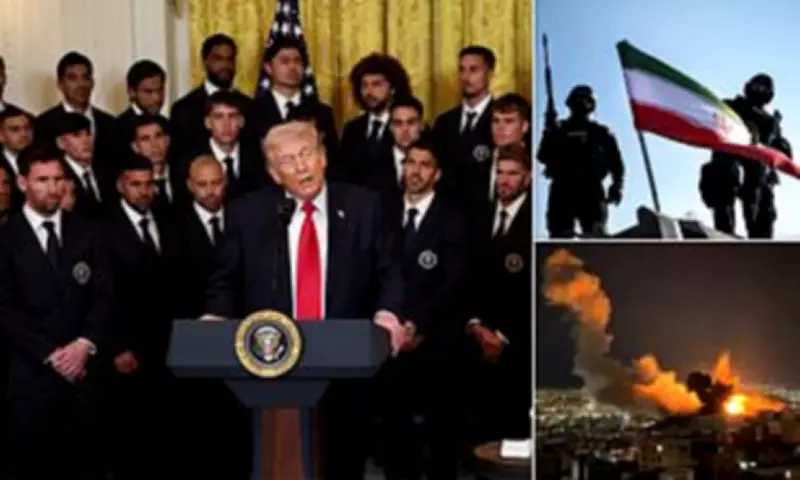
Trump Delivers Ultimatum to Iranian Forces Amid Escalating Conflict
Former US President Donald Trump has issued a dire warning to Iran's besieged military forces, demanding they surrender or face "guaranteed death" as American attacks on Tehran intensify. The warning comes as Iran unleashed its most intense barrage yet on Thursday night, targeting Israel and US allies across the Gulf region while threatening to drag additional nations into the expanding Middle East conflict.
Iran's Aggressive Retaliation and Regional Impact
The Islamic Republic had previously vowed the United States would "bitterly regret" torpedoing one of its warships, responding with hundreds of drones and missiles directed at Arab neighbors. Visible consequences included smoke billowing over Saudi Arabia's capital Riyadh and above Abu Dhabi's world-famous Yas Marina, where six people sustained injuries from falling debris.
Iran's threats provoked fury from Trump, who specifically addressed members of the Iranian Revolutionary Guard Corps (IRGC), military, and police during a White House appearance. Standing before David Beckham's Inter Miami squad, Trump urged these forces to "lay down your arms" and help "take back your country," offering immunity to those who comply.

Military Assessments and Strategic Developments
Trump claimed Iran had reached out seeking a deal to end US military operations, but he dismissed these overtures as belated. He asserted that the Iranian navy "is gone" following the destruction of 24 ships within three days, and that Iran lacks functional air force and air defense capabilities.
"The United States military, together with the wonderful Israeli partners, continues to totally demolish the enemy," Trump stated, describing the campaign as proceeding "far ahead of schedule."
Israeli Defense Forces (IDF) Chief of Staff Lt Gen Eyal Zamir confirmed Israel was "moving to the next phase of the operation" against Iran, aiming to "further dismantle the regime and its military capabilities." He noted that coordinated efforts had strategically isolated Iran, bringing it to unprecedented weakness.
International Reactions and Diplomatic Tensions
US Secretary of War Pete Hegseth criticized UK Prime Minister Sir Keir Starmer for not permitting American attacks from British bases from the conflict's outset, though he acknowledged access was eventually granted. Hegseth warned that "the amount of firepower over Iran and over Tehran is about to surge dramatically" with increased fighter squadrons and bomber capabilities.
Regarding Iran's leadership future, Trump indicated he would personally influence the selection of a new leader, dismissing Mojtaba Khamenei—the Supreme Leader's second son and presumed successor—as "unlikely."
Expanding Regional Conflict and Civilian Impact
Iran continued its bombardment of Saudi Arabia with cruise missiles striking Riyadh, while drone attacks on the United Arab Emirates triggered alerts across Dubai, Abu Dhabi, and Fujairah. The UAE confirmed being struck by a ballistic missile and six out of 131 suicide drones.
Additional explosions were reported in Qatar and Kuwait, and an Iranian missile hit Bahrain's largest petroleum refinery—capable of producing 267,000 barrels daily—sending a massive fireball skyward. Azerbaijan became the latest nation drawn into the conflict when Iranian-made drones struck near its border with Iran, injuring four civilians and damaging an airport terminal and school.
Azerbaijani President Ilham Aliyev accused Iran of "terrorism" and demanded an apology, though Tehran denied involvement and blamed Israel for staging provocations.
Military Exchanges and Infrastructure Damage
Israel reported multiple incoming missile attacks with air sirens sounding in Tel Aviv and Jerusalem, while continuing strikes against Hezbollah strongholds in Beirut. The Israeli Air Force claimed to have dropped over 5,000 munitions on Iran since the conflict began Saturday, causing extensive damage to Tehran's key buildings and a sports stadium.

In one of few clerical statements from Iran, Ayatollah Abdollah Javadi Amoli used state television to call for "the shedding of Zionist blood, the shedding of Trump's blood."
Naval Engagement and Aerial Interceptions
The conflict's naval dimension escalated when a US submarine sank the Iranian warship Iris Dena off Sri Lanka's coast Tuesday night, killing at least 87 sailors with 70 more missing. This marked the first US submarine torpedo sinking of an enemy warship since World War II.
Iranian Foreign Minister Abbas Araghchi condemned the sinking as "an atrocity at sea" and warned the US would "bitterly regret" it. Sri Lankan officials evacuated over 200 crew members from a second Iranian vessel, moving it to Trincomalee port for safekeeping.
It also emerged that Iranian bombers came "minutes away" from striking al-Udeid Air Base—the largest US military base in the Middle East—before Qatari F-15 fighter jets shot them down Monday morning.





