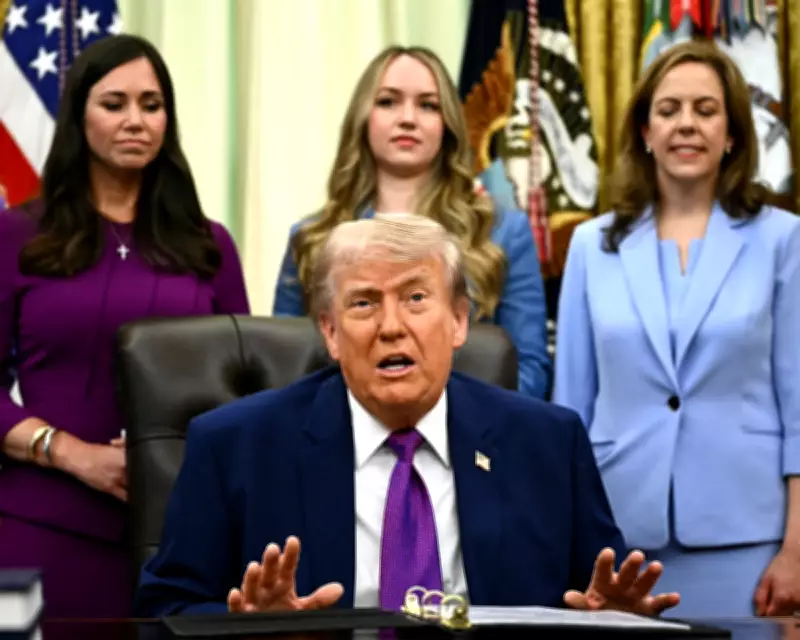
US President Donald Trump has declared that the ceasefire with Iran is on "life support" and indicated he is considering reinstating US Navy escorts in the Strait of Hormuz to counter the Iranian blockade of the vital waterway. Trump dismissed Iran's peace proposals as "stupid" and denied any domestic pressure to reach an agreement.
Trump's Harsh Assessment
Referring to the ceasefire in effect since 7 April, Trump stated: "I would call it the weakest, right now, after reading that piece of garbage they sent us – I didn't even finish reading it." He added: "I would say the ceasefire is on massive life support, where the doctor walks in and says: 'Sir, your loved one has approximately a 1% chance of living.'"
Last week, the US sent Iran a set of conditions for de-escalation, primarily focused on preventing Tehran from expanding its nuclear programme. Over the weekend, Iran submitted counter-proposals, which Trump summarily rejected.

Military Options Back on the Table
Trump called off Project Freedom, the plan to escort oil tankers through the Strait, after just over two days last week, ostensibly to give Iran time to respond. The plan had also faced opposition from Saudi Arabia, which refused to allow its airspace or bases to be used for what it deemed an escalatory move.
Trump's latest remarks came as oil prices surged again after Iran declared there would be no further talks on ending the blockade unless he accepted its terms. Major General Mohammad Ali Jafari, a former commander of the Islamic Revolutionary Guard Corps, stated: "As long as the war on all fronts is not over, sanctions are not lifted, blocked funds are not released, war damages are not compensated and Iran's sovereignty over the Strait of Hormuz not recognised, there will be no other negotiations."
Iran's Position
Esmail Baqaei, the Iranian foreign ministry spokesperson, described Iran's proposals as "reasonable, responsible and generous." He maintained that agreement was still possible and that nothing Iran had proposed was unreasonable. Mostafa Taheri, a member of the Iranian parliament's industry commission, claimed that revenue from proposed new transit fees for the Strait of Hormuz could amount to $15 billion annually, roughly one-third of Iran's current oil revenue, enough to stabilise foreign exchange reserves.
Oil prices climbed above $105 a barrel amid the deadlock, reviving discussions of military options that are unlikely to alter Iranian calculations.
International Implications
The impasse is expected to overshadow Trump's summit with Chinese President Xi Jinping, which begins in Beijing on Thursday. China has deep economic ties with Iran, and Xi is unlikely to agree to any US request to restrict oil purchases or arms sales between Beijing and Tehran.
There had been expectations that Trump would want the Iran issue resolved before his most important summit of the year. However, despite postponing a visit in late March, the US president appears far from an agreement with Tehran. He is now reconsidering military options to recover Iran's stockpile of highly enriched uranium, but Iranian officials have said the stockpile is protected.
Humanitarian and Economic Strain
The standoff means individual shipping companies continue to negotiate with either Iran or the US to bypass blockades in the Strait, but the number of tankers allowed through remains minimal. On Monday, tension focused on a cargo of Emirati liquefied petroleum gas sailing under the Panamanian flag from the port of Sharjah.
Oman's Foreign Minister Badr bin Hamad Al Busaidi held talks with Arsenio Dominguez, Secretary General of the International Maritime Organization (IMO), a UN agency, to seek a new regime for the waterway and urgent humanitarian measures for crews stranded on tankers. Nearly 1,500 tankers and 20,000 seafarers are stranded in the Gulf, according to IMO estimates. Dominguez warned that supplies of water, food, and fuel would soon run short.
Iranian Economy Under Pressure
There are signs of mounting pressure on the Iranian economy. Tehran city council ordered offices to reduce electricity consumption by 30% during office hours and 70% outside them, affecting both public and private offices. The head of the national society of internal medicine specialists reported a serious decline in the country's medicine reserves.

Estimates indicate that Iran's internet shutdowns are costing $30-40 million per day in lost sales, with indirect damage roughly double that. The Iranian parliament, which has not met in public during the war, has begun holding online sessions as advised by the supreme national security council. The Iranian reformist press noted: "Inflation, reduced purchasing power and concerns about the supply of essential goods has put heavy pressure on public opinion."
Upcoming Multilateral Meeting
On Tuesday, the UK and France will host a meeting of up to 40 defence ministers to discuss contributions to a taskforce aimed at protecting free naval passage in the Strait of Hormuz after any US-Iran agreement.