

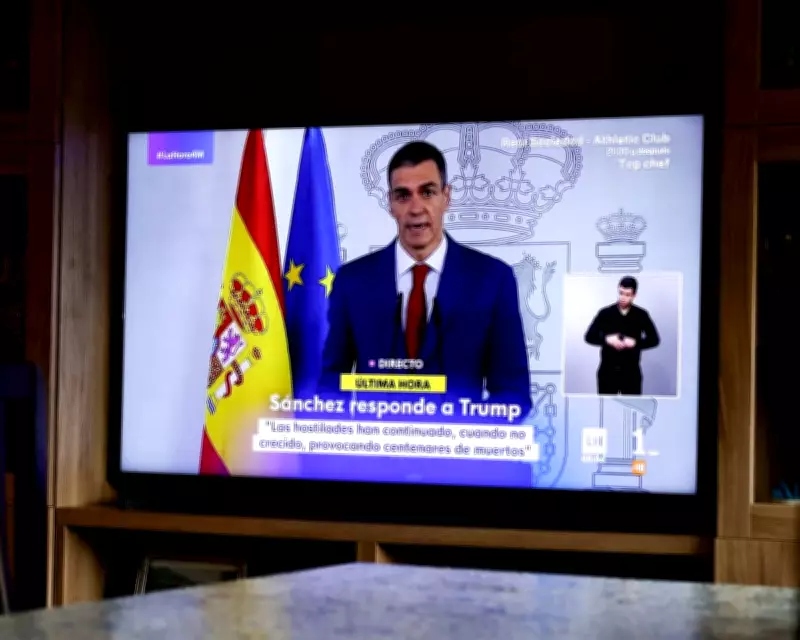
Sánchez Stands Alone: Spain's Prime Minister Defies Trump as European Allies Stay Silent
In a bold televised address on Wednesday, Spanish Prime Minister Pedro Sánchez delivered a powerful rebuke to Donald Trump's administration, becoming one of the very few European leaders to openly challenge the US president's demands regarding military action against Iran. While Sánchez's speech thrilled his leftwing base and echoed through Spanish political circles, it highlighted his solitary position among Europe's major powers.
A Defiant Declaration Against War
Sánchez's ten-minute address, titled "An institutional declaration by the prime minister to assess recent international events," came hours after Trump threatened to cut off trade with Spain over its refusal to allow two jointly operated bases in Andalucía to be used for strikes against Iran. The Spanish leader's words were anything but diplomatic niceties.
"A government's overriding duty," declared Sánchez, "is to protect and improve the lives of its citizens, not to manipulate or profit from global conflicts." He went further, stating that "it is absolutely unacceptable that those leaders who are incapable of fulfilling this duty use the smokescreen of war to hide their failure and, in the process, line the pockets of a select few."

The prime minister's argument centered on the devastating consequences of another Middle East conflict, warning it would claim numerous lives, further destabilise the world, and have dire economic repercussions. His language became particularly personal when he asserted that "practising blind and servile obedience is not a form of leadership" and that Spain would not be complicit "simply out of fear of reprisals from someone."
European Silence and Domestic Reactions
While Sánchez's stance resonated with many Spaniards—only 15.7% of whom view Trump favorably according to recent surveys—it exposed the reluctance of other European leaders to confront the US president. The Spanish prime minister finds himself virtually alone among Europe's major capitals, with counterparts in Berlin, Paris, and Rome unwilling or unable to speak out against Trump.
Domestically, Sánchez's address drew predictable responses. Alberto Núñez Feijóo, leader of the conservative People's party, accused the prime minister of playing partisan politics and jeopardising Spain's relationship with the United States. Santiago Abascal, who leads the far-right, pro-Trump Vox party, suggested the decision had been taken by "ayatollahs" and a prime minister determined to remain in power despite corruption scandals.
Germany's Pragmatic Approach
From Germany's chancellor, Friedrich Merz, Europe has seen rhetoric sharply differing from Sánchez's. As he prepared for a Washington visit, Merz struck a remarkably conciliatory note, stating that "categorising the events under international law will have relatively little effect" and that "this is not the time to lecture our partners and allies."
Merz's strategy appears focused on pragmatism, allowing room for manoeuvre on Europe's most pressing concerns: Ukraine and Trump's chaotic tariffs. The unpopular chancellor, facing challenges from the far-right Alternative für Deutschland party and struggling to revive Europe's top economy, can ill-afford a frontal collision with Trump.
When offered an opportunity to defend Spain after Trump announced plans to stop trading with the country, Merz instead supported Trump's criticism of Madrid for refusing to increase defence spending to 5% of GDP. While Merz later claimed to have stood up for Spain in private talks, commentators described his public reticence as "shameful."
France's Delicate Balancing Act
French President Emmanuel Macron contacted Sánchez on Wednesday to express France's "European solidarity" in the face of US trade threats. However, Paris is walking a tightrope of pragmatism. Macron has been clear in saying US and Israeli attacks on Iran did not observe international law, but has also stated that Iranian leadership bears responsibility for its nuclear programme and human rights abuses.

France has moved its aircraft carrier, the Charles de Gaulle, to the eastern Mediterranean for what Macron called a "strictly defensive" presence. A French official stated that one of France's top priorities was "working to find a way out of this crisis," reflecting the country's complex position between European solidarity and practical diplomacy.
Italy's Ambiguous Position
Italy's position appears deliberately ambiguous. Prime Minister Giorgia Meloni has tried to keep one foot in Trump's camp—often boasting of her personal and political affinity with him—and the other in Europe. This balancing act has become a defining feature of Meloni's foreign policy.
"We are not at war and we do not intend to enter one," Meloni told Italian radio, expressing concern about "an increasingly evident crisis of international law." However, Defence Minister Guido Crosetto took a more forthright line, stating that strikes against Iran "fell outside the rules of international law" and represented "a war that was started without anyone in the world knowing."
Sánchez's Consistent Stance
Sánchez's language, though stark, is hardly out of character. He has been one of the most vociferous European critics of Israel's conduct in Gaza, accusing the country of "exterminating a defenceless people." He also spoke out against the US's armed toppling of Nicolás Maduro in Venezuela and has bucked global trends by defending immigration benefits while others prefer radical rhetoric and razor wire.
The White House press secretary, Karoline Leavitt, claimed on Wednesday that Madrid had changed its mind about cooperation, but Spanish Foreign Minister José Manuel Albares bluntly dismissed the suggestion: "Our 'no to war' stance remains clear and unequivocal."
As Spain's lonely duel with Washington continues, Sánchez's increasingly loud voice remains, for now, a solitary one in European leadership circles.





