
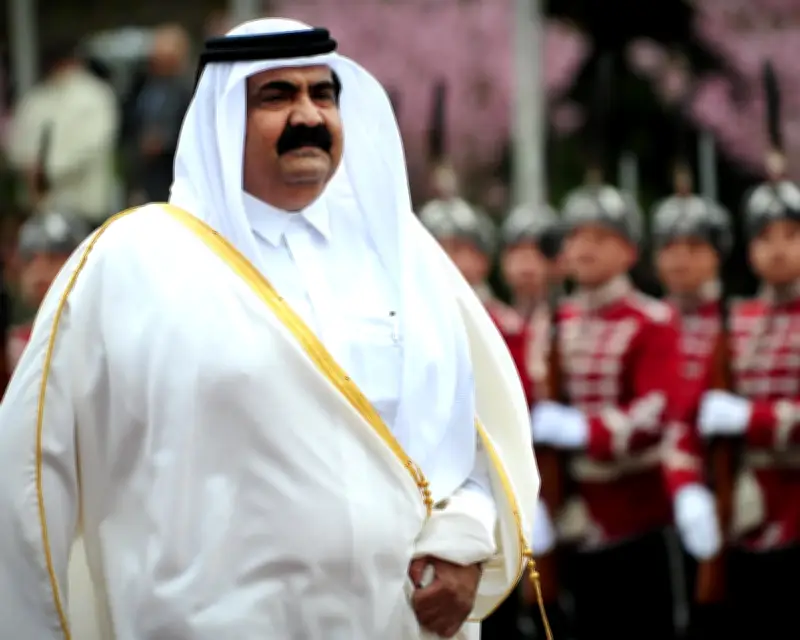
Sheikh Hamad bin Khalifa Al Thani, the emir of Qatar who deposed his father in a bloodless coup and transformed the small Gulf state into a global economic and media powerhouse, has died at the age of 74. He was born on 1 January 1952 and died on 12 July 2026.
Early Life and Education
Born in Doha, Hamad was a member of the Al Thani ruling family, part of the Bani Tamim tribe. His mother, Sheikha Aisha bint Hamad Al Attiyah, died shortly after his birth. As a youth, he experienced democracy for the first time during a trip to London, where he found the spectacle of parliamentary debate so absurd that he laughed hysterically. His early education was dominated by Egyptian teachers, under whose influence he became a Nasserist, even throwing stones at the British embassy in 1967. He later recognised the flaws of pan-Arabism, leading him to establish the Qatar Foundation to promote indigenous education and research.
He attended the Royal Military Academy Sandhurst, graduating in 1971, and later held various military posts before being appointed minister of defence in 1977.
Seizure of Power
In June 1995, while his father, Emir Sheikh Khalifa bin Hamad Al Thani, was holidaying in Geneva, Hamad deposed him in a swift, bloodless operation. Hamad had effectively run the country for over a decade during his father's absences. He proclaimed himself the new emir at age 43, a move that permanently altered Qatar's trajectory.
Unlike other Gulf rulers, Hamad governed with a down-to-earth style, often driving himself around Doha and dining with minimal security. He focused on long-term strategy, delegating daily governance to technocrats. A leaked 2008 US embassy cable noted: "The Amir seems to be the only one in the Government who has a vision for this country. The details of that vision, however, are not entirely clear to anyone, except perhaps the Amir himself and his closest associates."
Transformation of Qatar
Hamad aggressively developed Qatar's offshore natural gas reserves, bypassing the "oil curse" and making Qatar one of the wealthiest nations per capita. Domestically, he introduced Qatar's first written constitution, democratic municipal elections, and improved women's rights. In 1996, he founded Al Jazeera, a media network that expanded into English and Spanish, and abolished the ministry of information in 1998, ending state censorship.
Internationally, he maintained defence ties with the US while supporting the Palestinian cause, giving Hamas leaders a base in Doha to encourage negotiation. During the Arab Spring in 2011, he championed "Arabs sorting out Arab problems," backing revolutions in Libya and Syria via Al Jazeera, and contributing troops to Bahrain.
Personal Life and Succession
Hamad had three wives and 24 children. His second wife, Sheikha Moza bint Nasser al-Misned, was a key partner in education and social reforms. He groomed his children in a competitive environment to select a capable successor. In an unusual move, he abdicated voluntarily in 2013, passing power to his son Sheikh Tamim. Their crowning soft-power achievement was securing the 2022 men's football World Cup. The "father emir" is survived by his three wives, 11 sons, and 13 daughters.




