Nato Lacks Crucial Tools for Modern War Despite Blitz-Style Drills
Nato Lacks Crucial Tools for Modern War Despite Blitz Drills

Analysis: Forget the Blitz spirit, Nato is missing something crucial as it prepares for war. Nato's war games on the London Tube are exciting and revive images of the Blitz, but the alliance has not got the tools it needs to win, explains world affairs editor Sam Kiley.

Friday 22 May 2026 16:05 BST. Nato tests 'deep strike' missile operations from London Tube station to prepare for Russian attack. While Russia displays its nuclear weapons in public exercises designed to intimidate Ukraine and rattle its allies, Nato's response is to scuttle underground and thumb its nose at the Kremlin's bear.

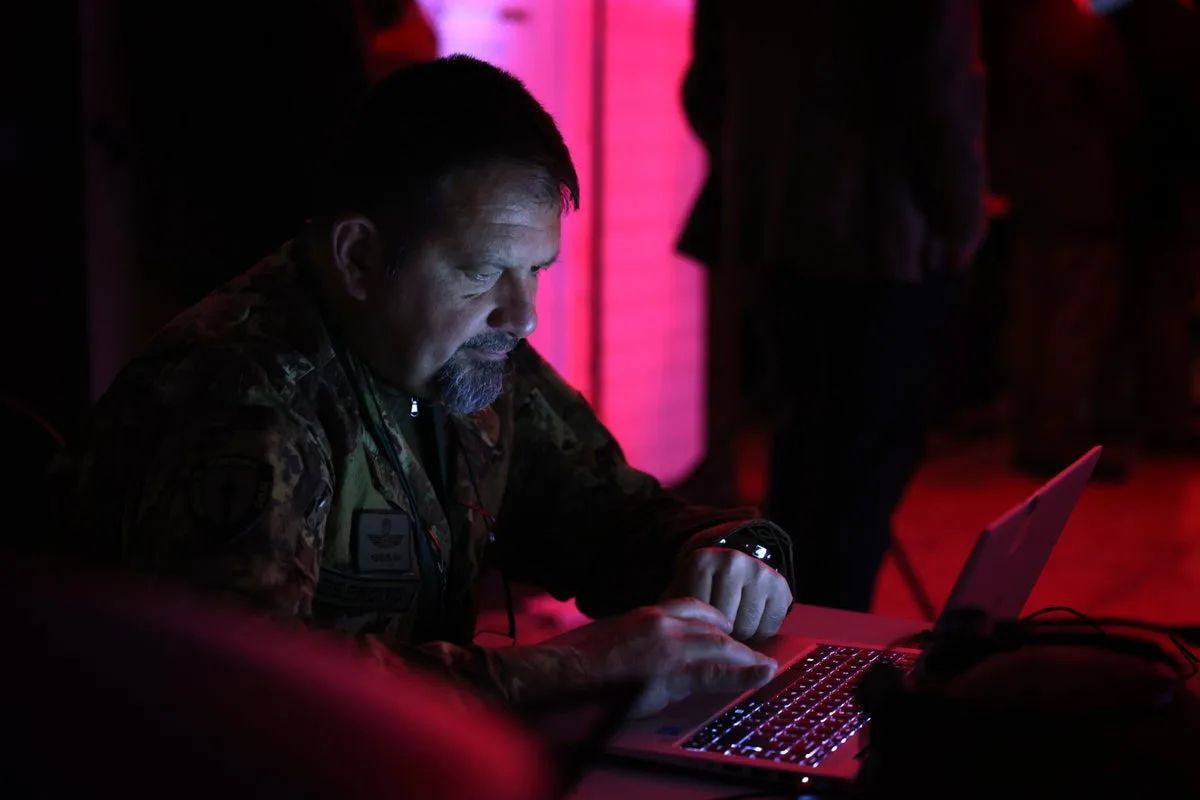
The scenes of a British-led headquarters for the alliance's attack dog Allied Rapid Reaction Corps setting up beside the Jubilee Line at Charing Cross station to war game blasting Russian forces as they stampede into the Baltics - by attacking Moscow's forces and jamming its electronic communications systems - is fictional. So too, for now, is the notion that Nato actually has the equipment it needs to fight off a Russian invasion.

Wide Pickt banner — collaborative shopping lists app for Telegram, phone mockup with grocery list

By the admission of defence sources involved in Operation Arcade Strike, Nato and the UK do not have enough drones to match what the Russians could, in theory, send into battle. The command and control system being tested underground - safe from possible Russian air attacks - is intended to lead the effort to break the back of Russia as it invades Estonia.

The British Army's Allied Rapid Reaction Corps (ARRC) has deployed a multi-national command post at Charing Cross underground station - Exercise Arrcade Strike (MOD Crown Copyright 2026/WO2 Jon Bevan RLC). The idea is to use AI to speed up the 'kill chain' and to blunt and then reverse Russian forces - much in the way that Ukraine has done over the last four years.

The British Ministry of Defence says: 'Personnel were able to receive large volumes of data in real time, visualise that data in new and novel ways, and enable commanders to make decisions faster than an adversary can respond. While the scenario is fictional, the capabilities being tested are real and are being rehearsed to ensure Nato forces can respond rapidly, cohesively and effectively.'

But nowhere in Europe, or the rest of Nato, is there anything to match what Ukraine has already developed to meet the growing threat and use of Russian drones on the battlefield. In Nato nations, as Britain's glacial development of the Ajax armoured reconnaissance vehicle project has shown, the delivery from contract to deployment can take more than a decade.

Compare that to Fire Point in Ukraine - one of dozens of Ukrainian companies that have gone from zero to producing cruise missile equivalents, long-range drones and tiny interceptors to take down Russian weapons, in a couple of years. General Cherry, another drone outfit, produces thousands of drones a day. And almost all Ukraine's startup arms manufacturers take real-time feeds from front line operators and adapt their weapons to the changes on the battlefield in minutes and seconds. In Nato, such adaptations would take years.

A Ukrainian serviceman pilots a drone during the 'Wild Drones' racing competition designed to simulate battlefield conditions in Truskavets, Lviv region, on May 20, 2026 (AFP/Getty). Ukraine used to produce vast quantities of tanks, artillery and rockets for the Soviet Union when it fell under Moscow's control. Since independence it allowed its weapons industry to atrophy. Modern warfare has meant that the kind of heavy armour used by Russia and its rivals in Nato have been vulnerable to cheap, fast, First Person View (FPV) remotely piloted missiles based on commercial drones that were first developed by frontline infantry out of desperation.

Battlefields are now much deeper, more subjected to intense surveillance, and require an entirely different approach to tactics on a grand scale that Nato generals have no experience of - and they know it. 'The rapid evolution of unmanned systems, real-time battlefield software updates, and data-driven targeting have compressed kill chains and reward those who learn and adapt the fastest,' said US general and Nato's Supreme Allied Commander Europe Alexis G Grynkewich.

Pickt after-article banner — collaborative shopping lists app with family illustration

Simultaneously, there are deep concerns within Nato that the UK is failing to meet its operational commitments to the alliance, and falling behind in defence spending, in spite of claims from the government that it is committing more money to fight a hybrid war with Russia that has already begun. Russia has brandished its short range nuclear arsenal in exercises in Belarus and continues to spy on Europe under sea communications cables, its onshore installations, carry out assassinations and sabotage operations including arson against supplies to Ukraine.

In this photo, released by Belarusian Presidential Press Service, Belarus' President Alexander Lukashenko, center, speaks to officers as he attends joint nuclear drills held by Russian and Belarusian armed forces in Asipovichy district of Belarus, Thursday, May 21, 2026 (AP). Its soft power operations include undermining democracy and the concept of truth itself, especially via social media.

As a result, experts are calling on the UK government to organise a wider national resilience effort to counter the attacks it is already enduring and those that may come. Dr Fiona Hill, a former adviser to the White House on Russia, recently told The Independent: 'In the UK, our systems are not designed to cope with major disruptions. It is up to the leadership to come up with a plan because, at the moment, what is there is not fit for purpose.'

A recent poll conducted by Glasgow University showed that only a third of people aged 16-29 would be prepared to take up arms to protect Europe - Nato clearly hopes that reminding Brits that they survived the Blitz by sheltering in the tube system may revive a martial spirit that has so faded. But volunteers will need to know they have enough of the right weapons. At the moment, Nato does not.




