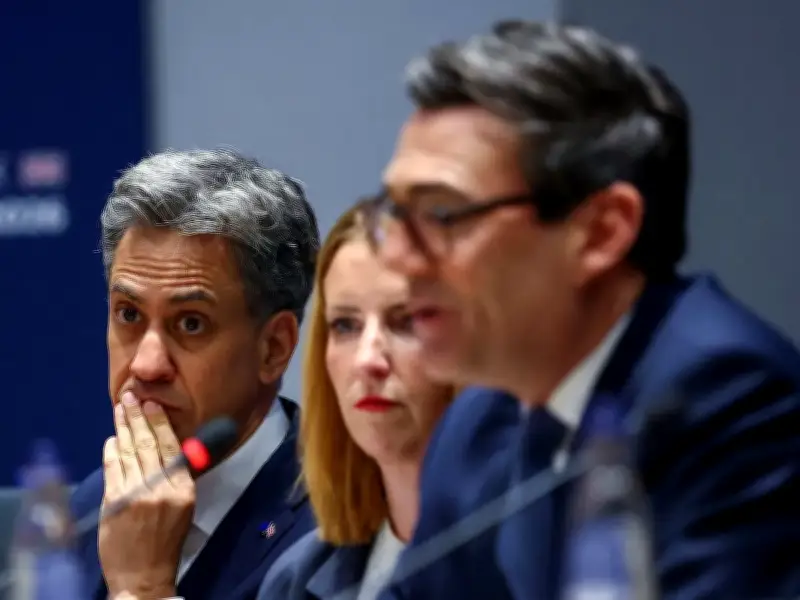
Foreign Secretary Ed Miliband has said "all options will be on the table" for the UK's future relationship with the European Union, including the possibility of rejoining the bloc, as Prime Minister Andy Burnham begins informal discussions with Brussels.
Mr Burnham plans to hold "brainstorming" talks with the EU over the coming 12 months on the options available for the future relationship, after stating that Friday's agreements with Brussels represented the limit of what could be achieved before the next election.
World has shifted 'massively' since 2016
Mr Miliband said the world had shifted "massively" since the 2016 referendum vote to leave the EU. He told the BBC's Sunday With Laura Kuenssberg that "of course all the options will be on the table" when asked whether rejoining would be examined, adding that "we will look at the benefits and the costs of all the different options".
The Prime Minister is adhering to the red lines in Labour's 2024 manifesto, which ruled out joining the single market or customs union or returning to freedom of movement within the EU. However, he will use the unveiling of his 10-year plan next month to outline ways the UK could move closer to the EU beyond the current parliament, with informal discussions scheduled to take place with Brussels ahead of the next annual UK-EU summit.
Mr Miliband said he accepts the outcome of the 2016 vote but "the world has changed massively". "Europe is changing too, so we've got to look at what that means. It's not about this parliament, we're respecting the red lines in this parliament."
Three landmark agreements reached in Brussels
On Friday, Mr Burnham reached three landmark agreements with the EU in the Belgian capital. A food trading deal, officially known as a sanitary and phytosanitary (SPS) agreement, will end most post-Brexit checks and restrictions on food and agricultural products from March 1 2028.
An emissions trading systems (ETS) agreement, applied from the start of 2028, will mean £6.5 billion of British exports, including from the steel and aluminium industries, will be exempted from EU carbon border taxes. A youth experience scheme will allow UK and EU citizens aged 18 to 31 to live and work in each other's jurisdictions for up to three years, with 100,000 visas available each year. The first young people to travel under the scheme will do so "no later than January 2030", according to Government documents.
Tuition fees remain a sticking point
A potential sticking point remains over the matter of tuition fees charged to EU students at British universities. A six-month deadline has been set to reach a resolution after EU member states called for their students to be charged the same rate as their British counterparts. This would mean a reduction from fees of up to £38,000 per year to £9,970 – something the UK has pushed back on due to the financial consequences it would have for universities.
The dispute prompted concerns in Brussels over whether the remainder of the deal would be honoured unless the UK concedes to EU demands. However, Mr Miliband insisted it was "absolutely clear" the agreements would go ahead. He said: "The dates are set out in 2028 when these things are coming in, we're introducing legislation in Parliament, so definitely."
He stated that European Commission president Ursula von der Leyen was clear "there are those three agreements and then there's a separate piece of paper and a separate issue, which is looking at the issue of tuition".
Concerns over cost and university places
The Government has been cautioned that reducing fees for EU students to the same level as home undergraduates could cost approximately £500 million annually and may limit the number of places available for young British students. University of Manchester vice chancellor Professor Duncan Ivison described closer UK-EU relations as a "good thing", but warned that "the issue of tuition fees is something we do have to figure out because there is a cost".
"If nothing was done to compensate or provide additional funding, it would take £500 million pounds, we estimate, out of the higher education sector at a time where there's a lot of pressure on the sector," he told BBC Radio 4's Today programme, adding: "If EU students come and are paying domestic fees, it's not clear we'd be able to increase the number of places for EU students anyway."
Cabinet minister Dame Angela Eagle confirmed that the Treasury and Department for Education would collaborate with universities throughout the fee negotiations. The Environment Secretary told BBC Breakfast: "I don't think anybody wants to do deals that negatively impact anything. We want win-win deals."
The UK asserts that the agreements reached on Friday will contribute 0.5% to gross domestic product – representing a £17 billion boost to the economy – by 2040.