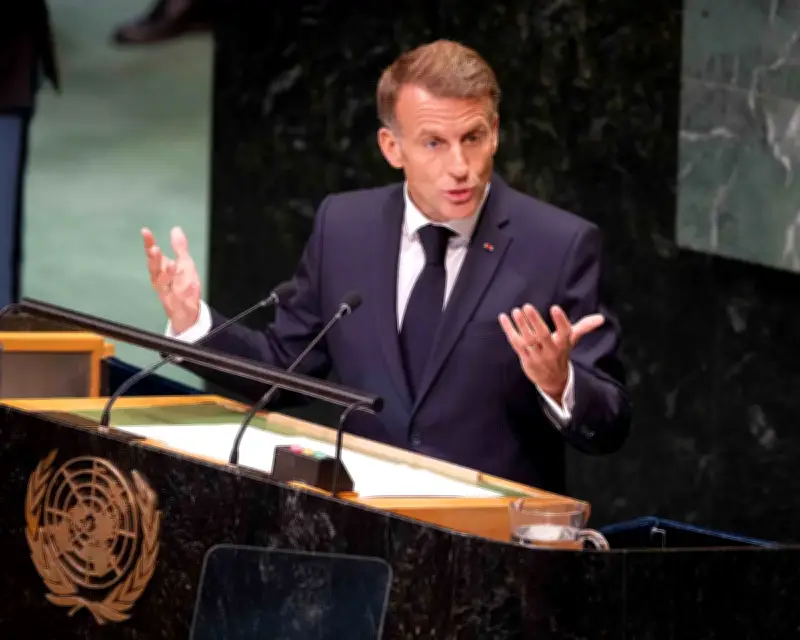
In his final address to the United Nations general assembly, French President Emmanuel Macron offered a robust defence of international law and multilateralism, a stance that appears to have emboldened other 'middle power' leaders to challenge US President Donald Trump's vision of a US-dominated world order.
Macron's speech, delivered on the first day of the assembly, directly criticised Russia and Israel while clearly aiming much of its rhetoric at Trump. He argued against the notion that 'might is right,' stating, 'we will not yield,' and questioned whether the world should live under 'the law of the jungle' or in a 'civilised international society.' He also acknowledged the west's 'permanent temptation to espouse double standards,' insisting that 'a life is a life' and that peace and security are indivisible.
A Decade of Defending the Rules-Based Order
Over the past decade, Macron has been a consistent voice for a morally intelligent analysis of Europe's role in the world. He has championed European strategic autonomy and was the only major leader during Trump's first term to publicly state that Nato could no longer rely on the US. However, his big speeches have rarely translated into substantial change, with his 2017 EU reform call stalling due to a lack of backing from then-German Chancellor Angela Merkel.
Macron's domestic political situation has also limited his global influence. He has been a lame duck since his disastrous snap election in 2024 left him without a parliamentary majority. Yet, his final UN speech, before he steps down next spring, set the tone for the week.
Middle Powers Find Their Voice
In the days following Macron's address, a procession of leaders from so-called middle powers defended UN principles and offered coded criticisms of Trump. Australian Prime Minister Anthony Albanese warned that the UN mission cannot be left solely to the great powers, while Spain's PM Pedro Sánchez called for countries to unite against those who want to 'take us back to a dark past.'
New alliances based on values are being formed, representing a reinvention of multilateralism. This month, the EU and Canada discussed 'associate membership,' and the UK formed a coalition of middle powers to impose sanctions on Israel's occupation of the West Bank. Finland and Norway also launched a call for an international body to oversee AI safety, a direct challenge to Trump, with 27 world leaders signing up, including Macron, Canada's Mark Carney, and Germany's Friedrich Merz.
A New Era of Values-Based Realism
These efforts are tied together by the concept of 'values-based realism,' first proposed by Finnish President Alexander Stubb and echoed by Carney, who spoke of the 'rupture' in the world order caused by Trump. The new world being built will consist of different, sometimes overlapping alliances of like-minded states.
For UK leaders Andy Burnham and Ed Miliband, questions remain about which groups to join or form. The UK has not yet joined the Finnish AI group, possibly to avoid provoking Trump. Each middle power now faces a conundrum: when to fight back and when to sit on the sidelines. At least, they now understand that fighting back is an option.