
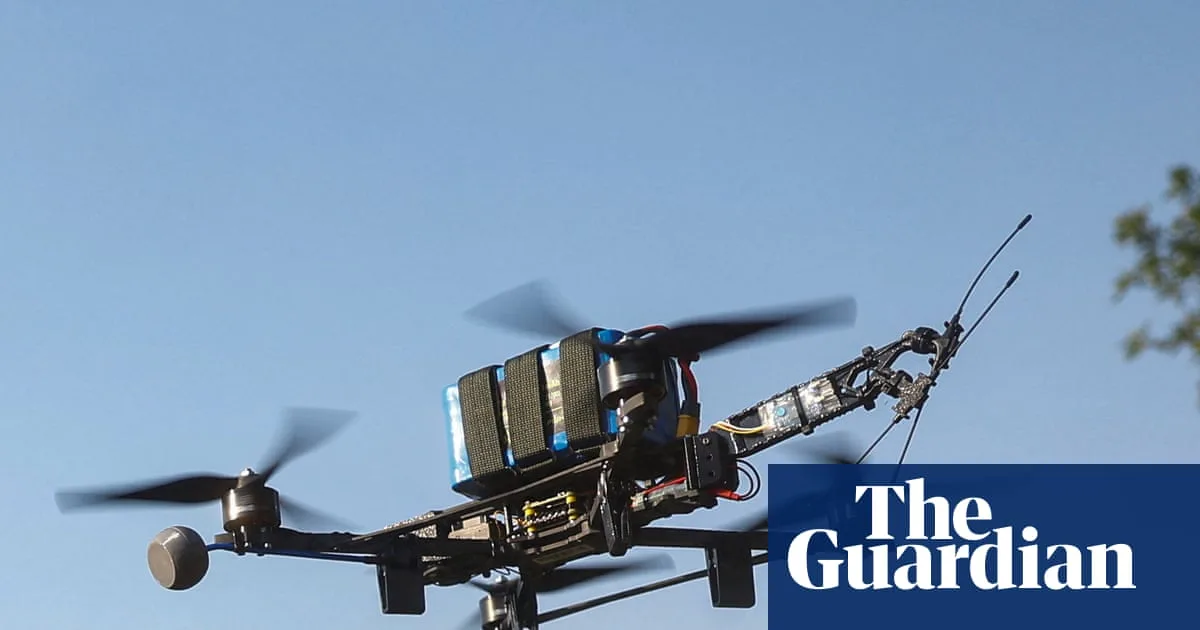
Lithuania has announced plans to teach more than 22,000 people, including children from the age of eight, how to build and operate drones as part of its efforts to bolster civil resistance against any future Russian threat. The joint initiative by the defence and education ministries, unveiled on Tuesday, is intended to expand civil resistance training across the Baltic nation.
The programme will be tailored to different age groups, with third- and fourth-grade pupils aged between eight and ten learning to construct and pilot simple drones. Secondary school students will design and manufacture drone parts, as well as build and fly more advanced unmanned aerial vehicles (UAVs). The government hopes to train 15,500 adults and 7,000 children by 2028.
Lithuania, a country of 2.8 million people bordering Russia's Kaliningrad exclave and Moscow's ally Belarus, has been on high alert since Vladimir Putin launched his full-scale invasion of Ukraine in 2022. The heightened concern was underscored on Wednesday when Estonia expelled a Russian diplomat. Estonian Foreign Minister Margus Tsahkna said the official had been directly involved in undermining the country's constitutional order, adding that the Russian embassy's ongoing interference in Estonia's internal affairs must end.
Lithuania's Defence Minister Dovilė Šakalienė said drone control centres would open in September in Jonava, Tauragė and Kėdainiai, with six more to follow in other regions by 2028. The government will spend €3.3 million (£2.9 million) on specialist equipment, including indoor and outdoor first-person-view drones, control and video transmission systems, and a mobile training app.
The training will be delivered by the Lithuanian Riflemen's Union together with the Lithuanian Non-Formal Education Agency. Vice-Minister of National Defence Tomas Godliauskas said the extracurricular courses would deepen children's technical literacy, with younger participants learning through games and experiments, while older students would gain programming basics and design 3D-printed drone parts.
Lithuania has intensified its focus on drone technology following two incidents in July when suspected Russian drones crossed from Belarus into its airspace. In Russia, meanwhile, the training of children in drone use has proved controversial, with recent revelations suggesting children were allegedly involved in designing and testing the technology through video games.




