North Korea's Kim Jong-un is said to have ghosted Donald Trump for one year by repeatedly ignoring the President's calls and sending back an unopened letter. Trump last week floated the idea he might meet with the North Korean dictator while in China to reengage with the isolated nation on its nuclear programme.
The US President has repeatedly referred to the dictator as a "friend" and even became the first sitting US President to stand on North Korean soil, back in 2019. The friendship appears to have fizzled out however as reports claim Trump attempted to call Jong-un last year through "established phone lines and communications channels" but nobody picked up or called back.
Unopened letter returned at UN
The US President then wrote a letter to the dictator and had White House officials deliver it to the New York City office of North Korea's permanent mission to the United Nations. They reportedly handed the envelope to a North Korean diplomat but they tossed the unopened letter back to US officials at a UN meeting, according to the Wall Street Journal.
This alleged cold shoulder comes amid a shift in Jong-un's attitude to Trump in his second term. The dictator and Trump met three times during his first term in the White House.
History of summits and shifting rhetoric
Trump went from insulting Jong-un and dubbing him "little rocket man" to telling a rally in 2018 the pair "fell in love", saying: "I was really being tough - and so was he. And we would go back and forth. And then we fell in love, okay. No, really - he wrote me beautiful letters, and they're great letters."
The two leaders made history in June 2018 when they became the first sitting US president and a North Korean leader to meet. The pair were pictured smiling and shaking hands at the historic summit in Singapore. At this meeting the pair agreed to "complete denuclearisation" of the Korean peninsula.
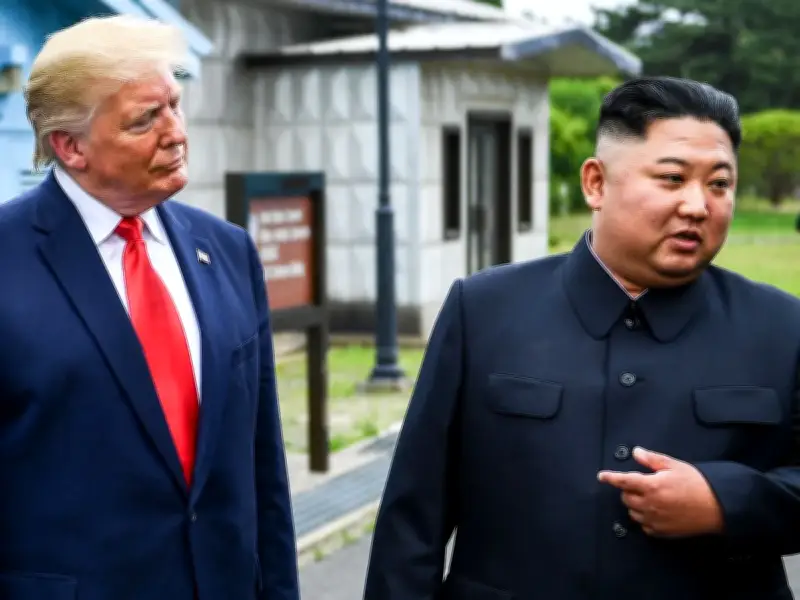
Trump and Jong-un met for a second summit in Hanoi, in February 2019, to discuss North Korea's nuclear and missile programmes. No deal was signed at this meeting and both leaders left the summit early. History was made again in June 2019 when Trump and Jong-un met for a third time at the demilitarised zone (DMZ) between North and South Korea. The pair shook hands and Trump stepped over the border into North Korea, becoming the first sitting President to do so.
No sign of Kim Jong-un at the summit
The US Commander-in-chief said: "Stepping across that line is a great honour. Great progress has been made, great friendships have been made and this has been, in particular, a great friendship."
Trump, ahead of his flight to Asia for the Asia-Pacific Economic Cooperation summit, suggested relations between the pair were still positive and teased the idea of a fourth meeting with Jong-un, saying: "We may meet with Kim Jong-un also. So that'll be good. We have a chance to accomplish a lot!" Trump added that it was "up to" China's Xi whether the North Korean leader was in the room with them, adding: "We might have Kim Jong-un. He may come. I don't know. That's up to President Xi."
Jong-un was snapped on a family trip to a new North Korean ski resort, near the border with China, ahead of the summit fuelling the idea he could make a surprise appearance in China. Despite this, there was no sign of the North Korean despot with Trump. Trump met with Vladimir Putin and Xi Jinping for historic three-way nuclear talks, where other topics including the International Criminal Court and Ukraine were discussed.
While the US administration has attempted to meet with North Korea to limit their nuclear programme, Jong-un has added to his nuclear arsenal since Trump's first term. The UN's nuclear watchdog warned North Korea has expanded its Yongbyon nuclear centre - a facility for enriching uranium - in the past few months, the International Atomic Energy Agency said. The IAEA chief, Rafael Grossi, said: "The ongoing expansion of the DPRK's uranium enrichment program remains a cause for serious concern."