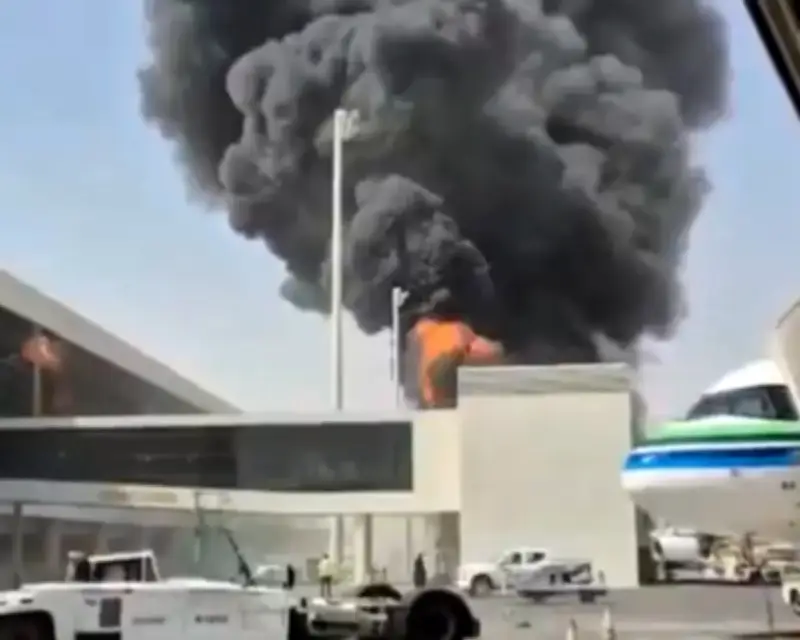
A missile attack by Yemen's Houthis on King Khalid international airport in Riyadh on Saturday killed 12 people, including an American, and has forced US President Donald Trump to reconsider his diplomatic and political strategy ahead of the midterm elections next month.
The attack, which sent thick black smoke and flames rising from the airport, came as Trump had unveiled a plan to blame spiralling diesel prices on Ukrainian President Volodymyr Zelenskyy, claiming his attacks on Russian oil refineries were the cause. The strategy aimed to keep the political temperature down on his war of choice in Iran and its spillover in Yemen until after the midterms.
Trump's strategy unravels
As part of the strategy, Trump claimed the Iranian blockade in the strait of Hormuz was effectively broken, producing figures on daily oil barrel exports to assuage markets. He also claimed it was impossible to negotiate with Iranians since there was no single leadership in Tehran.
Saudi Arabia, in conjunction with Turkey and Pakistan, were largely to be left to sort out the Houthis along the Red Sea. The fate of Yemen, the poorest country in the world according to the International Monetary Fund, was not going to shift votes in Kansas or Alaska.
Now, after the Riyadh airport attack, it is doubtful that this threadbare strategy, largely born of desperation, can hold. Something is clearly wrong with Saudi defences since the Houthis are firing rockets from 500 miles away and reaching their target too often.
Pressure on the US to act
The US has had a unilateral ceasefire with the Houthis since 2025, renewed quietly when hostilities between Saudi Arabia and the Houthis recommenced in the summer. Trump has twice rejected Saudi appeals for help, and the question is whether he can spurn them three times.
The "blame Zelenskyy, trade with Russia" strategy is unlikely to work. Russia accounted for about 12% of global diesel shipped by sea, and exports have fallen by about a third, according to calculations by the Center for Research on Energy and Clean Air. The additional diesel Vladimir Putin will put on the market is not enough to bring down prices at the pump.
The deal has also reawakened Europe's worst fears about Trump's relationship with Russia only weeks after Congress had passed a sanctions package against Moscow authorising Trump to penalise buyers of Russian energy. Europeans know the inflation problem driving populism is caused by the Iran war, not by Zelenskyy's tactics.
European and political backlash
Former UK Conservative prime minister Boris Johnson wrote: "It is sickening that the USA is now lifting sanctions on Russian fuel, and transparently ridiculous to blame Ukraine for the spike in prices that obviously began with the closure of the strait of Hormuz. Putin is murdering innocent Ukrainian civilians every day. The Ukrainians are fighting for their lives. And yet the White House is apparently determined to force American drivers to bankroll Putin's slaughter."
German education minister and CDU member Karin Prien said: "For a few litres of diesel. What moral bankruptcy."
Nato secretary general and Trump ally Mark Rutte will travel to Estonia this week, a country among the most supportive of Ukraine. Estonia's foreign minister, Margus Tsahkna, vowed that EU foreign ministers on Monday will impose the biggest package of sanctions in its history, and he, along with Sweden, wants to revisit using frozen Russian assets to help Ukraine.
Damage to Republicans and possible paths
Polls show the political damage to Republicans caused by the Iran war is irrecoverable. The war has been weaponised as a pocket book issue by every Democratic candidate in every TV debate, and Republican candidates are scrambling for the relative safety of identity politics.
Iranians are also trying to maximise damage in the strait of Hormuz, countering Trump's narrative that the blockade has been broken, with scenes of tankers on fire proliferating.
Trump post-Riyadh needs to rethink. He can rejoin the war against the Houthis, ending the unilateral US ceasefire, but this would be costly. The first three weeks of the war against Iran cost $1n a day. Many advisers say he may as well also attack Iran, the Houthi's backers, as Tehran expects. The Iranian military still believes it has escalation dominance, and what happened in Riyadh can be repeated across the Gulf.
The alternative is to negotiate discreetly and indirectly with Tehran as is occurring in Doha. Some Iranians are urging their leadership to seize the chance, arguing Trump is uniquely vulnerable in the run-up to the midterms. A deal could be done, including on uranium enrichment, but it would not be palatable for the US or for Israeli prime minister Benjamin Netanyahu's reelection chances.
China and Russia are trying to sort out the Houthis diplomatically, but Houthi objectives are broadening. The south of Yemen is split about its future, harming the country's ability to be the ground component Saudi Arabia needs to supplement its dominant air power. Taiz, Yemen's third city, is struggling to overcome a Houthi siege. The Saudis can deliver retribution, but retribution is not a solution to a decade-long civil war.
So for now, the twin Trump strategy – to park the Iran and Yemen conflicts while blaming Zelenskyy – is so transparent, morally craven, and in its own terms so ineffective, that it looks unsustainable. The only question is whether the strategy will be jettisoned by the president or just rejected by the American people at the ballot box.