
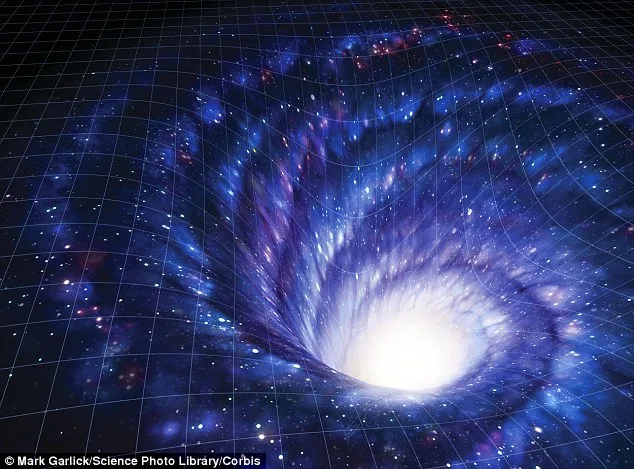
A giant doorway to another universe may exist at the centre of the Milky Way, and it could be large enough to swallow spaceships whole, according to a recent study. The research, published in the journal Annals of Physics, suggests that what appears to be a super-massive black hole at the galaxy's core could actually be a wormhole in disguise.
Wormholes, which allow instantaneous travel between distant points in space and time, are permitted under Einstein's theory of General Relativity. However, most scientists have dismissed the possibility of building one large and stable enough for travel, and no natural examples have been detected. The new theory, based on complex mathematical models, proposes that such a portal could be constructed from dark matter—the invisible material that makes up about 26 per cent of the universe.
Professor Paulo Salucci from the International School for Advanced Studies in Trieste, Italy, said: 'What we get is that our galaxy could really contain one of these tunnels, and that the tunnel could even be the size of the galaxy itself. But there's more. We could even travel through this tunnel, since, based on our calculations, it could be navigable. Just like the one we've all seen in the recent film Interstellar.'
The researchers combined the map of dark matter in the Milky Way with the latest Big Bang model. They note that any wormholes existing in nature have previously been assumed to be microscopic rips in space-time, but the one possibly at the galactic centre would be large enough to swallow a spaceship. Professor Salucci added: 'Obviously we're not claiming that our galaxy is definitely a wormhole, but simply that, according to theoretical models, this hypothesis is a possibility.'
Other spiral galaxies similar to the Milky Way, such as Andromeda, may also contain wormholes. Theoretically, it might be possible to test the idea by comparing the Milky Way with a different type of nearby galaxy, like one of the irregular Magellanic Clouds.




