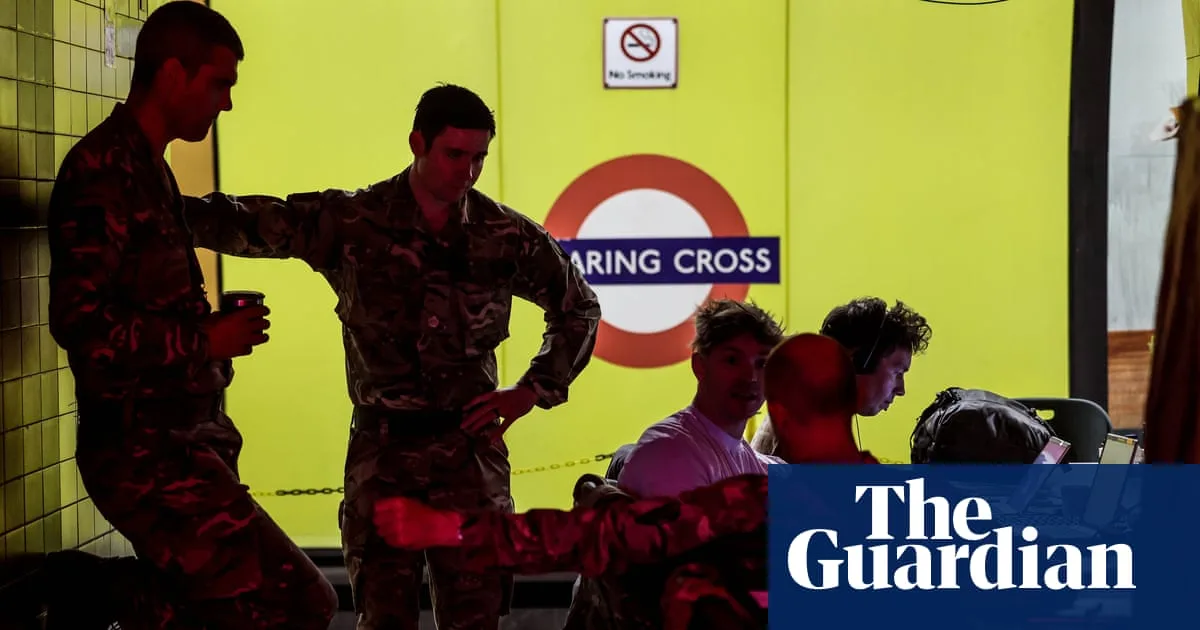
Deep in Charing Cross underground station, in the disused terminus of the Jubilee line, a secret Nato command bunker has this week been discreetly at work. Dozens of mostly British soldiers were engaged in a war game defending Estonia from a Russian invasion in 2030, unbeknownst to commuters and tourists bustling above.
The secret chambers are behind two sets of normally locked, metal double doors. A red glow at the bottom of the escalator beyond is the first sign of troops below; next are mocked up newspaper covers pasted over ageing adverts. A British Nato force has deployed to Estonia they blare, in response to a Russian massing of troops on the border.
“The scenario you are about to see is very deliberately set in 2030 because that is where we see the threat from Russia to be at its most acute,” says Lt Gen Mike Elviss, commander of the Allied Rapid Reaction Corps, in a video briefing. If the war ends in Ukraine it is the point at which, military analysts estimate, a remilitarised Russia could be ready to attack Europe again.
The aim, ostensibly, is to show Moscow that for all Donald Trump’s bluster, Nato is ready, operationally at least, to defend its most exposed members on the Baltic. But a more important audience is a mile or so down the road in Westminster, where the Ministry of Defence has been locked in a funding battle with the Treasury for months.
Remodelling the British army, it is said, will cost billions in investment, particularly on drones. It is estimated that it will cost £50m a year to get the arms industry building the required volumes of simple one-way attack drones, so familiar in Ukraine, and £500m a year to develop more sophisticated models, such as armed driverless vehicles.
If there was a full-scale war in eastern Europe tomorrow, it is understood the British military would run out of drones in less than a week, able only to launch a few hundred a day. On this thinking, the British army is between 80 and 90% short of the drones it thinks it needs – for reconnaissance, air defence or attack.