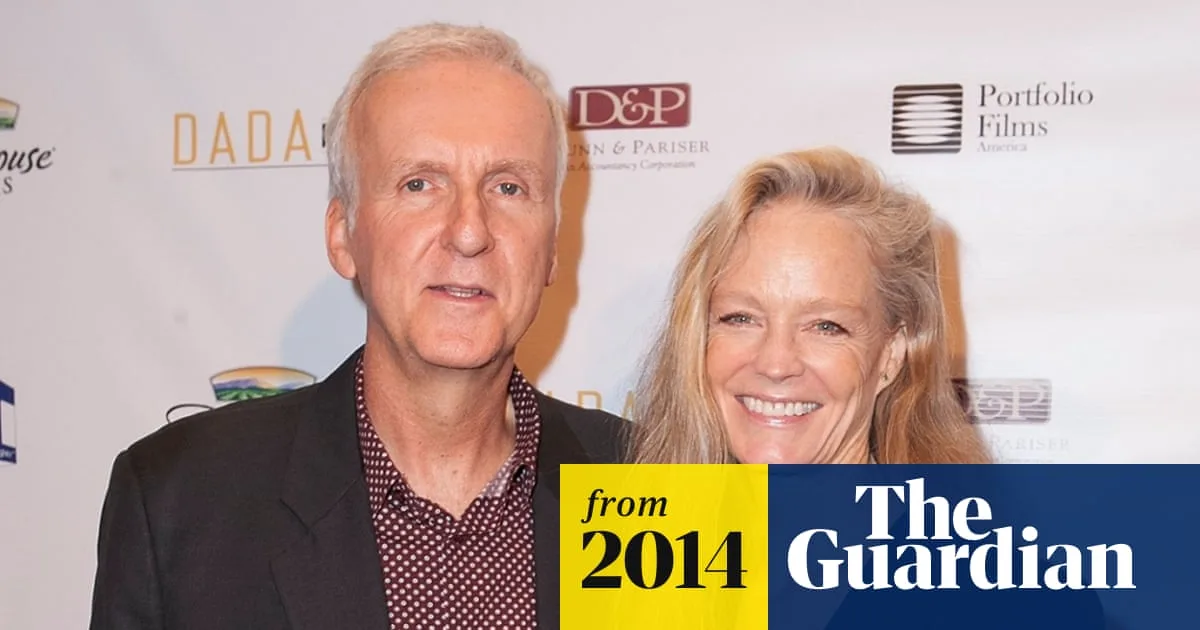
James Cameron and Suzy Amis Display Affection at Billie Eilish Documentary Premiere
Cameron and Amis Share Romantic Night at Documentary Premiere

James Cameron could not keep his hands off his wife on Wednesday evening during the premiere of the new Billie Eilish documentary. The 71-year-old director was seen holding hands and cuddling up to Suzy Amis, 64, whom he met when she was starring in his film Titanic almost 30 years ago.

A Love Story That Began on the Set of Titanic

Amis played Lizzy Calvert in the movie, part of the modern-day portion of the film in which Leonardo DiCaprio and Kate Winslet starred as the doomed couple on the Titanic. Cameron and Amis wed in 2000 and have three children together: a son, Quinn (21), and two daughters, Claire (23) and Elizabeth (18). Cameron also has a daughter, Josephine (31), from his previous marriage to Linda Hamilton, who starred in his early blockbuster The Terminator (1984) alongside Arnold Schwarzenegger.

A Carefree Life Together

Last year, Cameron told The Hollywood Reporter that his life with Amis is very carefree. He said, 'It's us walking around the house in socks, being voracious readers, building fires, and hanging out — after 30 years, there's never a moment we don't have something to talk about.' During the interview, Amis also discussed Cameron's 2012 journey to the bottom of the Mariana Trench using a submersible. She admitted she was 'beyond nervous I would never see him again' but was happy for him: 'He was just so excited; like a little kid. He'd been working on it for years, and you can't hold that back from somebody.' Cameron used the craft's radio to say, 'I love you, baby. I love you, wife… all the way from the heart of the ocean.'

Wide Pickt banner — collaborative shopping lists app for Telegram, phone mockup with grocery list

Cameron's Views on AI in Filmmaking

This display of affection comes after Cameron said he thinks the idea of generative AI replacing actors is 'horrifying.' The Avatar: Fire and Ash director, who sits on the board of Stability AI, has previously been positive about the use of artificial intelligence in filmmaking but has limits on how it should be used. The Oscar-winning moviemaker hailed motion capture as the 'purest form' of performance and admitted it was a 'mistake' that he was reluctant to 'pull the curtain back' on the CGI-assisted technique when working on 2009's Avatar to keep the 'magic unblemished' for audiences.

Motion Capture vs. Generative AI

Speaking on CBS Sunday Mornings, Cameron stressed how different motion capture and AI are in the filmmaking process. He said, 'For years, there was this sense that, 'Oh, they're doing something strange with computers and they're replacing actors,' when in fact, once you really drill down and see what we're doing, it's a celebration of the actor-director moment, and the actor-to-actor moment. It's a celebration of, I call it, the sanctity of the actor's performance moment.' He continued, 'Now, go to the other end of the spectrum, and you've got generative AI, where they can make up a character, they can make up an actor. They can make up a performance from scratch with a text prompt. It's like, no. That's horrifying to me. That's the opposite. That's exactly what we're not doing.'

The Titanic director insisted he never wants to 'replace' actors with technology, adding, 'I don't want a computer doing what I pride myself on being able to do with actors. I don't want to replace actors, I love working with actors.' However, Cameron does feel AI has a place in the industry, as it could be helpful in 'making VFX cheaper.' He explained, 'Right now, imaginative films, fantastic films, science-fiction films — they're starting to die off as a breed because they're expensive and the theatrical marketplace has contracted, and now studios are only comfortable spending those kinds of dollar amounts with blue-chip IP, that which we've seen, that which we know. I mean, a movie like Avatar would never get made in that environment. That was brand-new IP; nobody had ever heard of it.'

Pickt after-article banner — collaborative shopping lists app with family illustration

Cameron doesn't think generative AI would undermine his work but rather will make filmmakers push themselves more. He said, 'It might [undermine the work], but it also causes us to have to set our bar to a very disciplined level, and to continue to be out-of-the-box imaginative … what generative AI can't do is create something new that's never been seen. If you think about it, the models — it's a magic trick, what they can do is quite astonishing. But the models are trained on everything that's ever been done before that; it can't be trained on that which has never been done. So you will innately see, essentially, all of human art and human experience put into a blender, and you'll get something that is kind of an average of that. So what you can't have is that individual screenwriter's unique lived experience and their quirks. You won't find the idiosyncrasies of a particular actor... The act of performance, the act of actually seeing an artist creating in real time will become sacred, more so.'




