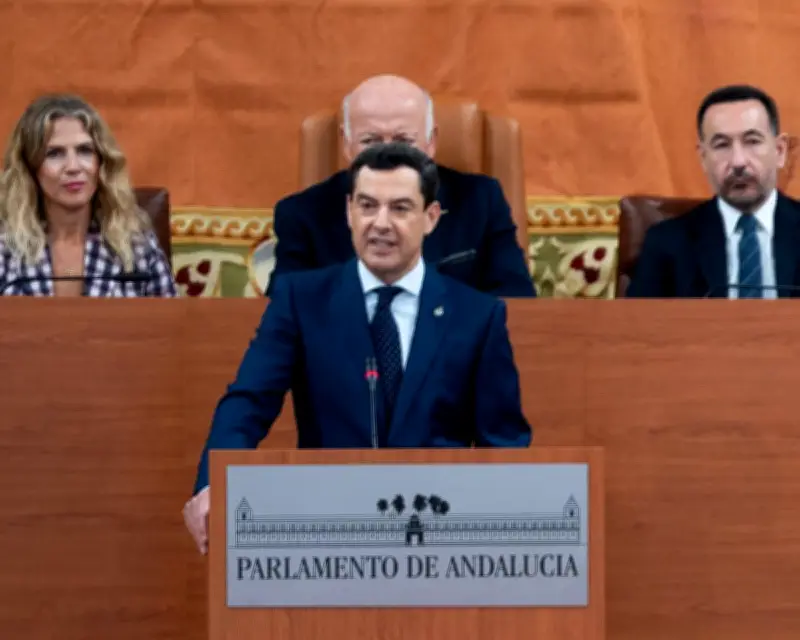
Spain's conservative People's Party (PP) and the far-right Vox party have signed a new coalition agreement in Andalucía, bringing a potential national coalition closer. The deal, signed on Thursday, allows the PP to continue governing Spain's most populous region after losing its absolute majority in May's regional election.
Coalition Agreement Details
The agreement includes Vox's controversial 'national priority' policy, which gives Spanish-born people priority over those born abroad for housing and public services. Incumbent PP regional president Juan Manuel Moreno Bonilla had dismissed this policy as 'a sensationalistic but empty slogan' during the campaign, but the pact explicitly guarantees 'national priority in accessing public benefits'. The deal also rejects the immigration policies of Spain's socialist-led central government and states that Andalucía will not accept any more unaccompanied migrant children.
Other priorities include opposing 'the imposition of ideological agendas when it comes to caring for the environment', defending intensive livestock farming 'in the face of criminalisation from the animal rights lobby and the climate policies developed in Brussels', and protecting and preserving bullfighting.

Historical Memory Law Repeal
As in other PP-Vox coalition regions (Extremadura, Aragón, and Castilla y León), the new Andalucían government seeks to overturn legislation introduced four years ago to bring 'justice, reparation and dignity' to victims of the civil war and Franco dictatorship. It plans to replace it with a 'harmony law', which the national government, historical memory associations, and UN experts have decried as an attempt to whitewash the Franco era.
Political Reactions
Moreno hailed the pact as a 'sensible, fair and legal legislative agreement' that would bring four years of stability. National PP leader Alberto Núñez Feijóo praised Moreno's 'commitment, capacity for dialogue, and vocation of service'. Vox's leader in Andalucía, Manuel Gavira, who will serve as regional vice-president, said the deal ensures a government 'that defends common sense and improves the lives of the people of Andalucía'.
PSOE's organisational secretary Rebeca Torró criticised the deal, stating there is no 'moderate PP' or 'hardline PP', only 'a PP that's exactly the same as Vox'. She warned of 'backward steps in equality, attacks on the rights of LGBTI people, a weakening of public services, a questioning of climate change, and the normalisation of speech that jeopardises rights and freedoms'.
National Implications
May's regional election saw the PSOE drop to 28 seats (its worst ever in Andalucía) in the 109-seat parliament, while the PP fell to 53 seats and Vox rose to 15. With Spain gearing up for next year's general election, polls suggest the PP may need Vox to govern nationally. Feijóo has refused to rule out a coalition, stating he hopes to govern alone but won't 'demonise' Vox. In a TV interview, he said: 'If it turns out that we need to make a deal for a coalition government, we'll sit down and we'll form a government coalition that's in line with the basic principles of our parties and we'll set out a series of red lines that I won't cross.'