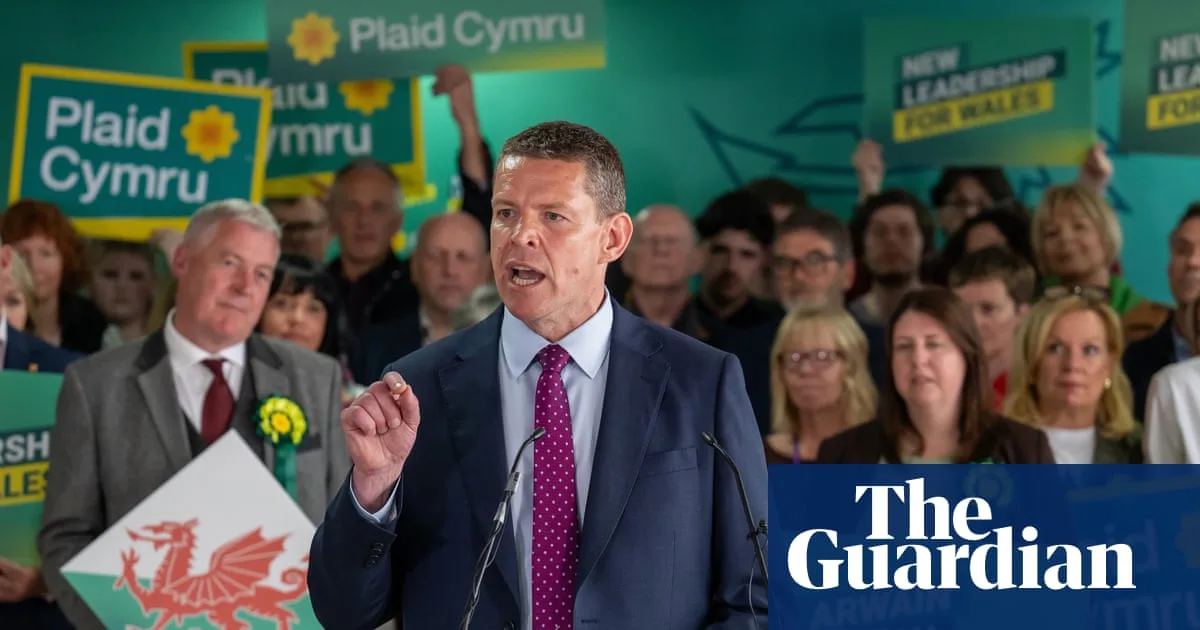
Plaid Cymru has won the Welsh Senedd elections, ending 100 years of Labour dominance in Wales and blocking the momentum of Nigel Farage’s Reform UK. Party leader Rhun ap Iorwerth said he stood ready to become first minister and form the next Welsh government, taking over from Welsh Labour, which has governed Wales since devolution began in 1999.
The results gave Plaid Cymru 43 seats, Reform UK 34, Labour nine, the Conservatives seven, Greens two and Liberal Democrats one. With at least 49 seats needed for a majority under Wales’s new electoral system, no party achieved one, but Plaid Cymru can comfortably form a minority government.
Speaking in Llandudno, north Wales, ap Iorwerth said: “The people of Wales have today decided on the next steps in Wales’s journey. Plaid Cymru now stands ready to take the necessary steps to form the next government.” He added: “This is a moment 100 years in the making. We have won because we represent hope over division, credibility over chaos, and progress over stagnation.” His name will be put forward for nomination as first minister, and he said he would talk to other parties sharing Plaid’s goals.

Labour’s defeat was seismic. Eluned Morgan, who took over Welsh Labour in 2024, became the first UK government leader to lose their seat while in office. Speaking at her count in Llandysul, she said she would resign as party leader and took “full responsibility” for the result. She called Labour’s prospects “catastrophic”, saying: “Today we see the end of over a century of Labour winning in Wales… The age of two party dominance is at an end.” She also called on the UK Labour government to “change course”.
Support for Welsh Labour had been ebbing for years, with frustration over public services and the 2024 UK general election leaving Cardiff Bay unable to blame a Conservative-led government. The new D’Hondt voting system, which created 16 six-member super-constituencies, made polling predictions difficult. The result makes a Welsh independence referendum a future possibility, and means all three of the UK’s Celtic nations are now controlled by separatist parties.