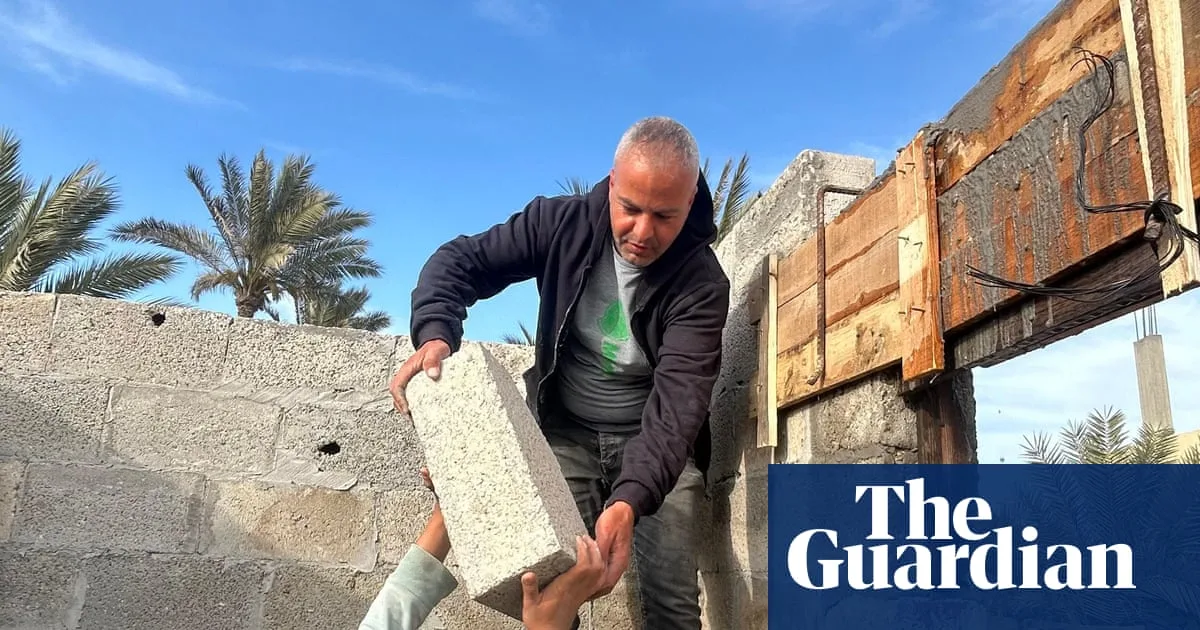
With Israel blocking imports of building materials, Palestinians in Gaza are recycling ruins to make their own cement. Inside a cramped tent on the eastern edge of Khan Younis, Ibrahim al-Aloul works alongside four others, sifting and grinding toxic grey powder. A donkey cart carries the finished product to be mixed with gypsum, calcium and binding agents before being bagged in flour sacks and sold.
This improvised cement industry is the only construction option in the besieged coastal strip. Israel has barred cement and all building materials since October 2023, deepening a blockade in place since 2007. By October 2025, satellite imagery found approximately 81% of all structures in Gaza had been damaged, with more than 123,000 destroyed outright. The UN estimates the destruction generated 61 million tonnes of rubble.
Saadi al-Sha’er, who employs Aloul, began experimenting after noticing clay fused with cement dust around bombed factories. Workers break down hardened deposits by hand, sieve them through fine meshes, and mix the powder with lime, gypsum, calcium and a bonding agent. When the bonding agent runs out, wood glue is substituted. His operation produces between half a tonne and two tonnes a day, employing about 30 people.

The substitute cement sells for 12 to 18 shekels (£3-£4.60) per kilogram at source, but after passing through traders, a single bag costs 2,000 shekels (£506) — compared to 40 shekels before the war. For those who can afford it, the substitute offers the only path to something sturdier than a tent. Mahmoud al-Astal, a farmer in al-Mawasi, is building a two-room house using the substitute cement, saying it should suffice for a shelter that lasts longer than a tent.
Builder Othman al-Awda adjusts his mix ratios to compensate for the reduced strength of the substitute cement. “It is clearly limited in strength,” he says. “But it works for brickwork. I would never use it for columns.” The October 2025 ceasefire agreement required the immediate entry of reconstruction materials, but the blockade continues.