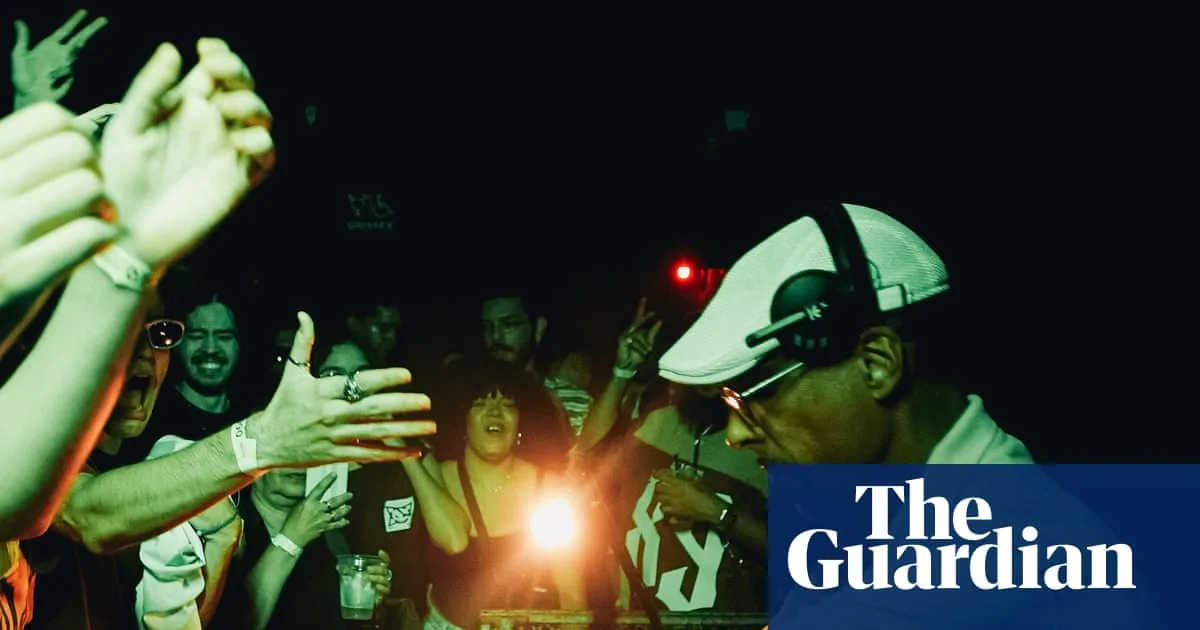
When drum'n'bass grew stale in the 1990s, it got a samba-splicing Brazilian twist. As that style returns, the scene's legends and newcomers celebrate a cross-cultural triumph.
The Beginning of a Transatlantic Connection
Wagner Ribeiro de Souza, better known as DJ Patife, wasn't carrying much in his backpack when he arrived in London in 1998. Inside were a local compilation of techno, house and jungle hits, a couple of news clippings, and a VHS tape featuring footage from the club where he played weekly in São Paulo, Brazil. These were small fragments of a music scene that he and some friends were building back home.
Patife had traveled to London to pitch an edition of Movement, one of Britain's most important drum'n'bass nights, in Brazil. He recalls, "I played that tape recorded at the club. When Bryan Gee saw 2,000 people singing, he said: 'Let's go to Brazil right now!'" From that moment, drum'n'bass began flowing between the two countries at just the right time.
A Fresh Sound for a Stale Scene
By the late 1990s, drum'n'bass had become somewhat formulaic in the UK, losing the chaotic energy of jungle that had emerged earlier in the decade. The Brazilian infusion, with its ginga (swing) rooted in bossa nova samples and melodic instrumentation, revitalized the genre. "We brought together two spectacular things: Brazilian music and electronic music," Patife says. "Everyone drank from the Brazilian source!" In return, the UK opened doors for Latin America to explore genres like speed garage, two-step, and grime.
This cultural crossroads is now more vibrant than ever, thanks to a new generation of artists on both sides of the Atlantic. British producer and DJ Sherelle notes, "There's a natural connection between Brazil and the UK: our music tastes are both so vast." She adds, "If you've come from a working-class or even underclass background in the UK, music is your only outlook to escape and express yourself, and I noticed that is the same here for many artists."
Pioneers and Their Journey
Patife lived in London from 2000 to 2017 before moving to rural Portugal, where he now works as a bus driver—a childhood dream. Despite his new career, he remains hugely celebrated in both Brazil and the UK. This weekend, he performs at Boa Nova, a new festival dedicated to Brazilian music at Leyton Jubilee Park in London, one of the closing acts of the British Council's UK/Brazil Season of Culture.
In the mid-1990s, Patife and fellow Brazilian drum'n'bass legend DJ Marky were rising stars in São Paulo's electronic scene. Their passion for UK club music grew through record catalogues and magazines like Mixmag and DJ Mag. Marky introduced Patife to "The Dark Stranger" by Boogie Times Tribe, a track that changed his life. Both artists had backgrounds in hip-hop and Black Brazilian music, favoring gritty, breakneck sounds over the antiseptic pop dominating São Paulo's top clubs.
After saving enough money, they traveled to London for the first time. "In our first two hours in London, we ran into Goldie walking through Soho," Patife recalls.
Rise to Mainstream
From the late 1990s to early 2000s, Patife, Marky, and peers like Andy, XRS, Drumagick, and Mad Zoo built a drum'n'bass cult in São Paulo's underground clubs, such as Sound Factory and Arena. The scene eventually hit the mainstream. In October 2000, they performed at a free open-air stage in the city center, broadcast on national television, a defining moment for Brazilian electronic music.
As the genre grew, DJs began producing their own tracks. "Sambassim" by Patife, XRS, and Fernanda Porto became the first Brazilian drum'n'bass track played on BBC radio in 2000. In 2002, DJ Marky's track "LK"—a collaboration with XRS and British rapper Stamina MC—reached the UK Top 20, making them one of the few drum'n'bass acts to appear on Top of the Pops.
After Patife's meeting, Bryan Gee fell in love with the Brazilians' tropical, samba-laced sound and released "The Brasil EP" on his label V Recordings in 2001—the first Brazilian drum'n'bass release on a UK imprint. Gee compares the Brazilian twist to liquid drum'n'bass: "Both are soulful. Brazilian music has a lot of samba, breaks, so it was easy to be accepted in the UK."
Continuing Legacy
Gee has performed dozens of times in Brazil since meeting Patife, alongside other UK staples like Roni Size, Adam F, and Goldie. He admires new Brazilian artists like Spy, L-Side, and Level 2. "They don't have samba in their music, but there's a Brazilian vibe. And they love and respect the history."
Brazilian rap artists like Ajulliacosta are also hopping on drum'n'bass beats. Meanwhile, UK newcomers like Nia Archives sample Brazilian music in hits like "Baianá" and "Maia Maia." Sherelle performed in São Paulo for the first time in April at the Gop Tun festival, wearing a Corinthians football jersey. "I've been waiting since the start of my career to play here," she says.
New Generation and Future
Born in 1993, Sherelle grew up with the first UK-Brazil drum'n'bass dialogues. In the mid-2000s, gaming introduced her to Drumagick and Patife through the Fifa Street franchise. "The curation of that soundtrack was amazing," she says. During her trip, she also played at the Speedtest rave in Rio, founded in 2022 by DJ Chediak and Diogo Queiroz. The party and label focus on fast-paced breakbeat music from the UK and Brazil, blending baile funk, post-dubstep, and jungle breaks.
Chediak explains, "We're infusing baile funk sounds into UK club music, bringing a new layer with artists from underprivileged neighborhoods and favelas." He believes UK electronic music has a unique appeal for Brazilians. "It's not as groovy as what we do here, but it feels less square than European and especially US electronic music. It's more a sound, a timbre; less obvious, fresh."
Patife toured Brazil with the Speedtest crew at the end of 2025, hailed as a drum'n'bass oracle. "I was amazed by what I saw with these kids," he says. "I thought bass music would be where we left it, but now I see continuity—and a long road ahead. In 20 or 30 years, these kids will be the gurus of newer generations."
Boa Nova festival takes place at Leyton Jubilee Park, London, on 22 May.