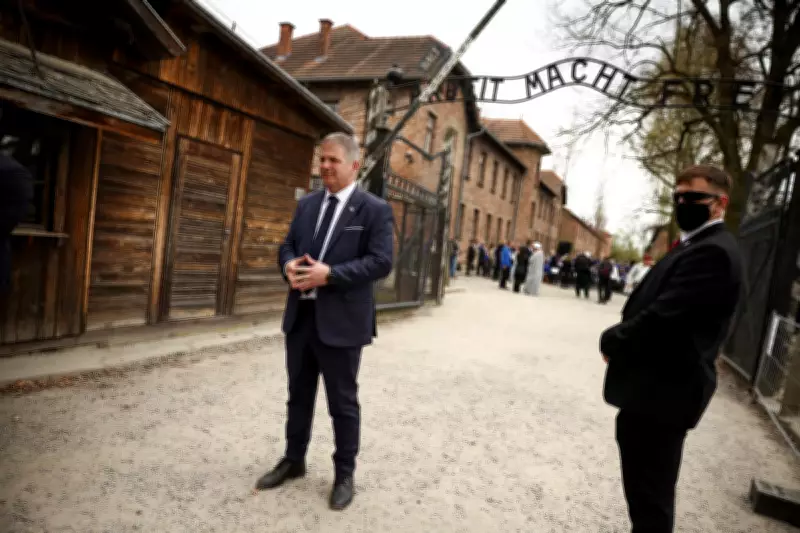
Survey Exposes Alarming Gap in Holocaust Knowledge Among Young Americans
A comprehensive survey conducted by the Conference on Jewish Material Claims Against Germany has revealed a troubling deficit in Holocaust awareness among younger generations in the United States. The 2025 study found that 48% of Americans aged 18-29 could not name a single concentration or death camp from the Nazi era. This knowledge gap emerges as approximately 70% of living Holocaust survivors are projected to pass away by 2035, potentially severing direct connections to firsthand testimonies of the genocide that claimed six million Jewish lives.
Social Media Amplifies Distortion of Historical Facts
Compounding this educational shortfall, 53% of surveyed Americans reported encountering Holocaust denial or distortion on social media platforms. This digital proliferation of misinformation coincides with a documented rise in antisemitic activities across multiple countries. Many experts attribute this concerning trend directly to inadequate education about the Nazi period and its systematic atrocities.
Historical Parallels: West Germany's Educational Reforms
My research, detailed in the 2024 publication "Teaching a Dark Chapter: History Books and the Holocaust in Italy and the Germanys," examines how Holocaust education evolved in post-war societies. The study focuses particularly on middle school history textbooks used in East Germany, West Germany, and Italy from the 1940s through the 1980s. Two significant antisemitic incidents in West Germany—one in 1959-60 and another in 1977—exposed profound gaps in students' understanding of this dark historical chapter.

The 'Swastika Epidemic' and Its Educational Aftermath
Following the reconstruction of Cologne's historic Roonstrasse synagogue in 1959, which West German Chancellor Konrad Adenauer attended, the building was defaced with antisemitic graffiti on Christmas Day that same year. The arrested vandals testified they had never received proper education about Nazism in school. This incident triggered what newspapers termed a "swastika epidemic" of antisemitic vandalism spreading through West Germany and even reaching the United States.
Public outcry over this wave of antisemitism, combined with a 1959 television documentary revealing West German high school students' ignorance about Jewish casualties under Nazi rule, prompted significant educational reforms. The West German cultural representatives' committee, known as the Kultusministerkonferenz (KMK), issued new guidelines in 1960 and 1962 specifying how educators should teach about Nazism and what we now recognize as the Holocaust.
Textbook Revisions and Expanding Historical Detail
Analysis of successive editions of the middle school textbook "Kletts geschichtliches Unterrichtswerk Ausgabe B" reveals substantial revisions between 1959 and 1960. The subsection addressing "Terror and Crimes" tripled in length and began including specific numerical data, such as the estimated six million Jewish victims, rather than vague generalizations like "many million." These changes represented a significant advancement in historical accuracy and detail.
Persistent Knowledge Gaps Despite Reforms
Seventeen years later, in 1977, teacher Dieter Bossmann's study exposed continued widespread ignorance among West German students. Some students admitted knowing almost nothing about Hitler, while others offered relatively positive assessments of the Nazi leader. Estimates of Jewish casualties ranged wildly from tens of thousands to sixteen million. The news magazine Der Spiegel observed that the problem extended beyond textbook content to pedagogical methods themselves.
In response, the KMK issued another resolution in April 1978 calling for new curricular materials. This prompted a shift toward active learning models, with teachers encouraging students to analyze primary sources, visit concentration camp memorials, and conduct local historical research.

Contemporary Challenges in Holocaust Education
Despite these reforms, Holocaust education remains imperfect. In 2023, a Berlin history teacher noted that while most students recognize names like Adolf Hitler and National Socialism, their knowledge contains "many blank spots." A 2025 survey revealed that 18% of German adults incorrectly believe two million or fewer Jews perished in the Holocaust.
Today, Germany mandates Holocaust education across all federal states. In contrast, the United States determines such requirements at the state level, with not all states providing guidance or mandates for Holocaust instruction. The West German experience demonstrates that continuous updating and reinforcement of historical teaching guidelines remains essential for combating ignorance and distortion.
As living memory of the Holocaust fades with the passing of survivors, the imperative for effective, accurate education about this genocide grows increasingly urgent. Historical knowledge gaps, while concerning, can sometimes catalyze significant educational advancements—a lesson contemporary societies would do well to remember.