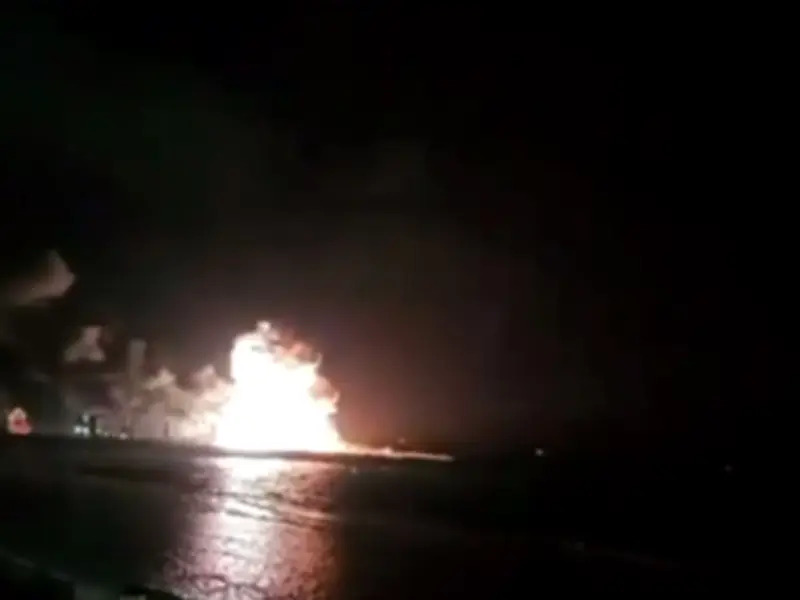
Four Russia-linked ships have been hit over the weekend in Ukrainian drone strikes in the Baltic and Mediterranean seas, showing the war is spreading well beyond the frontline. Symbolically a major defeat for Russian President Vladimir Putin, the blow represents a cost of about half a billion pounds.
Long-reach operations beyond the frontline
This is not the first time Ukraine has been involved in long-reach operations beyond Russia and the war inside Ukraine in its bid to leverage pressure on the Kremlin. But rarely have these Ukrainian covert missions been so exposed and admitted to. It also shows how Ukraine, without even a navy, is able to replicate having a sea-going fleet by just using drones.
After Russian missiles hit Poland on Friday, hours before UK and French-led exercises just 30 miles away, the war is no longer confined to Ukraine.
Attack on the Merkury and other vessels
The main attack saw Ukraine's sea-going drones blitzing Russian corvette Merkury, first commissioned in 2023 and one of the prides of Putin's fleet. That this was 1,000 miles away from the frontline off the coast of Libya now makes north Africa as well as Europe an arena where this war is being fought.
Two more merchant vessels linked to the Kremlin were also hit in the Mediterranean and another came under fire in the Baltic Sea. It is believed they were linked to the Russian military and may have been illegally carrying arms and ammunition for Putin's war on Ukraine.
Kyiv's careful line and Putin's ambitions
Kyiv's war-planners are treading a careful line, pushing as far as they can in attacking Putin's strategic assets on the high seas, knowing it is an invitation to Moscow to do the same. Putin keeps pushing anyway, over-stepping at every opportunity, prodding and jabbing western governments to see where their red lines lie.
In these latest attacks, Ukraine is following up US President Donald Trump's cosying up to Putin in China by putting him back in his place. Covertly the war has been raging quietly for months beyond Ukraine but now it is becoming a norm, a habit and needs careful diplomatic intervention by the west.
Peace deal talk and the spreading conflict
There is increasing talk about a deal to mark the end of the war, although deluded Putin is likely just paying lip-service to the idea. Many do not believe he will settle for anything else but the annexing of Ukraine and the subjugation of its entire population. This, in the light of how hard Russia is being hit by the war, having lost more than 1,600,000 troops to death and injury and perhaps 50% of its working oil industry through drone strikes, is a now ridiculously ambitious goal.
Putin's long-term fall back position could be accepting the entire Donbas region in the east, the industrial heart of Ukraine representing 20% of the country. Ukrainian President Volodymyr Zelensky has already said this will not happen and that Putin cannot be trusted anyway, as his previous behaviour has demonstrated.
Ukraine is hanging on, its civilians coming under horrific daily missile and drone attacks, as seen with the deaths of at least 15 over the weekend. It is hanging on, perhaps hoping for a collapse in Kremlin resolve. But Putin is probably considering ever-more desperate measures to try and gain in his hopeless war, knowing his political asset Trump has an expiry date and the clock is ticking.
With the talk of a peace deal increasing in tempo, both sides are now locked into an increasingly violent war which is pushing the boundaries. Both want to leverage the other, to impress upon their allies and Trump's so-called peace interlocuteurs, that they are winning to give an advantageous starting point. The war in Ukraine is spreading beyond frontiers, into Europe and towards north Africa and the more this becomes the norm, the greater the risk of a wider conflict.