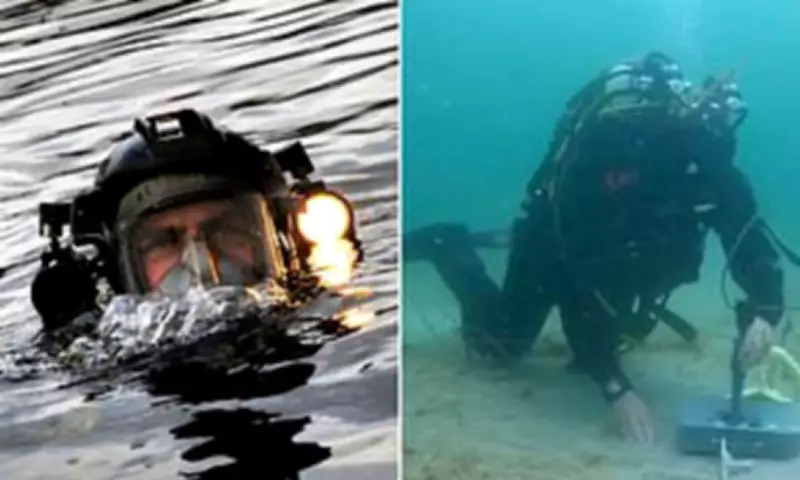
Royal Navy Elite Divers Poised for High-Stakes Mission in Strait of Hormuz
An elite team of Royal Navy divers is currently on standby, ready to deploy to the strategically vital Strait of Hormuz. Their mission: to help defuse Iranian mines that are blocking crucial international shipping lanes. This deployment comes amid escalating tensions in the region, with the potential to disrupt global oil supplies.
The Diving and Threat Exploitation Group: Masters of Underwater Danger
The divers are all members of the highly specialised Diving and Threat Exploitation Group (DTXG), a unit renowned for undertaking one of the most perilous roles within the British Armed Forces. Their primary responsibility involves the clearance of mines and improvised explosive devices (IEDs) from deep underwater environments. This hazardous work is often conducted in near-total darkness, illuminated only by torchlight, and devices may be deliberately booby-trapped to target clearance teams.
Advanced Deployment Capabilities and Tactical Partnerships
These exceptionally trained operatives possess a versatile array of deployment methods to reach their objectives. They can insert into an area via surface boat, by parachute, or using mini-submarines. These compact submarines are capable of transporting up to six divers and have an operational range extending to 30 miles. Furthermore, the DTXG utilises a sophisticated docking system that can attach directly to a Royal Navy Astute-class submarine, allowing for covert, long-range insertion.

The group maintains a close operational partnership with the Special Boat Service (SBS) and receives extensive training in counter-terrorist operations, enhancing their capability to handle complex maritime threats.
Standby Status and the Scale of the Threat
The divers have been on high alert for deployment since the onset of the regional conflict five weeks ago. Intelligence assessments suggest Iran may have positioned up to a dozen mines within the strait. This has created a critical bottleneck, with hundreds of commercial vessels effectively trapped in the area. The strategic importance cannot be overstated; approximately 20 percent of the world's oil transits through these narrow waters.
A Royal Navy source emphasised the preparedness, stating: 'It is unknown at this stage whether Iran has mined the strait but we need to be prepared for the worst-case scenario. Mine clearance is one of the DT's primary roles, so if necessary they will be used.'
Iran's Extensive and Sophisticated Mine Arsenal
Iran is believed to possess a formidable stockpile of around 5,000 naval mines, each packed with up to 260 pounds of high explosives—sufficient to catastrophically damage or destroy a passing ship. This arsenal includes various sophisticated types:
- Contact Mines: Detonated upon physical impact with a vessel.
- Influence Mines: Activated when a ship passes nearby, triggered by detecting magnetic signatures or acoustic signals.
- Moored Mines: Typically anchored to the seabed on long cables, rising to just below the surface when armed.
- Rocket Mines: Fixed to the ocean floor, designed to fire an explosive warhead upwards into the hull of a ship passing overhead.
- Delayed-Activation Mines: Can be programmed to remain dormant for up to 30 days after deployment, complicating detection and clearance efforts.
International Context and Political Stance
The DTXG's expertise is not confined to this crisis; members have previously collaborated with allies such as Ukraine and the United States on missions to enhance security in the Black Sea. The current situation has drawn sharp political commentary. US President Donald Trump has publicly threatened to 'walk away' from the Strait of Hormuz, arguing that nations reliant on Gulf oil should assume responsibility for securing the waterway. He stated, 'That's not for us... that'll be for whoever's using the strait.'
As the standoff continues, the readiness of the Royal Navy's elite divers represents a critical line of defence against a threat that holds significant implications for global energy markets and maritime security.