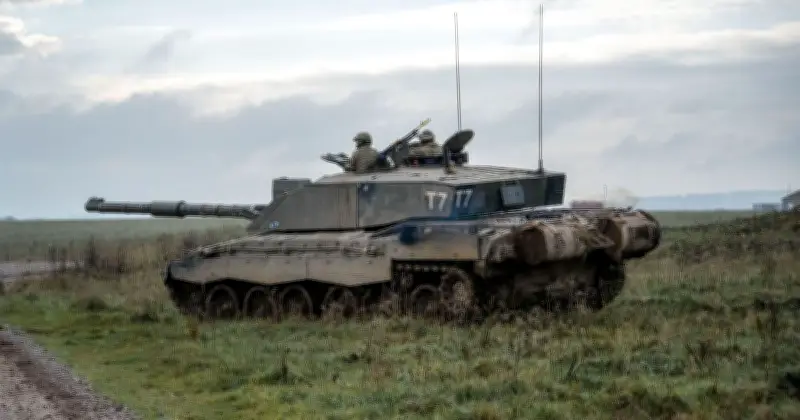
Britain's Challenger 2 has been ranked eighth in a list of the world's 10 most advanced battle tanks, behind rivals from Germany, the US, Russia and South Korea. The British Army's main battle tank is renowned for its heavy armour and battlefield survivability, but its ageing design faces competition from newer vehicles equipped with advanced sensors, digital networks and automated systems.
Ranking published by Warrior Maven
The ranking was published by defence website Warrior Maven and places Germany's KF51 Panther first, followed by America's M1A2 Abrams and Russia's T-14 Armata. It focuses heavily on emerging technology, including artificial intelligence (AI), automation and remote operation, rather than providing a definitive assessment of which tanks would prove deadliest in combat.
Top contenders detailed
Germany's KF51 Panther tops the ranking, with its design focused on advanced targeting, digital connectivity and future battlefield technology. Developed by defence giant Rheinmetall, the proposed tank features a 130mm main gun, larger than the 120mm weapons fitted to many Western battle tanks. Its design also incorporates technology intended to connect the tank with unmanned systems and loitering munitions.
Warrior Maven highlighted the Panther's ability to share information between sensors and weapons, potentially helping crews identify targets and respond more quickly. However, the KF51 is a development programme, not a tank with an established combat record. Its first-place position reflects its technological ambitions rather than proven superiority on the battlefield.
America's M1A2 Abrams combines heavy armour, a powerful 120mm smoothbore gun and advanced targeting systems. The tank has extensive combat experience, including in the Gulf War and Iraq, and has undergone successive upgrades to improve its electronics, protection and ability to engage targets. Warrior Maven focused on the M1A2 SEPv3 variant, highlighting its Ammunition Data Link technology, which allows compatible programmable ammunition to be configured for different functions before firing. The Abrams is also being developed within a wider network of battlefield sensors and unmanned systems. Its substantial weight and demanding logistical requirements, however, can complicate deployment and maintenance.
Russia's T-14 Armata stands out for its unmanned turret and protected crew compartment. Unlike conventional tanks, the T-14 places its three crew members inside an armoured capsule in the hull, with the turret operated remotely. The design is intended to improve crew protection while allowing a high degree of automation. Warrior Maven also highlighted the tank's potential for remote operation and its role as a self-contained digital battlefield platform. But the T-14's operational status and combat record remain major limitations. Its advanced design has attracted considerable attention, yet its capabilities have not been demonstrated on the scale of established tanks such as the Abrams or Challenger 2.
Other tanks in the list
South Korea's K2 Black Panther is an advanced operational tank featuring sophisticated suspension technology, a 120mm smoothbore gun and an automatic loading system. Its hydropneumatic suspension allows the vehicle to adjust its position to negotiate difficult terrain and alter its profile when engaging targets. Warrior Maven also highlighted its ability to cross water obstacles using specialised equipment, making it suited to challenging terrain. The K2 combines mobility with modern targeting and battlefield-management systems. South Korea has also secured export orders, underlining international interest in the platform.
China's Type 99, also known as the ZTZ-99, combines a 125mm smoothbore gun with composite armour and electronic systems designed to improve its effectiveness against modern threats. The tank can use conventional ammunition and, in compatible configurations, gun-launched anti-tank guided missiles. Warrior Maven also pointed to a reported laser-based defence system intended to interfere with the guidance systems of incoming weapons. However, reliable independent information about the Type 99's precise capabilities is limited. Claims about its speed, protection and electronic warfare systems should be treated cautiously, particularly when comparing it with Western tanks whose specifications are better documented.