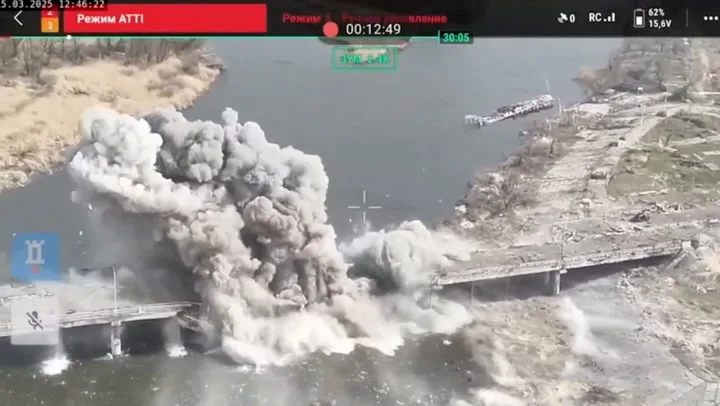
In a groundbreaking military operation, Ukrainian forces successfully deployed British-made drones to destroy a vital Russian-held bridge used for supplying troops in the occupied Kherson region. This mission, conducted in March of last year, is believed to represent the first-ever instance of a drone-led combat operation successfully eliminating a bridge structure.
Strategic Drone Campaign Against Konka River Crossing
The targeted crossing spanned the Konka River and became the focus of a sustained two-month campaign utilizing Malloy T-150 heavy-lift drones. Initially considered an impossible task by military planners, the persistent drone attacks eventually achieved devastating results. Two critical sections of the bridge were blown apart in massive explosions, sending debris crashing into the river below amid enormous clouds of thick, dark smoke.
This strategic destruction significantly degraded the Russian army's operational capacity under Vladimir Putin's command, particularly hindering their ability to strike the besieged Ukrainian city of Kherson located on the right bank of the Dnipro River.
Engineering Challenges and Tactical Innovation
Colonel Oleksii Bulakhov explained the tactical complexity to the Telegraph, noting that "bridges are relatively easy to destroy from underneath" but are "engineered in a way that makes them extremely robust from the outside." This inherent structural resilience made the drone operation particularly innovative and challenging.
The Malloy T-150 drones deployed in this historic mission are manufactured by Malloy Aeronautics, a subsidiary of the prominent British defence contractor BAE Systems. Remarkably, these drones were not originally designed as weapons systems. Their initial development focused on creating a "flying motorcycle" intended for practical applications like herding cattle across the vast Australian outback.
Critical Impact on Kherson Front Lines
The successful bridge destruction proved vital in preventing Russian forces from further pummeling the Ukrainian city of Kherson. Although the bridge had sustained damage earlier in the conflict and remained partially functional for military supply routes, the precision drone attacks rendered it completely unusable for Russian logistics.
The Konka River serves as a tributary to the larger Dnipro River, which has functioned as a de facto border separating Ukrainian and Russian-controlled territories within the Kherson region. The drone strike occurred near the occupied town of Oleshky and reportedly came as a "complete shock" to Russian occupying forces, who had not anticipated this novel form of aerial assault.
British Military Technology in Ukrainian Conflict
These drones represent just one example of British-made weaponry being utilized in the ongoing Russia-Ukraine conflict. The United Kingdom is currently developing powerful long-range ballistic missiles capable of destroying Russian targets at distances exceeding 300 miles. These Nightfall rockets, which carry 200kg warheads and can be fired in rapid succession with potential reach extending toward Moscow, could become valuable assets in President Volodymyr Zelensky's continued defense against Putin's forces.
British defence firms have been engaged by the UK Ministry of Defence to design, develop, and deliver the first three test missiles under a contract valued at approximately £9 million.
Russian Nuclear Drills and Escalating Tensions
In a concerning parallel development last month, Russia conducted nuclear drills featuring a terrifying intercontinental missile system. Eerie images released by the Russian defence ministry showed the massive missile being transported through snow-covered Siberian forests under cover of darkness, with its imposing launcher emerging ominously from the shadows during the military exercise.
During these drills, Russian crews practiced various operational activities involving camouflaged movements of Yars intercontinental ballistic missiles, which are capable of carrying nuclear warheads. The exercises included rehearsals for responding to simulated enemy attacks and repelling air strikes, though the Defence Ministry reported no actual missile launches occurred during these preparations.






