
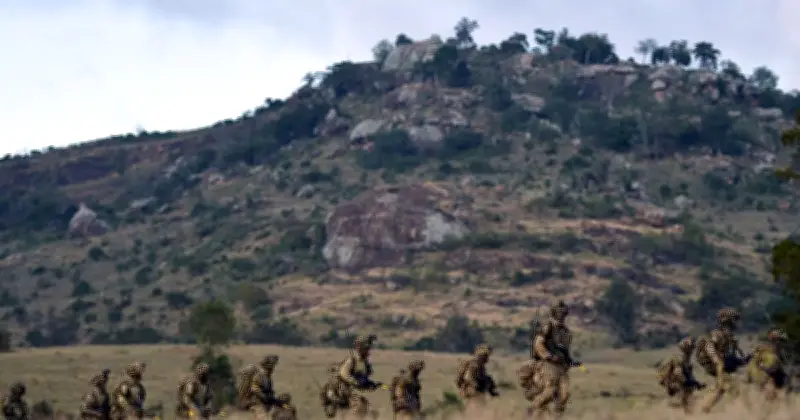
The British Army has been forced to cancel a major overseas deployment after the Kenyan Government refused to issue a license. 1st Battalion, the Duke of Lancaster’s Regiment (1 Lancs) had been set to deploy to the country in September, allowing them to test their soldiers in an arduous environment to prepare them for global operations.
Alternative deployment to Salisbury Plain
According to Forces News, a refusal by the Kenyan Government to grant the Ministry of Defence (MOD) a license to train in the country means the unit will instead deploy to Salisbury Plain. It comes as tensions between the two countries have become strained in recent years following the murder of a local woman, allegedly at the hands of a British soldier and uncertainty over the legal status of soldiers during deployments.
A MOD spokesperson said: "The UK highly values its relationship with Kenya, which is underpinned by mutual benefit, respect and cooperation."
“The UK-Kenya Defence Partnership is one of the great strengths of our relationship. Our joint training and operations with the Kenyan Defence Forces are keeping both Kenyan and British people safe.
"It is with regret that the necessary licences required to allow training to take place in Laikipia later this year have not been forthcoming. As a result, the planned training will now be conducted at an alternative location outside Kenya."
Background of tensions
Pressure has grown on the British Army to improve the behaviour of soldiers whilst deployed in Kenya, following the murder of a 21-year-old, Agnes Wanjiru from Nanyuki in 2012. Ms Wanjiru’s body was found in a septic tank close to a ranch attended by soldiers deployed in the country, sparking a long-standing pursuit of justice.
The Kenyan government is seeking the extradition of former British soldier Robert Purkiss in connection with the murder. Mr Purkiss denies all charges.
Ms Wanjiru was working as a sex worker at the time of her disappearance, a practice that has become common in towns surrounding military bases for centuries. Last year, her niece told the Daily Express how efforts to stop the use of sex workers by soldiers had failed and that the practice was ongoing.
Esther Njoki said: "It is still happening for sure, I have observed it.
“The only thing they have done is change the way they are soliciting sex, nowadays they have a group of girls and then they are taken to a B&B, they have mobile apps, so nothing has changed."
Speaking at the time, Ms Njoki called on the government to stop allowing the British to train in the country, labelling it a lingering consequence of colonialism.
Economic impact and future cooperation
British Army Training Unit Kenya (BATUK), headquartered in Nanyuki, facilitates military exercises for up to 10,000 British soldiers annually, making Kenya one of the UK's most important overseas training destinations because of its vast training grounds and terrain that closely resembles operational environments. Established shortly after Kenya gained independence in 1964, BATUK has become a central part of defence cooperation between Britain and Kenya.
Alongside training British personnel, the unit conducts joint exercises with the Kenya Defence Forces, delivers engineering and medical programmes, and supports local economies in Laikipia and nearby counties through jobs, procurement and spending on accommodation and hospitality. The presence of soldiers has a significant economic benefit on the town and country as a whole, injecting an estimated £58 million annually into Kenya’s economy.
A MOD spokesperson added: "We recognise the disappointment this decision will cause for those who would have benefited from the economic activity generated by the exercise. All UK training activity in Kenya is dependent on permission from the Government of Kenya.
"We remain committed to our defence partnership with Kenya and the continued British Army Training Unit presence in the country. We will continue to engage closely with the Kenyan Government to support the resumption of training in-country at the earliest appropriate opportunity."




