
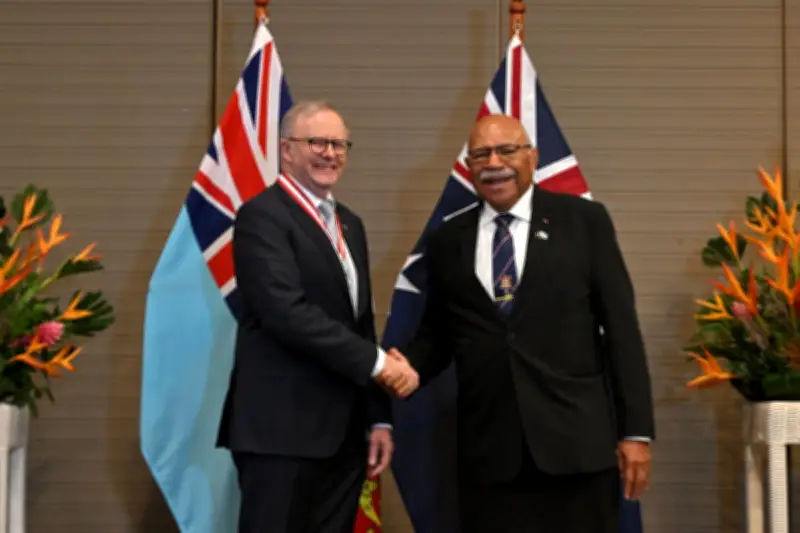
Australia and Fiji have signed a major new defence alliance, further advancing the federal government’s strategy to limit China’s influence across the Pacific region. In a surprise move, Prime Minister Anthony Albanese and his Fijian counterpart Sitiveni Rabuka elevated Australia’s ties with Fiji to a formal treaty alliance.
Ocean of Peace Alliance
On Monday in Suva, Albanese and Rabuka signed the Ocean of Peace Alliance, which is open to other Pacific countries to join in the future, paving the way for participation by New Zealand, Papua New Guinea, and Tonga. The alliance says the nations will 'act to meet the common danger' in the event either country is attacked.
After 75 years of Australia only having formal alliances with the US and New Zealand, the Albanese government has now added two new agreements in less than 12 months, following a deal signed with Papua New Guinea in October.
Vuvale Union Agreement
Albanese said the alliance deal and the newly signed Vuvale Union agreement will transform Australia and Fiji’s relationship and underpin regional prosperity and security. The Vuvale deal could also expand visa access for Fijians seeking to come to Australia.
'The signing of these two agreements represents one of the most significant endeavours Australia has undertaken with any country,' Albanese said. 'When it comes to security issues the Pacific family need to look after our own security. The significance of these agreements cannot be underestimated.'
Security Provisions
The language of the agreement says Australia and Fiji will 'act to meet the common danger' in the event either country is attacked. It recognises that an armed attack on either 'would be dangerous to each other’s peace and security as well as the security of the Pacific'. Consultation provisions would see any security-related developments that might threaten sovereignty, peace or stability in either country discussed with the other.
Since coming to power in 2022, Labor has worked to push back on China’s influence building across the Pacific, including through a growing list of treaty agreements. Recent deals include the Nakamal agreement with Vanuatu and the Falepili Union treaty with Tuvalu. These agreements lock in Australia as the security partner of choice for Pacific countries.
China's Reaction
China signed a secretive security deal with Solomon Islands in 2022, prompting fears from Canberra and other regional capitals that Beijing could achieve a permanent military presence in a Pacific country. Speaking alongside Albanese, Rabuka said he did not expect any severe diplomatic pushback from Beijing as a result of the new agreements. 'I believe that they will welcome the understanding that it is within Australia and Fiji,' he said. 'It does not threaten Fiji’s relationship with China, nor Australia’s relationship with China, and as we have made it very clear in the past, your enemies are not necessarily my enemies.'
Climate Change and Regional Cooperation
The Vuvale Union text explicitly acknowledges that the two countries 'face emerging and multidimensional threats, with climate change as the single greatest threat to the livelihoods, security and wellbeing of Pacific peoples'. Australia and Fiji have agreed to 'mutually advocate for ambitious and meaningful action on climate change in support of Pacific goals endorsed by the Pacific Islands Forum'.
Albanese sipped Fiji’s traditional kava drink at a ceremony hosted by Rabuka. He was made a Companion of the Order of Fiji, one of the country’s highest honours. After leaving Fiji, Albanese is expected to visit Solomon Islands, and then host a group of Pacific leaders in Brisbane later this week.




