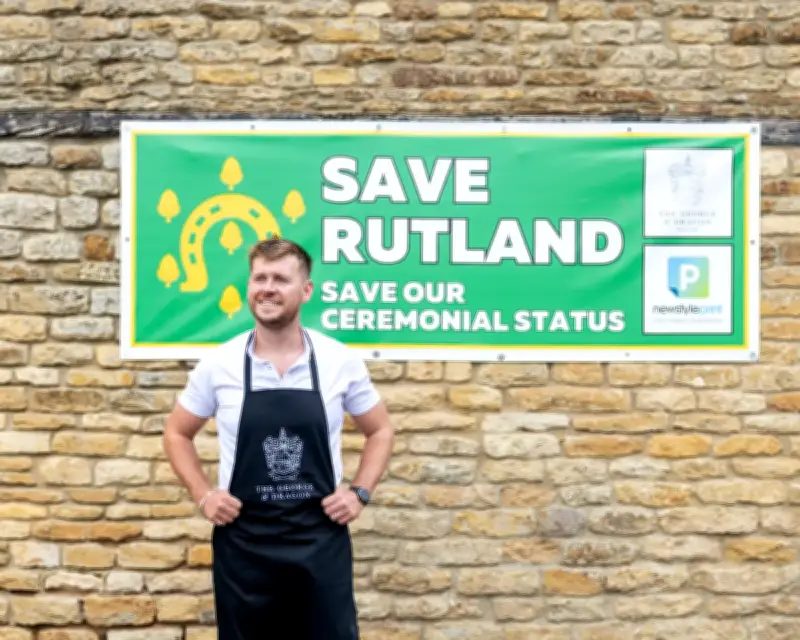
Rutland, often considered England's smallest county, is facing an identity crisis as its council is due to merge with Leicestershire county council in spring 2028. The changes are part of government plans to create 15 new councils across England, replacing smaller district and county councils with larger, single unitary authorities. The new authorities will have a population of about 500,000 people, while Rutland's estimated population is just over 41,000.
In recent months, road signs welcoming drivers into Rutland have been going missing. After 10 signs vanished, the council removed the remaining 17, leaving no official "Rutland" signs at all. The area's MP, Conservative Alicia Kearns, is "not sure" what the motivation behind the thefts is, but they serve as a fitting metaphor for Rutland's disappearing status.
Campaign to Save Rutland
According to a statement on Kearns's website, the merger marks nothing short of "having our identity stripped from us." This has sparked a campaign to Save Rutland, with a petition presented to parliament earlier in the year signed in person by 7,141 people.

Rutland is known for its community spirit, safety, and beauty, with thatched cottages, fields of sheep, and town centres lined with bunting. "The joke goes: 'Rutland is England 50 years ago,'" says Kearns, meeting at Rutland Water, the UK's largest reservoir by surface area. She highlights the county's farming community, its tradition of Friday shoots that supply local pubs with game, and its pride in local businesses. "We were the last county to have a McDonald's built," she says, noting that even when it arrived in 2020, the decision "was really controversial."
Historic and Ceremonial Status
The question of whether Rutland is or will remain the smallest county is complicated. There are 39 historic counties in England, of which Rutland is the smallest at 382 sq km (147 sq miles), and this will not change after any local government changes. Rutland was absorbed into Leicestershire as a local district once before, in 1974, before regaining its independent status in 1997 after a government survey found that about 80% of respondents had a strong sense of belonging to Rutland.
Separately, there are 48 ceremonial counties, each with a lord lieutenant. On that list, Rutland is not the smallest – it comes fourth, after the City of London, Bristol, and the Isle of Wight. This ceremonial status is what the Save Rutland campaign is fighting to keep, and it is not protected by legislation. Because Rutland is the only existing ceremonial county due to be wholly absorbed into a new local government area, it is uniquely affected.
Impact and Opinions
According to Joshua Malone, director of public affairs at the Historic Counties Institute, the main issue is "the visibility and official recognition of Rutland" that may diminish after merging. "Its name may become less prominent in civic life, signage, public information and administration." If it is no longer a ceremonial county, Rutland would cease to be considered a "lieutenancy area," losing its official representatives of the sovereign: the lord lieutenant and the high sheriff.
Kearns has twice attempted to get Rutland's ceremonial county status enshrined in legislation, but her amendments were rejected by the government. She does not believe the government has "gone out to try to screw us over," but thinks ministers "genuinely didn't realise" the changes would affect Rutland's ceremonial status. A spokesperson from the Ministry of Housing, Communities and Local Government told the Guardian that it would "protect Rutland's strong sense of community and heritage and ensure its unique identity endures through any reorganisation, including protecting its ceremonial status."

Ramsay Ross, leader of Rutland county council's Labour group, says there is also poverty in the county, "most evident in the constituency that I am in, and precious little has been done about it because we're seen as being a wealthy county." The council merger "will allow us to access more economic development funds," he says, and will hopefully mean more affordable housing can be built. Ross has little time for the Save Rutland campaign. "I can't see ceremonial status as the be-all and end-all," he says. "The lord lieutenant and the high sheriff do provide support to local charitable bodies. There's no question about that … But it's not something that I would die in a ditch over."
David Coop, a customer at the George & Dragon pub, agrees. "I honestly think it's pretty pointless," the 55-year-old managing director says. He decided against signing the petition because he wasn't entirely sure what "saving the ceremonial status of the county" means. Rutlanders will "still have a sense of pride" in where they live regardless, he says. His friend, Colin Lowther, 75, a retired academic, disagrees. He was "happy to support" the petition because "people have historical roots here," he says – such as the local blogger Charlie Pallett, 31, who helped start the Save Rutland campaign after being inspired by her late grandmother, who protested against Rutland's merger with Leicestershire the first time around. "Now she's no longer with us I feel as if she's shouting down at me, saying: 'You'd better fight for it, because we lost it once before, so we don't want to lose it again.' I feel like that's really important."
Whether or not there's an element of snobbery or nimbyness to the argument in favour of ceremonial county status, there's something very touching about meeting people who love where they live. As Coop reminds, a sense of local identity does not come from "what somebody else decides, what it's called or how big it is" – or even whether there are road signs announcing it. "It's what you make it."