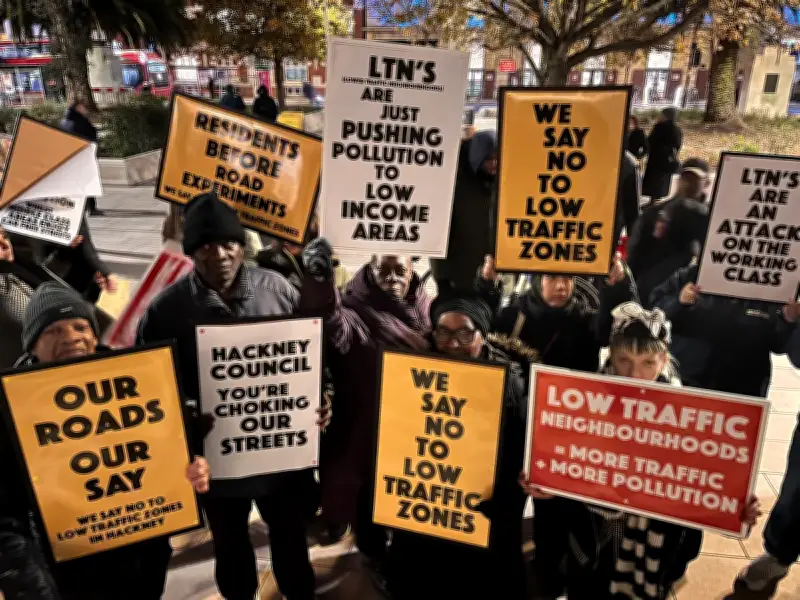
Scores of residents gathered outside Hackney Town Hall on Wednesday (November 25) to protest against a new “Liveable Neighbourhood” in Dalston, which the council has proposed to cut “dangerous” traffic in the district. The Green council’s cabinet lead for transport, Jacob Cable, faced a grilling from demonstrators over the council’s many Low Traffic Neighbourhood (LTN) schemes, which cover roughly half of the borough by area.
Opponents came wielding placards, claiming traffic controls were an “attack on the working class” because they have pushed car pollution to low-income areas. Those present included resident ShaToya Rose, who had fronted a January protest against LTNs over delays to car and bus journeys, displaced traffic and “daily disruption to work and family life”.
Residents say they feel unheard
Speaking to the Local Democracy Reporting Service (LDRS), Ms Rose said she “still felt unheard” almost a year later. “Residents who are unhappy with the impact deserve to be listened to too. Decisions shouldn’t feel like they’re being made for one side, while everyone else is left asking why their concerns don’t count,” she said.
The protest came ahead of a full council meeting where politicians faced further questions over the proposed Dalston scheme, which was technically approved by officials in February 2026 but went out to a final 21-day consultation this month.
Resident Peter Cox quizzed Cllr Cable on when the scheme was due to be enacted and asked the council if it would publish a delivery timeline and a report of objections. Ruth Parkinson, meanwhile, said residents on Dalston Lane, a “boundary road” sitting just outside the zone’s borders, “did not receive any information” about the scheme. She added that this particular road was expected to be badly affected by more restrictions with traffic displaced outside the target area.
Councillor defends consultation efforts
Both residents and businesses have argued the proposed traffic measures would make their neighbourhoods less safe for children and hit local traders’ livelihoods. Many have criticised the council’s engagement process, and local councillors recently raised concerns with officers internally about whether information about the scheme on the council website was properly accessible.
Cllr Cable replied that he welcomed “really constructive criticism” on what had been “quite a turbulent project”. He added that locals needed “a better understanding of what’s happening and when,” but blamed the former Labour administration for residents’ confusion.
“If I’m frank, this was an officer-led borough that was filling gaps left by politicians,” he said, adding that since the Greens took office in May 2026, he had discovered “quite significant gaps in comms structures”.
Cable defended the “extremely hard work” of Streetscene, the council team managing the borough’s roads and pavements, and cited the 9,000 booklets “hand-delivered” across the scheme area and the council’s social media messaging and drop-in sessions. But he added that boundary roads and busy corridors “can feel missed”. The new administration, he said, “can do much more” beyond the council’s formal channels to raise awareness and direct residents to information about road changes.
Political clash and next steps
Following the meeting, Labour group leader, Cllr Anntoinette Bramble, called Cable’s assertion an “extraordinary attempt to rewrite history”. She told the LDRS: “The election is over. The Greens sought responsibility for running Hackney and they now need to take responsibility for the decisions they make – not blame others.”
Over 1,130 people responded to the council’s earlier consultation on the scheme, held in summer 2025. The recent 21-day statutory consultation had seen “very high engagement”, Cllr Cable added. Amid a grilling by protesters on the Town Hall steps ahead of the meeting, the cabinet member had asked residents if they thought “ripping out all the LTNs” in the borough would solve traffic problems in Hackney.
He was confronted again in the chamber by another resident, Clair Battaglino, who had submitted a public question about diverted traffic congestion impacting air quality outside low-traffic zones, which she said was affecting social housing residents with “asthma and other underlying health conditions”. Though the Speaker called time on public questions before Ms Battaglino had the chance to formally put her questions to the chamber, she discussed the matter with Cllr Cable directly during the half-time break.
Due to the “sheer number of correspondents” who gave feedback during the final statutory consultation, an objection report on the Dalston scheme is due to come before the cabinet by February at the latest, said Cllr Cable. The Liveable Neighbourhood was first proposed in January 2023.