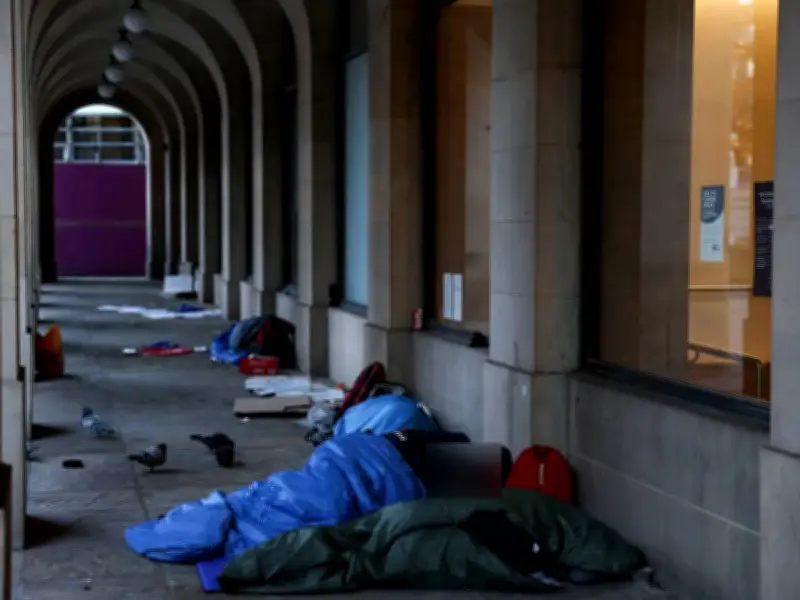
More than 9,000 children in Greater Manchester were living in temporary housing in December 2025, according to a Greater Manchester Combined Authority (GMCA) report, as political leaders grapple with a growing homelessness crisis.
The figures, recorded in December 2025, showed 9,105 children in temporary accommodation, up from 3,857 in June 2019. The overall number of households in emergency accommodation across the region also rose sharply, from 2,965 to 6,082.
Rough sleeping on the rise
Many of these families are staying in bed and breakfast-style accommodation (B&Bs). The number of households in B&Bs in Greater Manchester was recorded at 567 in December 2025, up from 383 in 2019.
Rough sleeping has also increased over the last six years, according to the GMCA report. The region-wide single night count rose from 115 in September 2020 to 155 in September 2026. Monthly totals of rough sleepers climbed from 202 in September 2020 to 444 this year.
When temperatures in Manchester dropped below freezing last week, the Manchester Evening News spoke to people who had spent the night on the street. One of them, 52-year-old Mark James, said: “It could be worse.”
Charities warn of unsuitable conditions
The situation has alarmed housing and homelessness charities such as Shelter, which has warned that some families facing homelessness may be suffering in unsuitable living conditions.
Alicia Walker, assistant director of policy and research at Shelter, said: “Sky-high private rents coupled with the freeze on housing benefit and a severe shortage of social homes, are pushing thousands of families into homelessness in Greater Manchester.”
Ms Walker added: “Every day our services hear from families who’ve had to spend weeks, months and in some cases years in appalling temporary accommodation while trying to access a secure home. They may be living in a single room without proper cooking facilities, or a bedsit that’s not only cold and full of damp but miles away from their children’s school and where they work.”
Council response and funding
The Bed Every Night scheme, set up by Prime Minister Andy Burnham during his time as mayor, has been in place since 2018. It currently offers more than 600 bed spaces for people experiencing rough sleeping in the region.
Manchester has also recently been given nearly £850,000 to help people rough sleeping find a place to stay by Christmas, as part of a pledge by the Prime Minister to end rough sleeping.
Greater Manchester Mayor Bev Craig said more needs to be done. In an interview reflecting on her first 100 days in office, she said: “I've come in though, and make no mistake, I don't think the status quo is good enough. I don't think that enough has been done to make sure that everyone on our streets has not just an offer of accommodation, but a suitable offer that doesn't just give them a roof, but gives them a home.”
The Mayor added: “I estimated that in the summer, we probably needed around about 300 new bed spaces to be able to make a proper offer to everyone across Greater Manchester. I think with government funding, we've now found how we're going to get those extra 200, and the plan that I'm working on in the coming weeks is where I'm going to get the extra hundred from.”
System change and housing plans
The GMCA report on homelessness set out the need for a ‘system change’ in how the region tackles the issue. It included a call for a ‘radical’ overhaul of the current approach, adding: “We’ll develop plans to properly solve the housing crisis in GM and make the case to government, while doing what we can within the current system.”
The plan involves a ‘refresh’ of Greater Manchester’s homelessness prevention strategy in 2027, with an outcome to ‘reset the regional Greater Manchester ambition and strategic approach to homelessness prevention’ and ‘to have set measurable and achievable outcomes that can be delivered’. The GMCA said there needs to be ‘more intensive support for people who have experience of rough sleeping and multiple disadvantage’.
In 2024, Greater Manchester was thought to have spent around £75m on temporary housing across the region. Data at the time showed there were 5,000 households living in temporary homes, and more than 7,000 children. Salford mayor Paul Dennett, who leads Greater Manchester’s housing plans, said at the time that the rising costs of temporary housing was becoming an ‘existential threat’ for the region’s town halls.
Mayor Bev Craig said a range of work is taking place to turn the situation around, including through building more homes. She said: “Too many families and children are being forced to live in temporary accommodation, often for far longer than they should. As Mayor, I’m determined to change that. That’s why I’ve committed to ensuring 10,000 council, social and genuinely affordable homes are built or in the pipeline by May 2028, and 50,000 are built across the city region by 2039, so more people can put down roots, build stable lives and have a place they can truly call home. Right now we are also boosting our empty homes programme to enable councils across the city region to rapidly make empty properties available for those who need it.”
The GMCA report showed that social housing completions are continuing to be outpaced by total sales through the right to buy scheme, combined with social housing demolitions.
Shelter said rising rent prices are partly to blame. According to government data, private rents in Manchester increased to an average of £1,380 in September 2026, an annual increase of 4.6 per cent from £1,319 in September 2025. In Salford, average private rent prices hit £1,173 in September.
Alicia Walker said: “To address record levels of homelessness across the country and end the housing emergency, we need social rent homes to be built quickly and in the right places.”