

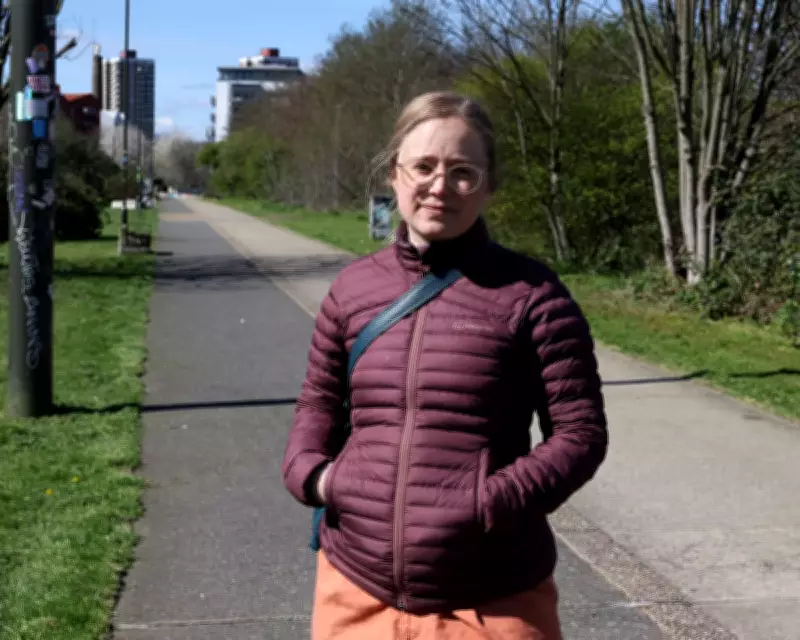
New English Council Guidance Prioritises Women's Safety in Public Spaces
Official guidance for English councils, produced by Active Travel England in collaboration with the national charity Living Streets, has placed women's safety while walking and exercising in public spaces at the forefront of urban planning. The comprehensive guidelines focus on practical measures such as improved lighting, enhanced CCTV coverage, and intentional design to foster environments where women and girls feel confident and secure.
Personal Experience Drives Campaign for Safer Streets
Reetta Vaahtoranta, a software developer from Newham, east London, began campaigning with Living Streets after experiencing persistent harassment while jogging along the Greenway, a four-mile pathway. She described altering her running attire to baggier clothing in an attempt to deter unwanted attention from lone male passersby. "The less attractive and weirder you look, the less likely you are to get people following you," Vaahtoranta explained.
Ultimately, she made the difficult decision to avoid the area after dark. "If I know it can be a bit dodgy, then I just stop doing it. Which is a shame because in the centre of the borough there aren't that many green spaces," she lamented. Her experience is far from isolated and has galvanised her advocacy for safer public environments in her home borough.

Intentional Design as a Model for Safety
Vaahtoranta contrasts the dimly lit, isolated Greenway with the neighbouring Queen Elizabeth Olympic Park in Stratford, which was intentionally designed with safety and mixed use in mind. The park, built on brownfield land for the 2012 Olympic Games, features wide avenues that are consistently populated throughout the day and night by parents with prams, schoolchildren, friends socialising, joggers, and cyclists.
"It's just really mixed use," Vaahtoranta noted. "So it has a lot of reasons for people to come there and it means that it's always used. You need quite a density of people to feel that if something happened to you, someone would step in and help. It's really well lit as well. So I don't have a problem walking through it to get to the train station at night."
Key Measures and International Inspiration
The new guidance from Active Travel England is expected to include several critical measures:
- Enhanced lighting to improve visibility and deter potential harassment.
- Increased CCTV coverage to provide passive surveillance and a sense of security.
- Replacement of dark underpasses with street-level crossings to eliminate isolated areas.
- Well-connected walking routes and the strategic placement of benches to encourage foot traffic.
Councils will be able to bid for public funding to implement these improvements. The approach draws inspiration from international schemes, such as those in Spain and Sweden where women can request bus drivers to drop them between stops at night for added safety. It also builds on pioneering national initiatives like Liverpool's "halo points"—well-lit, highly visible devices directly linked to emergency services and CCTV.
Consultation and Community Needs
Tanya Braun, Director of External Affairs at Living Streets, emphasised the importance of consulting women and girls during the planning stages of public spaces. "We know that lighting's really important in terms of women and girls feeling safe getting out and about, passive surveillance. There being lots of people on the streets and things like benches, well-connected walking routes and CCTV has been cited as something that's quite important as well. Just that feeling of someone's watching you," she stated.
Braun highlighted a growing recognition that more must be done to incorporate lived experiences into urban design. "A lot of our towns and cities have been built without consultation with certain groups of lived experience. That really needs to happen, because without consultation how is a designer supposed to know what that local community needs?" she questioned.
The guidance aims to address fundamental issues of fairness while simultaneously boosting physical activity levels by creating safer, more inviting public spaces for everyone.






