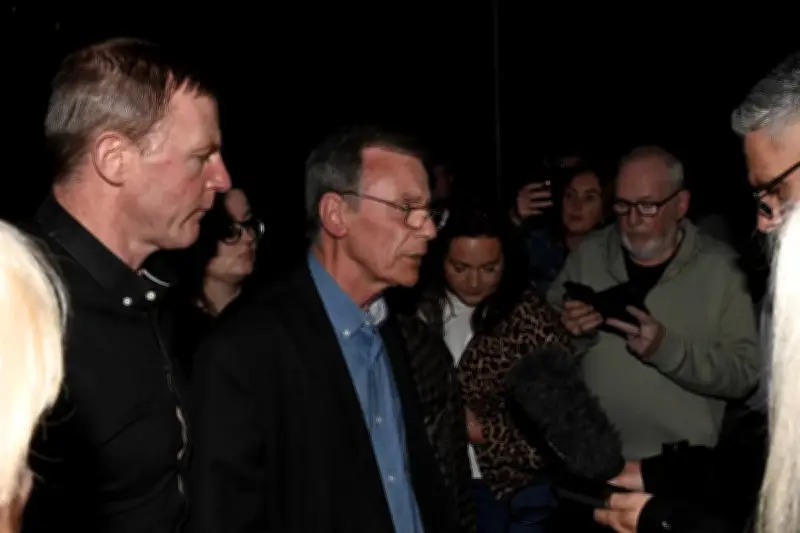
Crowds braved heavy rain in Portadown on Sunday morning as they gathered at the scene of the contentious Drumcree parade.
A ruling by the Parades Commission permitting the Orange Order to march on Garvaghy Road was upheld in an “unprecedented” late night sitting of the High Court in Belfast just a few hours earlier.
The crowds, many of them wearing balaclavas, clustered in large groups along Garvaghy Road in the hours leading up to the scheduled start of the parade at 8am.
Late-night court ruling
The march was finally given the go ahead at a hearing which concluded at 2.15am on Sunday after legal teams repeated their arguments over the contentious parade, which was a notorious flashpoint of the Troubles in the 90s.
The time-limited sitting beginning at 12.20am on Sunday was heard before Justice Michael Humphreys. He acknowledged the “unusual if not unprecedented circumstances as it is now 1.45am, with a parade scheduled to begin in just over six hours’ time”.
Outlining his decision, Mr Justice Humphreys cited case law that as a public body the courts must respect its judgment and “their decisions will not be lightly interfered with”.
He said: “The picture painted here is of a public body which took evidence from the relevant sources, weighed up the key issues which were in play and arrived at a reasoned decision.
“The jurisdiction to impugn (a) public body’s decision on that basis is necessarily limited to cases where no reasonable decision could arrive at that outcome and in my view, in this case that threshold has not been met.”
He added: “This court cannot substitute its own view or anyone else’s view for that of the commission.”
Appeal history
Northern Ireland’s most senior judge, Lady Chief Justice Siobhan Keegan, described the situation as “unprecedented”. Justices Keegan and Humphreys joined Lady Justice Denise McBride in the Court of Appeal which, in the late hours of Saturday, upheld an appeal by Portadown Orangeman Alan Hynes to allow the march to go ahead.
The stand-off at Drumcree made headlines in the 1990s, with nationalist residents of the Garvaghy Road opposed to the parade passing through the area, leading to violent clashes for several summers and political tension necessitating a major security operation.
The Orange Order has unsuccessfully applied for more than a quarter of a century to complete its 1998 walk along its traditional route. On Friday, the commission reversed its long-running determination, to the welcome of unionist parties and outrage of nationalist and republican parties.
On Saturday afternoon, Justice Patricia Smyth blocked the commission’s decision, saying the “long-running dispute has the potential to escalate” across Northern Ireland.
Legal arguments
Under the legal framework around parades in Northern Ireland, if the court simply passed an injunction against the Parades Commission ruling in relation to Drumcree, it would allow the Portadown District to carry out the parade without the restrictions outlined by the commission, because it was legally notified.
Justice Smyth passed an injunction pausing the effect of the Orange Order’s notification of the parade, which counsel for the Garvaghy residents had described as “novel” and John Larkin KC, representing Mr Hynes, as “rewriting history”. The Orange Order then lodged an appeal, which was upheld, before the case was remitted to the High Court and heard again before a new judge.
Barrister Denise Kiley KC represented the residents of the largely nationalist Garvaghy Road, outlining their position that much remained unclear about the Police Service of Northern Ireland (PSNI)’s threat assessment provided to the Parades Commission. She said “nowhere” in the PSNI’s contribution to the commission was there “any assessment of future risk” and was “entirely directed to past risk”.
Emma McIlveen, junior counsel for Mr Hynes, argued the Orange Order “has gone to great lengths to engage on the ground in the community”. Ms McIlveen also said it is an issue of the protection of minority rights, describing it as a “hecklers’ veto situation” where “those that scream the loudest get what they want”.
Ms Kiley argued the imposition of the injunction “does not mean that this parade cannot proceed, it means it cannot proceed tomorrow”.
She added: “The only way to preserve the position for this applicant and to preserve the supervisory position of this court was to grant interim relief and it was granted as a last resort.”
Tony McGleenan KC, representing the Parades Commission, said the court’s move to “deem a notified parade unnotified” was “entirely unprincipled”.
“It’s not who threatens the most, it’s that there’s an assumption in favour of legal assembly,” he said. “We cannot have every Parade Commission determination brought back into this court every week, that’s not how it is supposed to work.”
Justice Keegan earlier said “there is a major problem that the decision in this case was given after 2pm on a Friday afternoon. This cannot happen again.”