

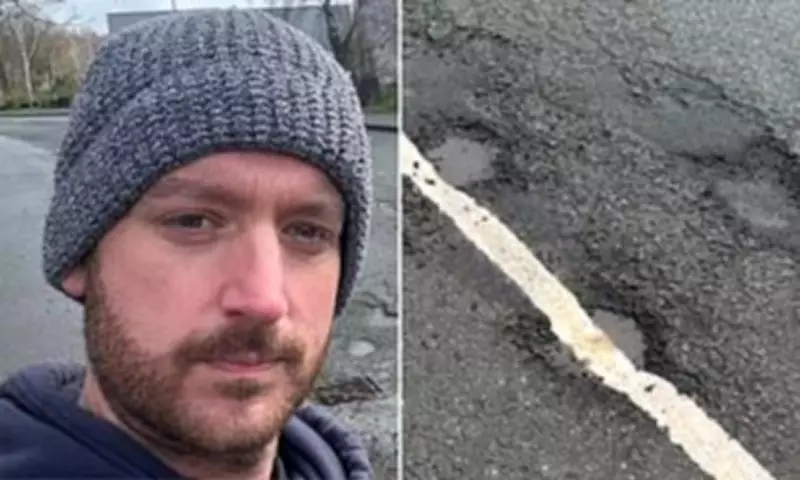
Council Paints Over Potholes Instead of Repairing Crumbling Roads
Bewildered motorists in Mold, North Wales, are questioning the logic of their cash-strapped local authority after maintenance crews painted fresh road markings directly over deep potholes rather than repairing the crumbling surfaces beneath them. The incident has sparked outrage among drivers who face daily damage to their vehicles from the deteriorating highway network.
Frustrated Drivers Voice Disbelief
Local motorist Jamie Lee Collins, 37, expressed sheer disbelief that council teams opted for what he called a 'fresh lick of paint' over urgent structural repairs. The daily commuter revealed he has been forced to memorize the exact location of every crater to prevent his car from being damaged.
'I just try to avoid them but you shouldn't have to because it's dangerous,' Collins said. 'If you don't, you'll break your car.'

Collins disclosed that he was forced to replace the shock absorbers on both his and his partner's vehicles following extensive pothole damage. He noted that he was only 'lucky' to be 'handy with mechanics,' which spared them from a significantly higher repair bill.
'People are struggling for money and then have to take their car to the garage,' Collins added. 'I've spent hours doing repairs myself so I only have to pay for the parts. I feel sorry for people who are struggling and have to pay for repairs.'
Council Defends Decision Citing Limited Budget
Flintshire County Council defended the controversial decision by stating that their limited pothole budget is being directed 'where it is needed most.' Katie Wilby, the council's chief officer for street scene and transportation, explained their approach.
'Routine safety inspections take place on all adopted roads in the county,' Wilby said. 'During these inspections officers will determine whether any defects meet our intervention criteria. This includes the condition of road markings, and repainting faded markings is important for safety.'
'The county council has a limited budget for resurfacing, and conditions surveys are used to allow for resources to be directed to the roads in the worst condition. We do not have the resources required to resurface all roads prior to line remarking when re-lining works are needed.'
Compensation Claims and National Context
According to monitoring data, the Labour-run council paid 50 percent (82 out of 164) of compensation claims from drivers for pothole damage. This comes as town halls across England and Wales face losing record sums for fixing roads under tough new rules being drawn up by ministers aimed at ending what they call the 'pothole plague.'
The 'carrot and stick' strategy will see ministers withhold a quarter of the cash earmarked for councils unless they share more performance data with the Government on repairs. Ministers will also block councils from spending money earmarked for road maintenance on other priorities to ensure funding for pothole-filling reaches the pock-marked frontline.
While the strategy has been used before, only one council lost their cash last year under more lenient rules. Ministers are now planning to strengthen them and withhold funds from any council given a 'red' performance rating, with nearly a dozen currently in this category. The tougher rules should be in place as early as next month, according to Government sources.
Legal Action and National Road Crisis
Earlier this month, it was reported that a frustrated motorist forced a council to fix three pothole-ridden roads after taking them to court using little-known legislation. Derek Bennett, 68, took action after becoming fed up with the dire condition of streets in his home village of Berkhamsted in Hertfordshire and nearby Hemel Hempstead.
He filed a notice under section 56 of the Highways Act 1980, which states that highway authorities must maintain roads at public expense. After the county council failed to respond to the applications in the 'proper manner,' the matter came before St Albans Crown Court, where Judge Andrew Johnson ordered the work to be completed within 20 working days.
Mr Bennett, who described the state of Britain's roads as a 'national disgrace,' told reporters: 'I'm doing this as a public service but I can't cover my own area, let alone the rest of the country.'

Government Funding and Alarming Statistics
The Government has committed a record £7.3 billion towards pothole spending between next month and the end of the decade. A report last week said the government's 17 percent spending boost for this financial year (2025/26) had 'marginally' improved the condition of local roads after years of what experts call 'dramatic underspending.'
But the annual Asphalt Industry Alliance (AIA) study also found the repair bill to fix Britain's pock-marked local roads has jumped to £18.6 billion – up from £17 billion last year. Alarmingly, local roads are now being resurfaced on average every 97 years, up from 93 years previously.
Almost half of local roads (49 percent) in England and Wales are set to crumble and become unusable within 15 years, while one in six will do so within the next five years, the report added. Figures from the RAC estimate a typical repair bill for pothole damage worse than a puncture is £590 for a family car.





