

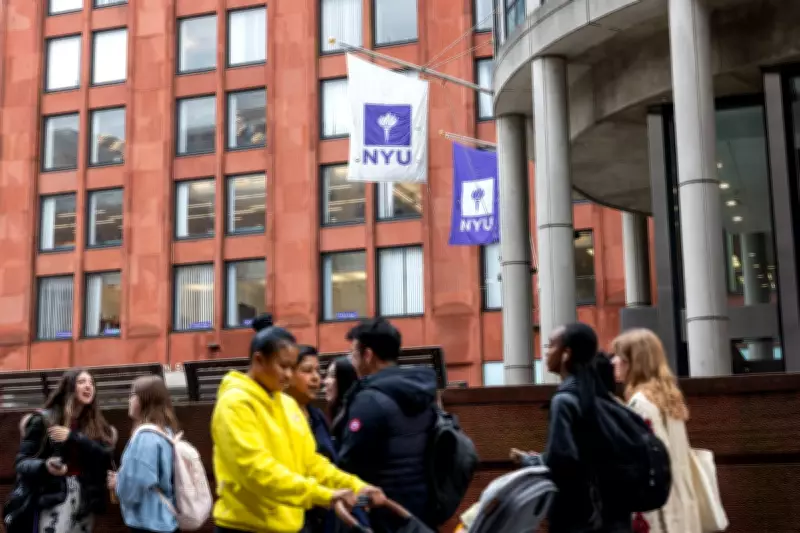
College students struggling to make friends are turning to a pre-millennium trick to get better at socializing: They are putting away their cellphones. In an era where students spend most of their waking hours staring at screens, colleges are seeking ways to help students ease isolation and form meaningful social connections.
NYU Leads the Way with IRL Initiatives
Leaders at New York University launched NYU IRL, or NYU “in real life,” aiming to foster a culture shift toward more real-world engagement. Over 200 NYU students recently gathered for the “Around the Longest Table” dinner, which spanned nearly an entire city block, allowing students and staff to converse with strangers, as reported by The Washington Post.
“If you’re someone who went to college 20 years ago, I don’t think you understand how different the experience is now, how much harder it is to interact with people,” NYU junior Grant Callahan told the Post. Growing up immersed in modern technology and hitting key milestones during the coronavirus pandemic has left many young people “socially illiterate,” Callahan explained.

Expanding Offline Opportunities
The offline initiative has been implemented at NYU’s campuses in New York, Shanghai, and Abu Dhabi, and the university plans to incorporate the idea of using devices more sparingly into student orientations. Students have embraced the concept, with many attending phone-free parties and other IRL events. “The best connections I’ve made with people have been face-to-face,” senior Berivan Ibrahim told the Post, noting she made her best friend when the WiFi went down freshman year.
NYU’s president, Linda G. Mills, whose background is in social work and mental health, told the newspaper she believes students are missing “spontaneity, and the opportunity of the collisions that happen in college that are so fundamental, whether you’re going to meet your life partner or you’re going to change your mind about something.” The university has also created an area called the Nest, where students dock their phones in a charging tower and engage in analog hobbies like crafts or reading. At the “Around the Longest Table” dinner, the only time guests took out their phones was to exchange contact information with new friends.
Other Universities Follow Suit
NYU is not alone in implementing IRL programs. At Yale, there is an “Offline Oasis,” a room filled with sunlight and plants where students can socialize without screens. The University of Alabama offers “Tech Free Thursdays” at its student center. The University of California at Berkeley has a class on limiting technology use and a Project Reboot club that hosts phone-free events.
Broader Context: Screen Time and Social Media Impact
The renewed focus on in-person socialization comes as a 2024 report from the National Center for Health Statistics shows that half of teenagers spend four hours or more per night looking at screens for non-homework activities. Teenagers are becoming more aware of the negative impacts of excessive screen time. Nearly half of teens surveyed by the Pew Research Center last year said social media platforms have a mostly negative impact on people their age.
For younger students outside of college, there has been an increase in banning cellphone use in schools. New research examining over 40,000 U.S. schools from 2019 to 2026 found that while locking phones in pouches helped reduce phone time, test scores did not improve, and there was “little evidence” of benefits for online bullying, attendance, or attention in class.






