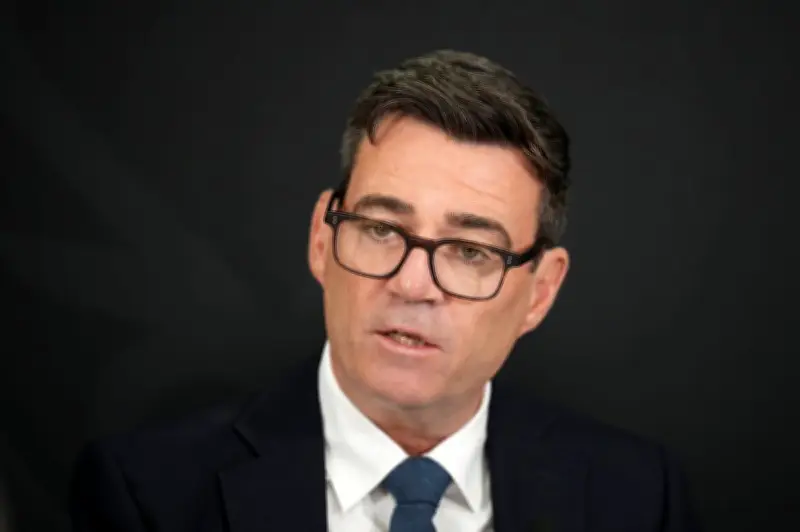
Prime Minister Andy Burnham will hold a cross-party meeting to discuss tackling the crisis in adult social care, as he pledged to “put everything I’ve got” into fixing the system. Both the Conservatives and the Liberal Democrats accepted the Prime Minister’s invitation “to build that spirit of collaboration from the start”, however, Nigel Farage hit out at Mr Burnham for ignoring Reform UK.
Mr Burnham said governments have, for decades, failed to tackle reform of social care in England, seeing it as “too risky, too difficult, and too complicated”.
Political responses
Tory leader Kemi Badenoch has already written to Mr Burnham to challenge him to rule out tax rises or increased borrowing to pay for social care reform. She is unable to attend the meeting, a Tory spokesman said, however, shadow health secretary Stuart Andrew will go in her place. A party source criticised the short notice invite, suggesting: “It’s almost like it’s only being done for show.”

Mr Andrew said his party is “ready to work with Labour on measures that improve social care provided they are not reliant on yet more tax rises and borrowing”.
Lib Dem leader Sir Ed Davey will join the meeting via Zoom on Wednesday. Writing on X, he said he is currently in France with his family and unable to be in Westminster. “I’m hopeful this call may prove to be the first step towards fixing our broken care service,” he added.
Mr Farage criticised the Prime Minister for not extending an invite to his party, which “led over 300 national opinion polls and represents thousands of councillors and millions of Britons across the country”. He claimed it is “uniparty in action”, adding: “It’s now clear that Burnham is conspiring behind closed doors with the failed political establishment to foist further tax rises on the country.”
Green Party leader Zack Polanski said inviting opposition leaders to talk is “positive”. He told the BBC’s Newsnight: “I would like to be there. Of course, I would, and I’d encourage the Prime Minister to extend that invitation. I think the point here, though, is not politicians’ personal egos. The point is, adult social care is a ticking time bomb.”
Burnham’s commitment
Mr Burnham has repeatedly vowed to expend “whatever political capital I have” on fixing the system, warning the NHS “will collapse” otherwise. Ahead of his speech in London on Wednesday, he insisted the time for “playing politics” on the issue is over, “when the human cost of that means carers struggling, families paying the price and our NHS buckling under the strain”.
He said: “Last week I said we needed a different kind of politics: problem-solving, not point-scoring. Nowhere is that more urgent than social care. For decades, governments have kicked this issue down the road because they’ve seen it as too risky, too difficult, and too complicated. Politicians might have different views, but I’m serious about fixing this issue and to do that, we have to find common ground and listen to others to find a way forward.”
He said reform of the sector “comes down to a choice”, adding: “We can carry on passing the problem to the next generation, or we can face it head-on and work together to build a care system that gives people dignity, security and the support they deserve. This is about bringing back hope that we can finally fix the difficult issues that have been ignored for too long, and making Britain believe again. That’s why I’m making this choice and I’m prepared to put everything I’ve got behind it.”
Background and review
It comes after the Government said there are “no plans” for a so-called “death tax” after reports Mr Burnham might seek to put forward plans he had previously put forward while he was health secretary in 2010. As part of the then-Labour government under Gordon Brown, Mr Burnham had suggested a levy to pay a proposed national care service could take 10% off people’s estates after they died. But the plans were scuppered by the Conservatives, who at the time accused Labour of levying a “death tax”.
The compulsory levy was one of a range of options for paying for social care presented by Mr Burnham more than a decade ago, with alternatives including increased state funding out of general taxation and a voluntary contribution.

Mr Burnham has frequently cited his personal experience of the care system, as his father lives with Alzheimer’s in a care home. He has described as “not defensible” a system that can see people lose their homes and savings to pay for care.
He will also visit a care home on Wednesday, alongside Baroness Louise Casey, who is currently leading a commission into social care. There, she is expected to announce her so-called “Big Conversation on Care”, seeking public opinion on what a social care system should look like, what people should pay and what role the state should play to inform her major review.
Lady Casey, who is expected to publish her first report from her review later this year, noted in a speech earlier this month that there have been no fewer than 22 attempts since 1997 at reforming the sector – none of which she said had “fixed the foundations”.
Ahead of the care home visit, she said there is a need for an “honest conversation about how to build something better” than the current system, which she has previously described as “patched together”. She said: “For too long, we have been stuck in the same cycle: crisis, promises of reform, another review and then retreat, while the people who need care, and their families, bear the brunt. Fixing adult social care is about far more than money. People are already paying for failure through council tax, pressure on the NHS, their savings, giving up work and the forced sale of their homes. The choice is whether we keep putting money into a system that is unfair, unpredictable and broken, or have an honest conversation about how to build something better. That is why we need a public conversation on care that tackles the tough questions. It’s only by facing up to this problem together that we can fix social care once and for all.”
While Lady Casey’s final report was given a deadline of publication by 2028, she has previously indicated the overall work might be completed sooner.
Reactions from organisations
Caroline Abrahams, charity director at Age UK, said the current system “came into being after the Second World War and is no longer fit for purpose, so it needs a fundamental rethink”. She said funding for reforms is likely to be “one of the thorniest questions of all”, adding: “The chances are that we will all have to put our hands in our pockets. However, this doesn’t necessarily mean we will pay more, just that we will pay differently.”
Sarah Woolnough, chief executive at The King’s Fund, welcomed engagement with the public but said “the floodgates to questions about how any type of reform will be funded” have been opened. She added: “One in three believe, wrongly, that social care services are generally free at the point of need. The Government must show the public what they stand to gain and first win the argument for the need for reform before talking about how to fund it.”
The Centre for Ageing Better’s State of Ageing report last year stated projections that 26% of the population in England will be aged 65 and over and 46% will be aged 50 and over by 2065, while the number of people aged 65 and over in England is projected to increase by 3.3 million in the next 20 years and by 6.5 million in the next 40 years.
Hugh Alderwick, director of policy and research at the Health Foundation, also welcomed Mr Burnham’s commitment, and called for “sustained political will and investment to make it happen”.
The Royal College of Nursing said all political parties “must feel a moral responsibility to get behind this after successive governments have failed”. Nicola Ranger, general secretary and chief executive, said: “A new model with registered nurse-led care at its core will be transformative in delivering high-quality, person-centred treatment and support, while reducing the pressure on the NHS.”