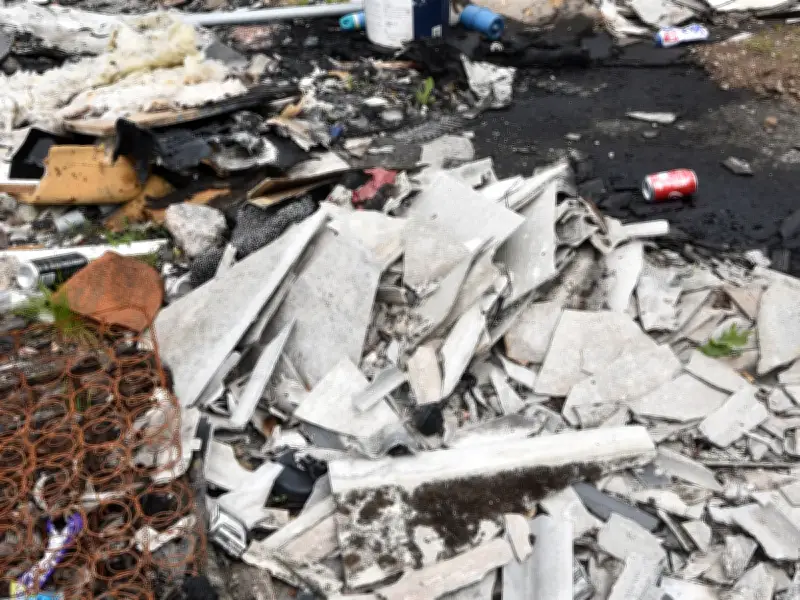
South Ayrshire councillors have unanimously backed a motion calling for tougher action against illegal dumping after workers were forced to use safety harnesses to remove fridges, washing machines and other household appliances from a steep embankment in Ayr.
The clean-up operation, which involved an external contractor assisting council waste management staff, took four days to complete due to the difficult terrain.
Dangerous clean-up operation
Councillor Ian Cavana told a meeting of the full council that the location in Ayr North was so hard to access that specialist safety equipment was required. Photographs showed fridges, washing machines, televisions and other bulky items dumped down the embankment.
“This is not just fly tipping like pulling up in the car with some black bags,” said Cllr Cavana. “It was so bad that that firm and their own waste management took four days to clear it.”
The councillor said vehicle access to the site had been blocked off years earlier, suggesting those responsible had used trolleys to transport appliances before dumping them down the slope. With much of the land privately owned, discussions are taking place between the council and the landowner about measures to prevent further dumping, potentially including fencing. Cllr Cavana declined to identify the location while discussions continued.
Call for stronger enforcement
The motion, proposed by Cllr Cavana and seconded by Councillor Laura Brennan-Whitefield, called for tougher penalties and stronger enforcement powers across South Ayrshire. Councillors agreed to seek a report within six months examining whether the current £500 fixed penalty could be increased, alongside options for greater surveillance, intelligence-led investigations and prosecutions.
The council will also write to the Scottish Government calling for higher maximum fines, greater flexibility for councils to set penalties locally and stronger powers to tackle repeat offenders and organised illegal dumping.
“The motion I brought today is not the answer. We all know it’s not the answer, but it’s at least maybe the bottom rung in a step that I would like South Ayrshire Council to take,” said Cllr Cavana.
Cllr Brennan-Whitefield said she had visited the location shortly after being elected and had been astonished by the amount of waste dumped there. She warned that fly-tipping could involve organised activity and businesses, rather than simply individuals disposing of unwanted household items.
“Because it’s a choice to fly tip. No one’s making you fly tip. You’re choosing to fly tip,” she said. “It doesn’t magically go away.”
Cllr Brennan-Whitefield warned that the consequences extended beyond clean-up costs, with dangerous conditions potentially putting workers’ lives at risk.
Enforcement challenges and next steps
The debate also exposed concerns about the effectiveness of enforcement. Assistant Director for Housing and Operations, Kenny Dalrymple, confirmed that councils could issue fixed penalties for illegal dumping but explained that difficulties arose when penalties remained unpaid and cases had to be referred to the procurator fiscal.
“I think that’s where we probably need to try and get better working relationships and better understanding with regards to how, where the blockages are and how we take this to the actual conclusion,” he said.
Councillors questioned whether reluctance to pursue smaller cases through the courts was undermining enforcement. Mr Dalrymple confirmed that he had asked officers to pursue several test cases to establish whether enforcement could be strengthened. “I think we do need to do the test cases and we’ll see what comes out of that,” he said.
Councillor Duncan Townson argued that councils needed greater powers and successful prosecutions could deter offenders. “Raising the fines would also be a good deterrent to some of these fly tippers, but catch them is the big thing I think,” he said.
Councillors discussed evidence residents could provide when witnessing illegal dumping, including vehicle registrations, photographs and information found among discarded rubbish. Mr Dalrymple said registration details could help investigations, although he could not confirm whether they alone would justify a penalty.
The debate also turned to South Ayrshire’s recycling centre booking system. Council leader Brian Connolly asked whether requiring appointments contributed to illegal dumping. Mr Dalrymple defended the arrangements, saying they had delivered significant savings by preventing waste from neighbouring council areas and commercial operators being disposed of at South Ayrshire’s expense.
Councillor Julie Dettbarn suggested a publicity campaign highlighting the council’s online fly-tipping reporting system, which allows residents to pinpoint dumped rubbish on a map, particularly useful in rural areas. It was also revealed that South Ayrshire was currently the second-highest-performing council in Scotland for recycling.
Councillors approved the motion unanimously, with a report on stronger enforcement measures expected within six months.