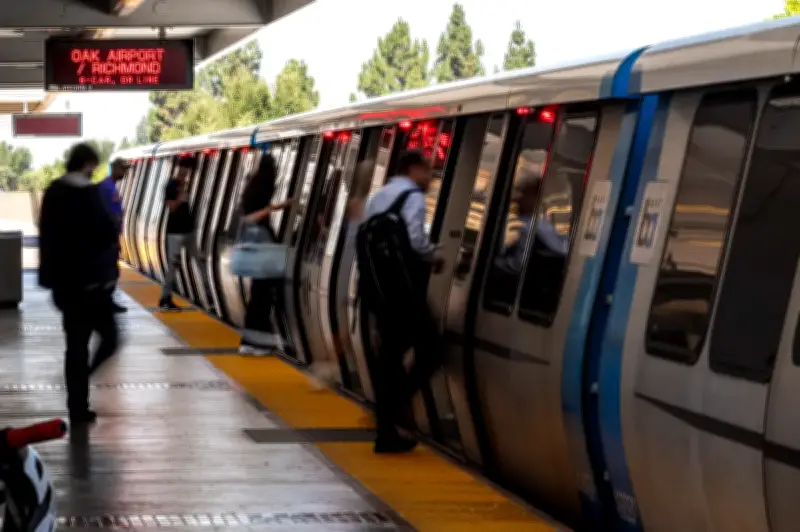
The San Francisco Bay Area's rapid transit system, Bart, is facing a fiscal cliff that could lead to a death spiral with massive repercussions for the region. As soon as early 2027, Bart could be forced to close as many as 15 stations, reduce service frequency by 63%, increase ride and parking costs by 30%, and end all service at 9pm. If service becomes less frequent and more expensive, fewer commuters will use the system, leading to less fare revenue and a downward cascade of financial austerity with ripple effects for all Bay Area residents, not just regular transit users. In a doomsday scenario, the entire system could be deemed unsafe and shut down.
Bart's history and engineering marvel
Bart has served the Bay Area for over five decades, connecting 50 stations in five counties. With 131 miles (210km) of track linking cities like San Francisco and Oakland with the wider south and east bay regions, Bart allows commuters to bypass congested roads and hefty bridge tolls. The region's freeways and bridges are notoriously gridlocked due to its sprawling geography formed around a large body of water.
Bart is also a feat of engineering. Its underwater tunnel, known as the transbay tube, sits 135ft (41 meters) beneath the San Francisco Bay. It was designed with flexible joints to absorb seismic activity from the region's two active faultlines and emerged unscathed from the 1989 earthquake. Bart is a model of self-sufficient funding and was the first US transit system made fully accessible for people with disabilities. At its high point in 2016, the agency boasted 435,000 riders each weekday and brought in nearly half a billion dollars annually.
Funding crisis and ballot measure
Since the pandemic, Bart has struggled to regain enough riders to sustain its funding model. Its future now hinges on voters approving a half cent sales tax across four Bay Area counties and a $0.01 sales tax in San Francisco. The regional transit measure would generate approximately $1bn annually to fund the four largest transit operators for 14 years. For San Francisco voters, it is one of two transit taxes on the November ballot.
“Losing Bart destroys the Bay Area economy,” said Jeffrey Tumlin, former head of the San Francisco Municipal Transportation Agency (SFMTA), now on a sabbatical. “All of the large Bay Area technology companies and the business associations that represent them understand that there’s no Bay Area tech economy without Bart.”
Commuters' reliance on Bart
On a Wednesday morning, the yellow line from Antioch bustles with commuters relaxing as they glide past gridlock. The highway is already choked with cars crawling into Oakland, Berkeley, San Francisco and other hubs for work and study in a region home to more than 7.5 million people. “Sometimes I sit here on Bart and just look out the window and laugh – ha, ha, ha! – at the people in traffic,” said Carissa Spencer, an executive assistant for Airbnb in her 40s who takes Bart almost daily from Antioch to downtown San Francisco. The prospect of losing this rail line and ending up in traffic seems like a cruel joke. “It just is shocking to me that that’s how we operate in the United States of America in 2026, where people have to have a car to be able to survive,” she said.
As slow as traffic is today, it could more than double if voters reject the ballot measure. Unlike transit systems in other world-class cities that receive significant government funding, Bart has generated 60%-70% of its operating revenue through passenger fares, making it uniquely self-sustaining and uniquely exposed to low ridership during the pandemic and the Bay Area's shift to remote and hybrid work. To lure back riders, the agency upgraded safety, cleaning, restrooms, fare gates and payment systems, while shortening trains, retiring legacy cars, re-aligning schedules for off-peak demand and syncing operations regionally. Despite delays due to old equipment overheating earlier this month and the rocky rollout of the new Clipper 2.0 card, Bart has a 95% customer on time performance and record high rider satisfaction.
Impact of potential cuts
David, 42, a surgeon taking Bart's red line to work at dawn, supports the ballot measure but would like to see big companies in the region step up: “I think that they should pay some portion of the subsidy for our transportation to work for them,” he said. The economic, climate and equity stakes of both measures failing at the ballot box couldn't be higher. A new report by the San Francisco Bay Area Planning and Urban Research Association (Spur), which spearheaded the regional transit measure, paints the bleakest picture yet: traffic delays on the Bay Bridge and other chokepoints would more than double during peak hours. “Traffic is going to get a lot worse and I think this is a best-case scenario,” said Laura Tolkoff, the transportation policy director at Spur and author of the report.
The transit system largely keeps the road systems moving, and people who cannot switch to driving, including low-income workers and people with disabilities, will be hit hardest. Alvina, 70, takes Bart every day from Oakland to her job at McDonald's in Lafayette. If Bart goes down, she would use Uber, she said in Spanish, which would significantly cut into her hourly wage. On the yellow line between Oakland and Antioch, the Guardian spoke with a half dozen riders who made decisions about buying homes or working certain jobs because of the area's relative affordability and proximity to Bart. Regina, 34, who studies risk for JP Morgan Chase, said she and her husband bought a house in Antioch three months ago because her job required her to commute into the office every day and she hates driving: “The biggest reason why I moved out here is knowing that there was a Bart line.”
Commuters displaced from transit to cars would potentially face multiple bottlenecks and have to drive an additional 10 miles (16km) each way to reach an open station, according to Spur estimates. They would also incur an estimated $3,280 per year in additional transportation expenses – the sales tax, Spur estimated, will cost 3% of that.
Campaigning for Bart
On a Friday evening in San Francisco's Sunset district, nearly three miles away from the closest Bart station, a group of young men with signs, clipboards and polling data went door-knocking in search of persuadable voters. Anki, a 33-year-old software engineer, has spent months walking up to strangers at bus stops, farmers' markets and protests to pitch them on approving the ballot measures. Motivated by fear of how the cuts will affect him personally and the region as a whole, he gathered a record 2,501 signatures to get the measures on this November's ballot. Though polling looks promising, it is still within the margin of error, and he plans to be out canvassing until November in early El Niño rains if he has to. “We refuse to wake up in January to creeping highways and choking bridges; to abandoned bus routes and boarded up Bart stations,” Anki said in a speech launching the final campaign push to save public transit. “We will not stand clear of the doors.”