

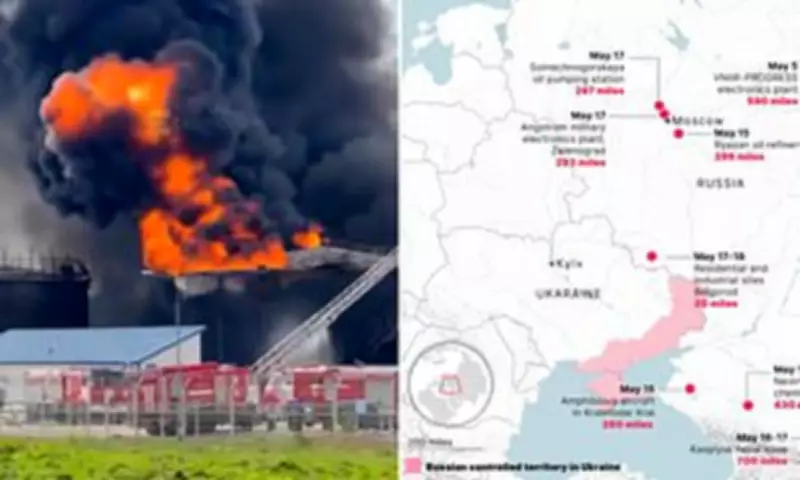
Ukraine's barrage of major long-range drone strikes on Russia demonstrates that the war is increasingly swinging in Kyiv's favour, an expert has revealed. This comes as a wave of almost 600 Ukrainian drones attacked Russia overnight, killing four people, authorities said on Sunday, as Ukrainian President Volodymyr Zelensky called the barrage an 'entirely justified' retribution for Moscow's own pummelling of Ukraine.
Massive Drone Offensive
Russia's defence ministry reported that air defences shot down 556 drones across the country overnight, followed by another 30 after dawn. Stretching up to 700 miles from the Ukrainian border, the barrage stands as one of the largest Ukrainian strikes of the war to date, taking out a navy vessel and drones. In recent weeks, Ukraine has stepped up its drone strikes on Russian territory as it increasingly relies on its own domestic weapons manufacturing.
Keir Giles, a Russia analyst at Chatham House, noted that this shift demonstrates Ukraine gradually gaining the strategic upper hand, as Putin will have to accept his country is facing defeat. Speaking to the Daily Mail, he said: 'The drone strikes on Russia will not win the war on their own, but they are one indication among many at the moment that the advantage in the war is swinging back Ukraine's way.'

'Ukraine is exploiting the fact that Russia is a big place, and it is not possible to defend everything within Russia in a meaningful manner. Even if Russia were to dedicate as much effort and resources to air defence as Ukraine has been forced to do under the relentless Russian bombardment, they would still not be able to protect all of the vital facilities that Ukraine is now targeting.'
Zelensky's Justification
Zelensky said Kyiv's attack on Russia - days after a massive drone and missile bombardment of the Ukrainian capital killed at least 24 people - was 'entirely justified'. 'Our responses to Russia's prolongation of the war and its attacks on our cities and communities are entirely justified. This time, Ukrainian long-range sanctions reached the Moscow region, and we are clearly telling the Russians: their state must end its war,' he said in a statement.
The attack on Sunday hit 'the Moscow Oil Refinery, the Solnechnogorsk oil depot, and several microelectronics manufacturing facilities for the first time', Ukraine's defence ministry said on social media. Ukraine's General Staff said that among the targets hit was a plant in the Moscow region 'which specialises in the production of high-tech products and microchips for high-precision weapons', adding that 'the war is returning to where it came from.'
New Drone Technology
The ministry revealed in a statement that it had used the FP-1 Firepoint and RS-1 Bars winged drones in the offensive as well as a previously unknown drone called the Bars-SM Gladiator. The FP-1 Firepoint has a range of up to 1,600km while the Bars drone missiles have an estimated range of 700-800km. Ukraine has increasingly sought to demonstrate the effectiveness of these newly developed domestic drones, which are relatively cheap in the realm of long-range weapons.
In Russia's capital region, 'a woman was killed as a result of a UAV hitting a private house,' governor Andrey Vorobyov posted on Telegram, adding that the early morning attack also claimed the lives of two men. One of the victims was an Indian citizen working in Russia, the Indian embassy in Moscow said in a statement. Within the capital, one of the strikes wounded construction workers at a job site near an oil and gas refinery, Mayor Sergei Sobyanin said. 'Refinery production has not been disrupted. Three residential buildings were damaged,' he added.
While the capital region is often subjected to drone attacks, the city of Moscow, around 400 kilometres (250 miles) from the Ukrainian border, is less frequently targeted. In recent weeks, Ukraine has also hit key sites such as the VNIIR-PROGRESS electronics plant, which manufactures components linked to guidance systems for Shahed-type drones, as well as the Ryazan oil refinery - one of Russia's largest oil refineries southeast of Moscow. Kyiv frequently claims long-range strikes that it says target oil processing facilities in a bid to dent the oil revenues that fund Russia's war chest.

Other Targets Struck
Earlier over the weekend, Ukraine struck several Russian military targets, including a Be-200 amphibious aircraft used for firefighting, maritime patrol and rescue missions and a Russian Project 10410 patrol ship in the Caspian Sea. Other targets struck this week also included a Kamov Ka-27 helicopter, a dry cargo ship carrying ammunition, an anti-aircraft missile and gun system, a Tor anti-aircraft missile system, a 'Redut-2US' communications system, and drones, Zelensky revealed.
According to security sources, Ukraine's intention by striking so deep inside the country is to convince Russians they are in danger as Vladimir Putin attempts to reassure his population that the war is being won and Russia is achieving its aims. 'An impact of this long-developing campaign by Ukraine is bringing to reality the aspiration that was stated at the very beginning of the war in 2022, that Ukraine saw as a key element in winning the war: bringing home to the Russian population that this was something that actually affected them,' Giles said. 'That the portrayal in Russian media of the war as something that happened to other people a long way away was different from what they would actually experience in their daily life. So the harder it becomes for Russians to treat this as something which has zero impact, the more likely it is that support for the war within Russia itself may eventually be challenged.'
Diplomatic Stalemate
Diplomatic efforts to end the conflict have been at a standstill, with Kyiv unwilling to accept Moscow's maximalist demands for territory in the eastern Donbas region, saying it would be tantamount to surrender. While the US has pushed for both sides to come to the negotiating table, the talks have noticeably stalled since Washington's attention turned to the US-Israeli war on Iran in late February. After the expiration of a US-brokered three-day truce to mark the anniversary of victory over Nazi Germany in World War II - which both sides accused the other of violating - Moscow and Kyiv have returned to trading attacks.
This comes after Putin showed rare vulnerability last week by downsizing the traditionally grand military parade, blaming potential Ukrainian strikes on Moscow meant to humiliate the Kremlin. For the first time in nearly two decades, tanks, missile launchers and other heavy weapons were absent from the parade, aside from a ceremonial flyover of combat jets. Russian officials blamed the sudden change in format on the 'current operational situation', while Kremlin spokesman Dmitry Peskov admitted authorities had introduced 'additional security measures' ahead of the event.
Zelensky fuelled the humiliation when he claimed Russian authorities 'fear drones may buzz over Red Square' on May 9. He later appeared to troll the Kremlin further by issuing a mock 'decree' supposedly permitting Russia to hold the parade safely, declaring Red Square temporarily off-limits for Ukrainian strikes. Putin used his annual Victory Day speech in Moscow's Red Square to justify his war in Ukraine and denounce Nato. Speaking in front of hundreds of military personnel and flanked by a few world leaders, the Russian president said he was fighting a 'just' war and called Ukraine an 'aggressive force' that is being 'armed and supported by the whole bloc of Nato'.
Putin also added: 'I think that the matter is coming to an end' - referring to the 'special military operation' in Ukraine. 'We saw a great deal of excitement after Russia's rather subdued Victory Day parade, at comments by Vladimir Putin that the end of the war might be in sight,' said Giles. 'The fact that this idea is being entertained could possibly indicate that the realisation that Russia is losing the war may finally be filtering through to Putin via his closest advisors.'
The expert added that freezing the conflict would fundamentally alter the situation by shifting Russia's core incentives. Previously, Russia believed it gained more from continued fighting than from accepting Trump's proposed ceasefire terms. By pausing the war, Russia would disrupt the current deadlock and change the strategic dynamic. 'We've known for a long time that this war is not going to be decided on the front line, and it is other factors that will determine which of the two sides has sufficient stamina to prevail in this war of attrition,' Giles said.
Russia has however maintained a steady stream of strikes towards Ukraine, with Zelensky saying Russian forces had attacked Ukraine overnight with 524 attack drones and 22 missiles, including ballistic and cruise missiles. And a Russian drone hit a Chinese cargo ship in the Black Sea overnight, Ukraine said Monday. Kyiv routinely announces Russian attacks on civilian vessels near the port of Odesa - a vital maritime hub for Ukrainian agricultural exports. But Monday's attack comes just ahead of Putin's two-day trip to Beijing where he and Xi are set to deepen bilateral ties between the friendly nations.





