

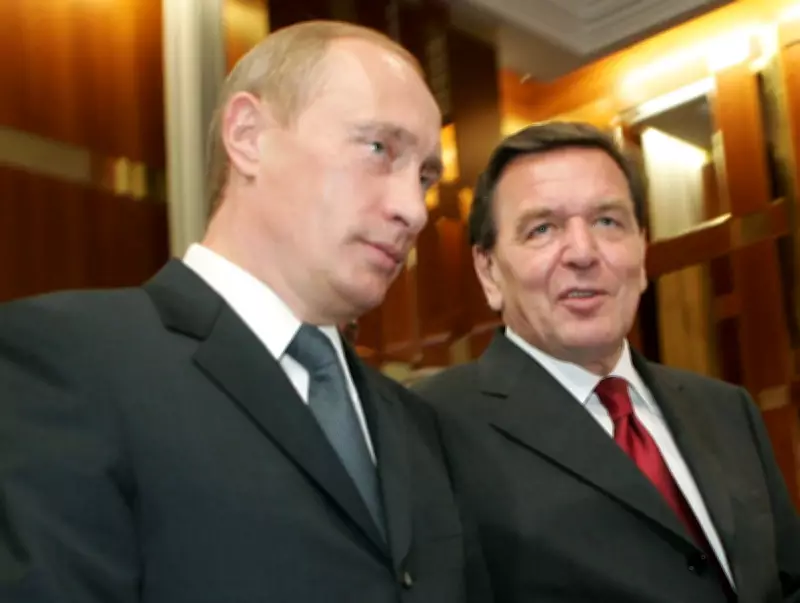
Former German chancellor Gerhard Schröder, long considered a close ally of Vladimir Putin, has been proposed by the Russian president as a mediator for Ukraine peace talks. The suggestion has been met with immediate skepticism and rejection from European officials, who question Schröder's impartiality given his extensive ties to Russian energy companies.
Putin's Proposal
Speaking to reporters on Saturday, Putin expressed openness to re-establishing communication with Ukraine and Europe, ideally facilitated by Schröder. 'For me personally, the former Chancellor of the Federal Republic of Germany, Mr Schröder, is preferable,' Putin stated. He hinted that the war in Ukraine might be nearing an end and raised the possibility of talks with the EU to design new security arrangements for a post-war Europe.
However, European officials responded with concern, arguing that Schröder lacks the neutrality required to act as an 'honest broker.' A German government spokesperson noted on Friday that Berlin sees no indication that Moscow is genuinely interested in serious negotiations, after both Russia and Ukraine accused each other of violating unilateral ceasefires.

Who Is Gerhard Schröder?
Gerhard Schröder, now 82, served as chancellor of Germany from 1998 to 2005. Rising from poverty through night school and various jobs to become a lawyer, he entered politics as a Marxist and environmentalist. His rapid ascent within the Social Democratic Party (SPD) ended Helmut Kohl's 16-year tenure as chancellor in 1998.
In office, Schröder focused on domestic economic reforms, including a controversial package of liberal welfare and labour reforms aimed at reducing unemployment. He also curbed nuclear power and tied Germany's energy needs to Russian fossil fuels—a decision that later haunted Berlin after Russia's invasion of Ukraine revealed the limited leverage such dependency provided.
Internationally, Schröder kept Germany out of the Iraq War, angering the United States, but committed troops to NATO missions in Kosovo and Afghanistan while maintaining balanced relations with Russia. His second term saw declining SPD support due to economic troubles, leading to his departure in 2005.
After leaving politics, Schröder continued work on the Nord Stream gas pipelines and joined the board of Russian oil giant Rosneft, a position he relinquished following the 2022 invasion of Ukraine. He remained close to Putin and refused to condemn the war, severely damaging his popularity in Germany.
Links to Putin
Schröder cultivated a warm relationship with Putin during the latter's first presidential term. In 2004, he famously called Putin a 'flawless democrat' and pushed for closer integration between Germany and Russia. Shortly before leaving office, he approved the first Nord Stream pipeline.
Their friendship continued, with Schröder attending Putin's birthday in Moscow in 2014, just months after Russia's annexation of Crimea. In 2016, he joined the board overseeing Nord Stream 2, a pipeline that never entered service and was damaged by underwater explosions in the Baltic Sea in 2022.
European Reaction
Putin's suggestion that Schröder mediate talks quickly drew opposition. Michael Roth, a former SPD lawmaker and chair of the foreign affairs committee, told Tagesspiegel that a mediator 'cannot be Putin's buddy.' Germany's Europe minister, Gunther Krichbaum, stated that Schröder lacks the credentials to be an 'honest broker,' noting his heavy influence by Putin and their close friendship.
Estonian foreign minister Margus Tsahkna dismissed the idea, saying, 'Gerhard Schroeder is a Putin idea. I think they are very close. Gerhard Schroeder won't be representing Europe.' EU foreign policy chief Kaja Kallas also rejected the proposal, warning that allowing Russia to appoint a negotiator on Europe's behalf would be unwise, especially as Schröder had lobbied for Russian state companies and would 'be sitting on both sides of the table.'






