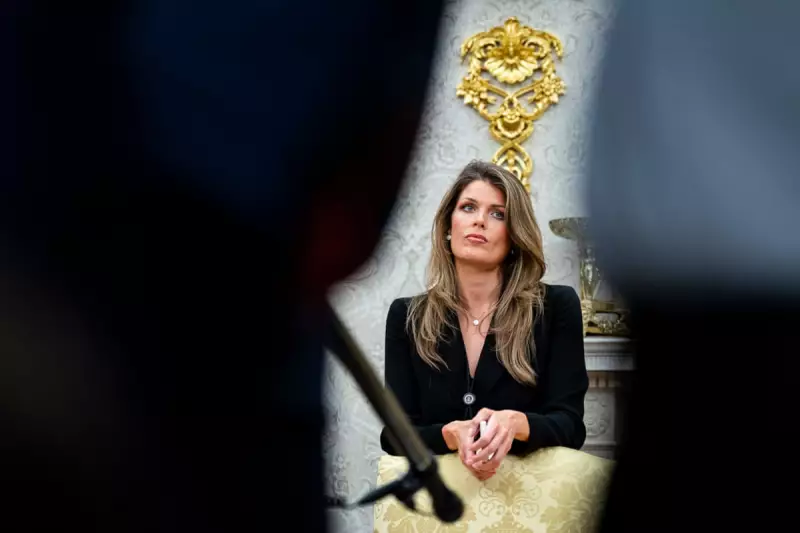
Lindsey Halligan, a federal attorney appointed by former President Donald Trump, has officially departed from her position at the US Department of Justice. This development follows intense judicial scrutiny and sharp criticism regarding the legality of her appointment and her handling of high-profile cases.
Judicial Rebuke and Legal Challenges
Attorney General Pam Bondi confirmed Halligan's exit on Tuesday, marking the end of a controversial tenure. Halligan, who previously served as Trump's personal attorney, faced mounting pressure after several federal judges cast serious doubts on her authority to remain in the role.
The situation escalated when multiple judges ruled that Halligan's appointment as interim US attorney for the eastern district of Virginia was unlawful. This legal determination stemmed from procedural issues surrounding the 120-day limit for interim appointments.
Controversial Appointment and Failed Prosecutions
Halligan assumed her position in September after Trump pushed out her predecessor, who had declined to bring charges against New York Attorney General Letitia James and former FBI Director James Comey. Notably, Halligan entered the role without any prior prosecutorial experience.
During her brief tenure, Halligan oversaw indictments against James and Comey, cases that were widely criticized as politically motivated. In November, a judge dismissed these cases entirely, further undermining her position.
The judge who dismissed the cases ruled that Halligan had been unlawfully appointed and therefore lacked the legal authority to bring the indictments. This ruling highlighted a critical procedural flaw: while attorneys general can appoint interim US attorneys for 120-day stints, Halligan's appointment was deemed invalid because her predecessor had already served the maximum period.
Escalating Judicial Pressure
Halligan's departure comes as she faced increasingly direct judicial action. On Tuesday, Federal Judge David Novak took the extraordinary step of ordering the removal of "United States attorney" from Halligan's signature on an indictment. Novak explicitly stated that Halligan was prohibited from continuing to present herself with that title.
In a strongly worded order, Judge Novak warned that he would launch disciplinary proceedings if Halligan violated this directive. He wrote, "No matter all of her machinations, Ms Halligan has no legal basis to represent to this Court that she holds the position. And any such representation going forward can only be described as a false statement made in direct defiance of valid court orders."
Novak concluded, "In short, this charade of Ms Halligan masquerading as the United States Attorney for this District in direct defiance of binding court orders must come to an end."
Position Declared Vacant
In a separate development on Tuesday, Chief Judge M Hannah Lauck of the eastern district of Virginia directed court clerks to publish a job posting announcement for the US attorney position, formally declaring the role vacant. This administrative action underscored the judicial branch's determination to resolve the appointment controversy.
The justice department had argued that the administration was authorized to make back-to-back interim appointments, but at least six federal judges rejected this interpretation, as noted by the Washington Post.
Political Context and Reactions
Attorney General Pam Bondi praised Halligan in a social media post announcing the departure, stating she had "fulfilled her responsibilities with courage and resolve." Bondi added, "The circumstances that led to this outcome are deeply misguided. We are living in a time when a democratically elected President's ability to staff key law enforcement positions faces serious obstacles."
Halligan and spokespeople for the US attorney's office for the eastern district of Virginia did not immediately respond to requests for comment on Tuesday night, leaving many questions unanswered about the precise circumstances of her departure.
The Associated Press contributed reporting to this developing story, which highlights ongoing tensions between judicial oversight and executive branch appointments in the US justice system.