
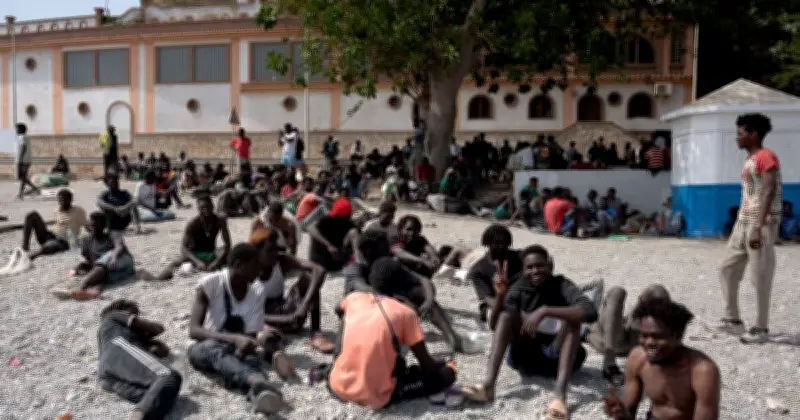
Poland has called on the European Union to adopt a sweeping new rule that would automatically bar migrants who enter the bloc illegally from ever obtaining residence rights, in a hardline push to deter mass irregular crossings.
Ceuta crisis sparks Polish proposal
The demand came during a special meeting of EU interior ministers on Tuesday, convened after tens of thousands of migrants stormed Spain's African exclave of Ceuta last week. Most swam across from neighbouring Morocco. Dozens died in the attempt.
Spain says the vast majority who reached Ceuta have already been returned.
Poland's interior ministry told the meeting that "illegal entry into the European Union should automatically exclude the possibility of obtaining residence permits, and therefore the possibility of permanent stay in the future." Migration, it insisted, "must be fully controlled" or it risks being "used against the values that guide the EU." Officials also pressed for migration to be formally recognised as a security challenge.
Poland's experience with 'weaponised' migration
The proposal draws directly on Poland's own experience of what it calls "weaponised" migration from Belarus. Since 2021, Minsk – backed by Moscow – has funnelled tens of thousands of migrants, mainly from Asia and Africa, towards the Polish border in what Warsaw and Brussels describe as a hybrid attack designed to destabilise the EU.
In response, Poland restricted the right to claim asylum for those who cross irregularly, poured billions into physical and electronic barriers, and deployed thousands of soldiers, police and border guards with expanded powers to use firearms.
Polish Prime Minister Donald Tusk last week urged Spain to "follow our example if Schengen is to survive."
EU leaders express concern
On Saturday, Mr Tusk and 21 other EU leaders signed a joint letter expressing "serious concern" over Ceuta and warning that the bloc "cannot allow uncontrolled mass border crossings, the instrumentalisation of migration, or other hybrid threats to create the impression that illegal entry… is possible."
They demanded a coordinated European response and rapid support for Spain.
Poland's border successes
Poland's intervention at Tuesday's meeting highlighted its recent success. Attempted illegal crossings from Belarus hit almost 40,000 in 2021 and remained around 30,000 a year in 2024 and 2025.
In the first half of 2026 they collapsed to just 235. Successful crossings fell from 12,000 in 2023 to zero in the first six months of this year, according to Polish figures.
The ministry welcomed a "shared perspective on migration among a growing number of member states," declaring that "the example of Ceuta clearly demonstrates that absolute access to asylum is impossible to maintain in the face of such real threats."
EU response and Spanish amnesty
The European Council later reported a "common understanding of the need to continue relentlessly fighting migrant smuggling networks, to reinforce returns, to strengthen EU borders, to build deep partnerships with third countries, and to improve foresight."
Member states expressed solidarity with Spain and condolences for those who died.
Although the Polish statement did not name it, the proposal comes after Spain's government ran an amnesty scheme earlier this year that allowed undocumented migrants to apply for legal status. More than a million people signed up before the programme closed at the end of June.
According to a report by Notes from Poland, the Polish interior ministry used the Ceuta crisis to present its border protection experience and the restrictions it has already imposed on asylum claims in the face of instrumentalised migration.




