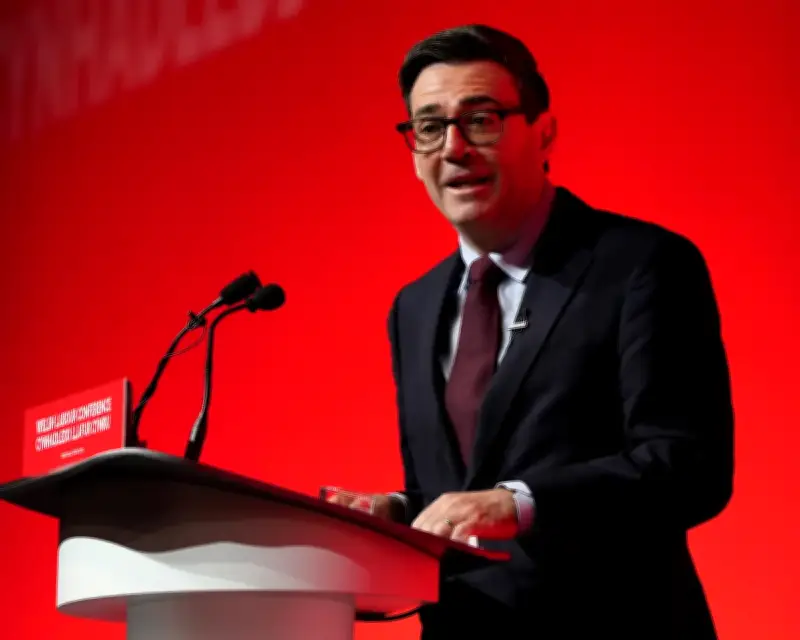
Prime Minister Andy Burnham has said the UK has "lost more than we gained" since leaving the EU, in his latest comments criticising Brexit. Speaking at the Welsh Labour conference in Llandudno on Saturday, he accused the Conservative party of having "burned all our bridges" with the bloc and said a new deal he hopes to secure with the EU next week will "get food prices down" and put more money in the pockets of British exporters.
Push for closer EU ties
Burnham outlined his desire to form closer ties with Brussels, saying the UK needs to be willing to take difficult decisions to bring down the cost of living. He said he will head to the next UK-EU summit in a few days' time and work towards a new deal on food and farming between the UK and the EU, explaining that he wants to help Welsh businesses.
The prime minister is due to meet European leaders at a summit next week and secure agreements that he says could raise GDP by 0.4% – about £17bn – including on food and farming, emissions trading and a youth mobility scheme. He will also "explore options" for a different long-term relationship with Brussels.
Criticism of Conservative Brexit approach
Burnham said he believes the UK has lost more than it has gained over the last 10 years, and that the Conservatives gave Britain a harsher and harder Brexit than people thought they were getting when they voted in 2016, because they burned all of the UK's bridges with the EU in the aftermath. He said he will lead as prime minister on this issue and try to get the best deal he can for Wales, including for Welsh farmers, exporters of Welsh shellfish and Welsh lamb.
Burnham has recently said he is open to rejoining the single market, customs union or to "go all the way" by rejoining the EU, but on Saturday he said voters would ultimately be "the boss" of any changes. He reiterated his commitment to Labour's manifesto "red lines" – which rule out returning to the customs union, single market or free movement.
Government moves and EU response
The government has already made several announcements that would tie the UK closer to Brussels. Earlier this month, the Guardian reported that the UK was prepared to spend up to £450m a year to give EU students discounted university tuition fees, if Brussels allowed Britain access to the Made in Europe industrial programme. Earlier this week, Hamish Falconer, the cabinet minister in charge of EU talks, said Britain was willing to discuss paying towards infrastructure schemes in poorer parts of the EU in return for access to the European electricity market.
Despite Burnham's recent pro-EU comments, senior figures in Brussels have said they want to see the UK begin to start paying for access to the European schemes it says it wants access to. The EU's former Brexit negotiator Michel Barnier told the BBC last week: "There will be no possibility to have one freedom and not the other. The four freedoms are clearly the four conditions to be inside a single market."
Ursula von der Leyen, the president of the European Commission, and António Costa, who leads the European Council, will meet Burnham on 20 November in Brussels for a summit where deals on food and drink, carbon emissions and youth exchange could be signed. Barnier said the UK could not rejoin the single market "à la carte", when speaking to the BBC's Laura Kuenssberg last Saturday, adding: "I said very, very often during these negotiations, the Brexit, there is no cherrypicking."