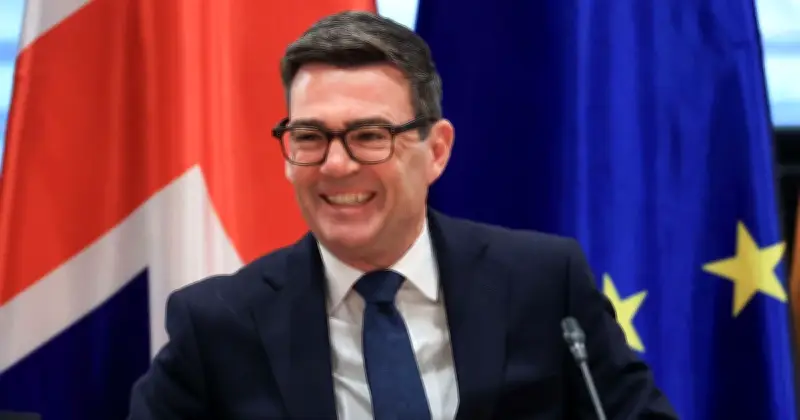
Andy Burnham has not ruled out the UK's future re-entry into the European Union. The German Chancellor, Friedrich Merz, vowed on Thursday to “do anything” possible to bring Britain closer to the bloc during the Prime Minister's visit to Berlin.
German Chancellor welcomes Burnham's stance
Mr Merz added he was “personally extremely happy” that Mr Burnham had reopened the question of Britain’s future relationship with the EU. The Chancellor said: “From our German side, I can assure you that we will do anything what we can do to bring the UK closer and closer back to Europe, to the European continent, to the European Union.
"And I’m really happy to have you here today with this clear message from your side and with this clear answer from our side.”
Prime Minister highlights growth potential
Mr Burnham said: “The time has come to think more seriously about growth, and obviously we know growth can come from that closer relationship.
“We have a UK-EU summit in front of us before the end of the year and I think it is important that we can show that growth comes from co-operation, as I believe it can do, as well as facing joint challenges together.”
He added: “It feels to me that the world as it is, is bringing us closer together. It’s making us more closely aligned. We already are very close partners, but UK and Germany becomes a more important axis as we go into the next next period.”
Possible roadmap for re-admission
So what could be a roadmap for the UK's re-admission into the EU? Firstly, this may have already begun as the Government seeks regulatory alignment with the bloc. The Sanitary and Phytosanitary (SPS) Agreement, for example, is a veterinary and agri-food agreement aiming to cut border checks and reduce food costs.
Further to this, Mr Burnham could in the future pursue a policy of Britain's re-entry into the Customs Union, Single Market or both. Labour’s election manifesto in 2024 ruled out joining a customs union, going back into the Single Market or allowing the return of freedom of movement with the EU. But Mr Burnham has indicated he is prepared to recommend going beyond those red lines in future.
“There are clearly options that need to be considered, and we have to look at what is doable and what would be the pros and cons of each,” he told the BBC.
Finally, a democratic mandate to re-enter the EU itself would likely be sought by the Government from the British public — either in the form including it in Labour's general election manifesto, or as a result of a second referendum on the UK's membership of the bloc. Formally applying for EU membership is done under Article 49 of the bloc's treaty.
The Institute for Government says regarding whether Britain would secure a rebate and opt-outs in the event it is re-admitted: "As an EU member, the UK negotiated a financial rebate of around two thirds of its net contribution.
"It also negotiated an opt-out from the monetary union and – had it remained a member – would have secured an opt-out from the EU’s desire for an ever closer (political) union. But as a new member state, the UK would have no such privileges. It could attempt to negotiate opt-outs and a rebate as part of the accession process, or after it had joined the EU, but these would almost certainly required the approval of all member states and a majority in the EU Parliament."