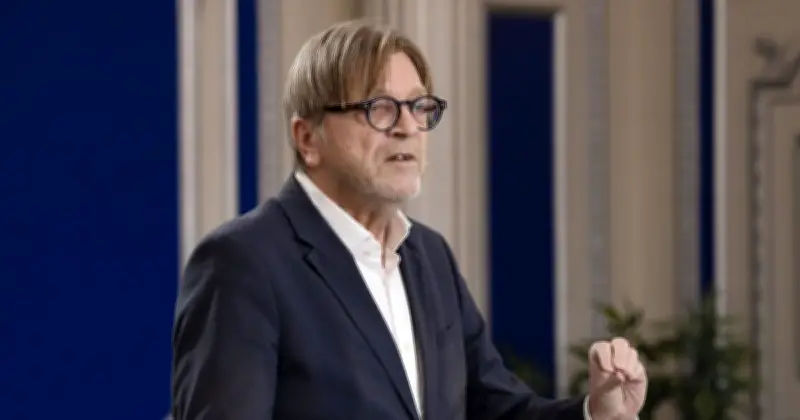
Guy Verhofstadt, the former Belgian Prime Minister and a vocal pro-European who was a persistent critic of Brexit, has launched a sharp attack on the European Union, accusing it of spinelessly appeasing Iran's "murderous dictatorship." Speaking at a high-profile meeting aimed at ending the Ayatollah-led Iranian dictatorship, Verhofstadt said: "In the last few months I have heard a lot about the mullahs and a lot about US leadership on the battlefield – but I have not heard much about European leadership. Why do we continue to talk to these people who so clearly do not represent the Iranian people? European leaders must stop their appeasement and silence policy and start taking an active role in this conflict."
Verhofstadt's broadside at European leaders
The meeting was organised by the National Council of Resistance of Iran (NCRI). Verhofstadt demanded a complete reset: isolating Tehran's diplomats, recognising the Iranian resistance as the true voice of the people, and ending appeasement. His intervention came just days after Britain designated Iran's Revolutionary Guard as a terror group, as pressure builds across Europe for a radical rethink of Iran policy.
Former Defence Secretary Liam Fox, also speaking at the conference in Rome, said change "will not come from the air" but from the Iranian people themselves. Diplomacy has failed, he warned, and military action offers "no viable prospect." Instead, attention is shifting to the organised resistance – specifically the NCRI and the People's Mojahedin Organization of Iran (PMOI/MEK).
Support for Iranian resistance
Paolo Gentiloni, Italy's former Prime Minister and EU Commissioner, echoed that message, insisting the solution "is in the hands of the Iranian people" and that backing the NCRI is now essential. The conference's keynote speaker, NCRI President-elect Maryam Rajavi, was even more direct: "The only viable solution is a path that guarantees the overthrow of this regime," she said, arguing that the PMOI/MEK's resistance units are the "defining catalyst for change."
Rajavi's two-day visit to Rome drew significant political support. In the Italian Parliament, senior figures including Vice President of the Italian Parliament Fabio Rampelli, former Foreign Minister Giulio Terzi, and American guests Rudy Giuliani and Patrick Kennedy (nephew of JFK) backed her call for democratic change. Giuliani dismissed any prospect of a return to monarchy, saying the son of Iran's exiled Shah should "return the money he stole" before perhaps being considered for "a job in the post room."
Rallies and calls for regime change
A bipartisan majority of Italy's Parliament and Senate went further, announcing support for a democratic provisional government based on Rajavi's Ten-Point Plan. Rajavi also told the Italian Senate's Human Rights Committee that 2,400 people had been executed in Iran in the past year alone. Outside the conference halls, around 2,000 Iranians rallied in Rome, declaring their readiness to support the NCRI's provisional government – which would transition from the Ayatollah – and demanding Europe abandon its failed engagement strategy.
Dr Fox delivered one of the sharpest warnings, branding the JCPOA nuclear deal negotiated by the Obama administration "fundamentally flawed" and accusing it of freeing up cash for Tehran while ignoring human rights abuses. He said it was "odd" that London sees weekly marches for other global causes but "none for Iran." There were no illusions, he added: "There are no 'solutions' in Iran… only regime change."