

The Invisible Border: How Asylum Seekers Use Irish Route to UK
For over five years, Carl has driven his 60-seater coach along the familiar route from Dublin to Belfast. The two-hour journey up the M1 motorway and across the border has become routine, with Carl believing he knew his passengers well. There were daily commuters, weekend travelers returning home on Fridays, and tourists clutching maps with anxious expressions. However, one summer morning revealed a startling new reality that transformed his understanding of this cross-border route entirely.
The Mysterious Money Man
As Carl loaded suitcases into the coach's undercarriage, he noticed a man standing nearby clutching a substantial wad of cash in his right hand. Dressed in jeans and a dark puffer jacket, the individual appeared nervous, repeatedly glancing over his shoulder as if anticipating unwanted attention. "At first I was unsure what he was doing," Carl confessed to the Daily Mail outside Dublin's central bus station, speaking under anonymity. "But then I saw he was handing €20 bills to a line of men—none of whom spoke English—who each used the money to buy a ticket and board my coach."
Only upon seeing this seemingly charitable figure a second time did Carl realize he was transporting not just commuters and tourists, but dozens of asylum seekers crossing into the United Kingdom. The absence of a physical border between Ireland and Northern Ireland has created what many describe as a soft route back to Britain, with coaches becoming an unexpected conduit for migration.

Brexit's Unintended Consequences
"I voted for Brexit," Carl continued, "and I've always identified as British rather than Irish. But in Northern Ireland, we didn't truly get Brexit—we have an open border with Europe for undocumented people. It's as simple as that." He expressed concern about growing tensions, noting that "for the first time in my life, we've got Nationalists and Loyalists uniting against a common enemy. I tell you, there's trouble brewing."
The Common Travel Area (CTA) agreement between Ireland and the UK permits British and Irish citizens to move freely with minimal checks between the two nations. While foreign nationals don't enjoy these same privileges, the lack of physical border infrastructure has left law enforcement struggling to monitor movements effectively. Asylum seekers now find that an air-conditioned bus journey through Ireland's rolling hills offers a far more comfortable alternative to perilous Channel crossings in leaky dinghies.
Astonishing Migration Patterns
What makes this situation particularly remarkable is that the "twenty or so" young migrant men traveling weekly from Dublin to Belfast aren't typically new arrivals to Ireland. Instead, many initially came to Britain through various means—including small boats or planes—only to flee after the announcement of the Rwanda deportation scheme. Now, with Labour having scrapped that policy, they're returning to the UK through this backdoor route.
This investigation boarded one of the more than 50 daily coaches traveling from Dublin to Belfast, making the 100-mile journey north for just €20 (approximately £17). Upon boarding, a young Croatian couple presented their passports to the driver, who waved them away dismissively with a casual "You don't need those!" The couple, both in their thirties, explained afterward: "We assumed that, as we're from Europe and entering the UK now, we would show our passports. But the driver just said no."
Eighty minutes into the journey, the coach passed without any checks or fanfare into Northern Ireland. Thirty minutes later, passengers disembarked in Belfast and dispersed into the city, again without encountering customs or immigration controls. "I wouldn't know who was carrying a passport and who wasn't," admitted the driver, who also requested anonymity due to professional concerns. "The bottom line is, you're supposed to be British or Irish, but we have no border, so you can imagine what might happen."

Law Enforcement Challenges
Reports of buses being stopped for immigration checks remain exceedingly rare, with drivers reporting anywhere from zero to four such incidents in the past year. Checks by the Gardaí (Irish police) occur more frequently as part of broader efforts to control immigration from Britain to the EU. However, the driver revealed that his bus had been stopped only once by the Police Service of Northern Ireland (PSNI)—during the middle of the night when no passengers were aboard.
To fully comprehend the asylum crisis along the Irish border and its current significance, we must revisit early 2024 when Westminster Parliament approved then-Prime Minister Boris Johnson's plan to send asylum seekers to Rwanda. This long-debated policy, praised by right-wing supporters but repeatedly delayed by legal challenges, appeared close to implementation just before the 2024 General Election. This prompted numerous asylum seekers to flee Britain for Ireland to avoid potential deportation.
Irish Response and Policy Shifts
At that time, deputy Irish Prime Minister Micheál Martin confirmed that those crossing from Northern Ireland into the Republic were "fearful" of remaining in Britain and sought "sanctuary here and within the European Union as opposed to the potential of being deported to Rwanda." In April 2024, weeks after Westminster ratified the Rwanda plan, then Irish Minister for Justice Helen McEntee revealed that 80% of immigrants entering Ireland were arriving from Britain via the open land border.
This estimate emerged as asylum claims at air and sea ports decreased while registrations at Dublin's International Protection Office, located near the central bus station, rose sharply. Complicating matters further, an Irish High Court ruling declared Britain "unsafe" for migrant returns due to the Rwanda deportation threat, preventing the Irish government from sending migrants back across the border—a decision even the UK Home Office labeled "absolutely absurd."
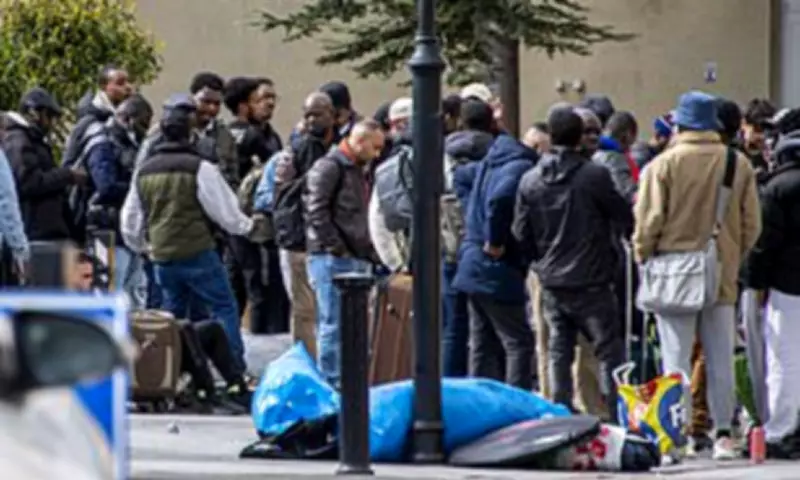
In 2024 alone, over 18,500 people claimed asylum in Ireland—an all-time high. One officer processing migrants in Dublin described the situation as a "madhouse," stating: "We've nowhere to put them all, and more keep coming. There's no end to it." A large refugee camp featuring tents and makeshift shelters subsequently emerged on Mount Street in central Dublin, housing over 1,500 asylum seekers sleeping rough.
Social Backlash and Recent Developments
The substantial influx of migrants sparked significant backlash across Ireland. In June 2024, migrant tents along Dublin's Grand Canal were slashed with blades, with belongings reportedly stolen and shelters thrown into the water. That same month, more than 3,000 people participated in an anti-immigration rally in Cork organized by the protest group Ireland Says No, with chants ranging from "Ireland for the Irish" to "Whose Streets? Our Streets."
October 2024 saw mass rioting across Dublin following the alleged sexual assault of a ten-year-old girl by a 26-year-old man outside the Citywest Hotel, which was housing asylum seekers. Widespread anti-social behavior ensued, with police vehicles set ablaze in scenes rarely witnessed since the 1998 Good Friday Agreement brought relative calm to the historically divided nation.
However, just months after these disturbing events, the situation has shifted dramatically. Many asylum seekers who previously flooded south into the Republic are now returning northward to the UK. Two primary factors explain this reversal:
- Shortly after taking office in July 2024, Prime Minister Keir Starmer announced that the Rwanda Plan was "dead and buried," eliminating the main deterrent for migrants seeking asylum in Britain.
- Late last year, Irish Justice Secretary Jim O'Callaghan introduced aggressive new measures making settlement in Ireland more difficult for asylum seekers.
Ireland's Tougher Immigration Policies
The new Irish regulations include a "pay-to-stay" initiative requiring weekly contributions up to €238 (£208) from those in government-provided accommodation. As of July 2024, 32,774 applicants resided in such accommodations, including hotels. Additionally, the naturalization waiting period increased from three to five years, while the income threshold for family reunification rose to €44,000 (£38,260) for sponsors.
Consequently, many migrants now perceive Britain as offering better prospects for both safety and financial stability. The Irish Justice Department informed the Daily Mail: "Minister O'Callaghan is committed to taking measures directed at curtailing abuse of the Common Travel Area; this includes further operational measures for law enforcement and border management."
Current Conditions and Social Media Influence
Returning to the migrant tent encampment on Mount Street in Dublin this week revealed a shocking scene, with rubbish scattered across the old towpath and at least five tents discarded in the canal water. Only about ten migrants remained beside the canal. Shortly after midday, two young men smoked a joint beneath a tree, another brushed his teeth while crouched beside the canal, and a third peered nervously from his tent, initially fearing intimidation.
"Most of the people here have gone," explained the young man once he realized no harm was intended. "Many have gone to Belfast, then they say it's easy to get to England. So maybe I'll go too."
Undoubtedly, many who recently crossed back into the UK were motivated by TikTok migrant influencers explaining the crossing's ease. One such personality, Updiweli Caatto with 250,000 followers, documented his journey from Libya to Ireland. In one video, he stands beside a bus telling followers: "You see, this bus is the one people take from Ireland," before explaining it's the safest and cheapest route into the UK from the EU. Having personally taken the €20 journey, it's difficult to dispute this assessment.
Growing Tensions in Northern Ireland
However, another troubling chapter may be unfolding in this complex narrative of migration. Upon arriving in Belfast, migrants are unlikely to receive warm welcomes from a Northern Irish population increasingly concerned about migration issues. Late last year, a group calling itself East Belfast Nightwatch First Division began patrolling city streets, confronting migrants or anyone perceived as threatening.
A Green Party spokesperson accused the group of "feeding into recent tensions across this island," while the PSNI urged citizens against taking the law into their own hands. Unfortunately, as European governments have discovered over the past decade, when authorities cannot protect communities from mass migration concerns, some individuals attempt to address the situation themselves.
The question now remains: How long before the tide turns again, forcing thousands of desperate young men to seek refuge elsewhere, perhaps booking another €20 bus ticket back to Dublin?





